What's inside
As an Amazon Associate I earn from qualifying purchases. This post may contain affiliate links at no extra cost to you.
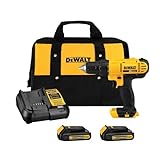
The best cordless drill under 200 for most home and workshop users is the DeWalt DCD791D2, while the Milwaukee M18 2801-22CT is the stronger alternative for frequent DIY work and the Ryobi PCL206K1 offers the lowest-cost entry into a broad battery system.
At this price, the right choice depends less on peak torque than on clutch control, battery capacity, kit contents, balance, and whether you expect to buy more cordless tools later. The drills below are all suitable for furniture assembly, shelving, repairs, pilot holes, and general woodworking; none should be confused with a dedicated hammer drill or high-torque impact wrench.
As an Amazon Associate we earn from qualifying purchases at no extra cost to you.



What we cover
Best cordless drills under $200 at a glance
| Model | Typical kit price | Speed range | Published torque | Battery included | Best for |
|---|---|---|---|---|---|
| DeWalt DCD791D2 | $140–$190 | 0–550 / 0–2,000 rpm | 460 UWO | Two 2.0Ah batteries | Best overall balance |
| Milwaukee M18 2801-22CT | $150–$200 | 0–550 / 0–1,800 rpm | 500 in-lb | Two 2.0Ah batteries | Frequent workshop use |
| Makita XFD131 | $130–$180 | 0–500 / 0–1,900 rpm | 440 in-lb | One 2.0Ah battery | Comfort and controlled drilling |
| Bosch GSR18V-400B22 | $130–$180 | 0–460 / 0–1,800 rpm | 400 in-lb | Two 2.0Ah batteries | Compact general-purpose work |
| Ryobi PCL206K1 | $80–$130 | 0–500 / 0–2,100 rpm | 515 in-lb | One 1.5Ah battery | Lowest-cost home use |
Prices are normal market ranges for drill kits and may change with promotions. Torque figures come from different manufacturers and testing methods, so they are useful for broad positioning rather than a precise head-to-head ranking.
Our picks by type of user
Best overall: DeWalt DCD791D2
The DCD791D2 is the safest recommendation for a mixed home-and-workshop tool kit. Its brushless motor, two-speed gearbox, 1/2-inch ratcheting chuck, 15-position clutch, and two 2.0Ah batteries cover most drilling and driving jobs without making the tool excessively large. The compact head is helpful inside cabinets and between studs, while the higher speed setting is useful for clean holes in wood and metal.
Its main limitation is that the included batteries are compact rather than high-capacity. They keep the drill light, but prolonged hole-saw work will drain them faster than a 4.0Ah or 5.0Ah pack. The DeWalt 20V platform is extensive, which improves long-term value if you later add a circular saw, trim router, or reciprocating saw.
Best for frequent use: Milwaukee M18 2801-22CT
The Milwaukee 2801-22CT is a strong choice when the drill will be used several times a week. It provides a 1/2-inch chuck, a 16-position clutch, two 2.0Ah batteries, and a metal belt clip. Its 500 in-lb rating gives it plenty of reserve for larger screws and ordinary spade-bit work.
The tool is not the fastest in this group at 1,800 rpm, but that is rarely a disadvantage in woodworking. Controlled speed matters more than maximum speed when boring near an edge or driving screws into soft pine. Choose it if you expect to build out an M18 collection; buying into a battery platform is a larger financial decision than the drill itself.
Best for comfort: Makita XFD131
The Makita XFD131 emphasizes smooth handling and a relatively compact feel. Its 440 in-lb rating, 1/2-inch chuck, two-speed transmission, and brushless motor are adequate for nearly all household drilling and driving. The kit commonly includes one 2.0Ah battery, charger, and case or tool bag, so check the exact package before comparing prices.
One battery reduces the initial kit value compared with two-battery competitors. However, the lighter pack is pleasant for overhead work, and users who already own Makita 18V batteries may find this the most economical option.
Best budget choice: Ryobi PCL206K1
The Ryobi PCL206K1 is the practical pick for occasional repairs, flat-pack furniture, curtain hardware, and small woodworking projects. It offers a brushless motor, 1/2-inch chuck, 24 clutch positions, and a 2,100-rpm top speed at a considerably lower kit price than premium alternatives.
The included 1.5Ah battery is the compromise. It is light and inexpensive but gives less runtime and less sustained performance than a 2.0Ah pack. For occasional use, that trade-off makes sense. For repeated deck screws, large hole saws, or workshop production, budget for a larger battery and charger upgrade.
How the important specifications affect real work
Torque and clutch precision
Peak torque tells you how much resistance a drill can overcome, but it does not tell you whether it will stop gently enough for cabinet screws. A clutch with many settings gives finer control, particularly in plywood, softwood, and furniture hardware. For woodworking, a drill that delivers repeatable low-to-medium torque is often more useful than one with the highest advertised number.
Battery capacity and runtime
A 2.0Ah battery contains roughly twice the stored charge of a 1.0Ah battery at the same voltage. Runtime still varies with bit size, material, pressure, and temperature. As a planning estimate, a compact 2.0Ah pack may handle roughly 100–200 ordinary 2-inch construction screws, but large screws and continuous drilling can reduce that substantially.
For occasional work, two compact batteries are preferable to one large pack because one can charge while the other is in use. For hole saws, auger bits, or long assembly sessions, a 4.0Ah pack is more useful than a second 2.0Ah pack, although it adds weight.
Chuck, gearbox, and ergonomics
A 1/2-inch chuck accepts larger woodworking bits than a 3/8-inch chuck and is the better default for a workshop drill. Two mechanical speeds are more valuable than a very high no-load speed: low gear improves control and torque, while high gear produces cleaner, faster small holes.
Pay attention to balance. A drill that weighs only a few ounces less can still feel better if its battery, motor, and handle are aligned. For overhead work, a compact 2.0Ah battery is usually more comfortable than a 5.0Ah pack. A bright work light, belt hook, and a narrow head also matter when working inside cabinets.
Decision matrix: which one fits your situation?
| Your situation | Recommended choice | Why |
|---|---|---|
| Under $125 and fewer than five projects per year | Ryobi PCL206K1 | Low entry cost and sufficient capability |
| New homeowner building a tool collection | DeWalt DCD791D2 | Two batteries and a large 20V ecosystem |
| Several workshop sessions each month | Milwaukee M18 2801-22CT | Strong reserve, useful clutch range, two batteries |
| Mostly overhead or cabinet work | Makita XFD131 | Compact, smooth, and comfortable with a small battery |
| Already invested in Bosch 18V batteries | Bosch GSR18V-400B22 | Good compact performance without another battery platform |
Ownership costs and maintenance
Consider cost per use before choosing the cheapest kit. A $100 drill used ten times costs $10 per use initially; a $180 drill used 60 times costs $3 per use before batteries or accessories. If a more durable platform prevents buying a replacement or lets you share batteries with other tools, its higher purchase price can be justified.
The chuck jaws, clutch mechanism, battery contacts, and carbon-free motor electronics are the parts most likely to affect long-term ownership. Brushless motors avoid routine brush replacement, but they do not make a drill immune to dust, overload, or impact damage. Keep the chuck clean, remove packed sawdust around the vents, and let a hot battery cool before charging.
Do not use the drill’s clutch as a substitute for a depth stop when drilling precise holes. Do not leave a bit tightened unevenly in the chuck, and avoid storing lithium-ion batteries fully discharged. For large bits, use low gear and moderate pressure; forcing a stalled drill overheats the motor and battery faster than controlled pauses.
What to buy
Choose the DeWalt DCD791D2 if you want the most balanced under-$200 kit for home repairs and woodworking. Choose the Milwaukee M18 2801-22CT for heavier recurring use, the Makita XFD131 for comfortable controlled handling, or the Ryobi PCL206K1 when keeping the initial cost low matters most. Whichever model you select, prioritize a 1/2-inch chuck, two-speed gearbox, useful clutch range, and a battery platform you can continue using.