What's inside
As an Amazon Associate I earn from qualifying purchases. This post may contain affiliate links at no extra cost to you.
What we cover
Start with the joist, not the drill
Engineered floor joists are not all alike. I-joists have solid top and bottom flanges joined by a thin web; open-web trusses have diagonal members; laminated veneer lumber (LVL) and similar products are solid structural members. The drilling rules differ, and a powerful drill cannot make an unsafe hole acceptable.
Before buying anything, identify the joist type and check its manufacturer’s installation guide or the building plans. I-joist holes generally belong in the web, not the flanges. Trusses may prohibit field drilling or require approval for any modification. Solid engineered beams also have their own limits. If you cannot verify the permitted hole location and diameter, stop and ask the joist manufacturer, builder, or a structural professional. Don’t cut a flange or truss chord to route a cable or pipe.
As an Amazon Associate we earn from qualifying purchases at no extra cost to you.
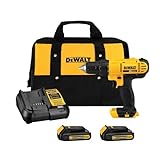


For ordinary permitted holes in wood framing, a cordless drill is usually enough. The job is less about maximum torque than controlled speed, a suitable bit, and a way to keep the drill square. For repeated large holes, a right-angle drill can be safer and easier to manage than forcing a compact drill into the space.
What to buy for the job
For occasional holes around 1/2 inch in diameter, a good 18V or 20V-class drill with a two-speed gearbox and a clutch is a sensible choice. A compact 12V drill can handle smaller bits and pilot holes, but may slow down or stall with a larger auger, especially in dense material or at the end of a long extension. For plumbing-sized holes, repeated work, or awkward access, look at a dedicated cordless right-angle drill.
A standard drill is often cheaper and perfectly fine if the joists are exposed, the holes are modest, and there is room to hold the tool straight. A hammer drill’s hammer setting is for masonry; leave it off for wood. An impact driver is designed mainly for driving fasteners and is a poor first choice for boring larger holes. Its pulsing action can make a large bit harder to control and may damage the bit or workpiece.
Compare drill types
| Type | Best fit | Trade-off |
|---|---|---|
| Compact 12V drill | Small holes, light work, tight spaces | Less reserve for large bits or sustained boring |
| 18V/20V-class drill | General framing holes and mixed DIY work | Bulkier than a compact drill; can still bind hard |
| Cordless right-angle drill | Repeated holes in cramped joist bays | Costs more and is less versatile for everyday driving |
| Impact driver | Fasteners and compatible small accessories | Not the best-controlled tool for large wood holes |
When comparing drills, check low-speed operation, handle shape, battery availability, and whether the tool has a side handle or a way to fit one. A high torque figure on the box does not tell you how controllable the drill will feel when a bit catches. If you already own batteries in a tool platform, buying a bare tool can save money; otherwise, compare the kit price, since a second battery is useful when boring many holes.
Choose the bit to match the hole
For small, clean holes, a sharp brad-point bit or standard twist bit is usually easier to steer than a large, aggressive cutter. For larger holes in permitted locations, an auger bit or self-feed bit can cut quickly, but it can also grab hard when it meets a knot or a previously drilled edge. Use a bit intended for wood and check its maximum recommended speed. A wood auger bit set is useful for repeated framing holes; for occasional small holes, a basic sharp wood-bit set may be all you need.
Match the shank to your drill’s chuck and tighten the chuck securely. A dull bit makes the motor work harder, wanders more, and encourages excess pressure. Clear chips when the bit binds or stops cutting; forcing it can overheat the bit or twist the drill from your hands. Keep a firm grip, brace your stance, and use the drill’s low gear for larger bits. Set the clutch to drilling mode only when the job requires it, and keep the tool speed controlled rather than leaning your body weight into the cut.
Drill safely and avoid common failures
Locate wiring, plumbing, and any hidden hardware before drilling. Use a stud or joist layout, inspection camera, or other appropriate method rather than assuming the bay is clear. Wear eye protection, keep loose clothing away from the chuck, and support the drill with both hands when the bit could bind. A long bit increases leverage: if it catches, the drill can rotate suddenly. Stop immediately if the bit snags, the tool twists, or you encounter an unexpected metal plate or obstruction.
Mark the approved location and hole diameter from the joist documentation, then verify that the bit will not break through a flange, chord, or other restricted area. Drill square to the web where the instructions permit it. Avoid enlarging a hole by rocking the drill; that can tear the material and leave an irregular opening. If the bit walks, make a small pilot hole only when allowed and appropriate for that bit. Do not use a larger hole simply because it makes routing easier.
After drilling, inspect the cut for torn material, cracks, or accidental damage to a flange or chord. If you have damaged a structural member, do not patch it with scrap wood, screws, or adhesive based on guesswork. Stop work and get repair instructions from the manufacturer or a qualified structural professional. For a one-off permitted hole, a basic drill and sharp bit are usually the economical choice; pay extra for a right-angle drill when the access, hole size, or repetition makes control the limiting factor.