What's inside
As an Amazon Associate I earn from qualifying purchases. This post may contain affiliate links at no extra cost to you.
What we cover
What matters for door hardware
For a deadbolt, entry knob, or passage set, the drill does not need huge torque or a hammer mode. It needs a controllable trigger, a clutch, and enough battery life to drill a few clean holes without becoming awkward in your hand. Most door-hardware jobs involve drilling through a wood door, driving screws into the door edge, and tightening small hardware screws. Those tasks reward control more than raw power.
Check the lock’s template before buying bits or starting work. Many residential locksets use a 2-1/8-inch face bore and a 1-inch edge bore, but dimensions vary. Use a hole saw and spade or auger bit sized to the actual instructions. A drill alone cannot make the large face hole cleanly; the correct cutting tools matter just as much.
As an Amazon Associate we earn from qualifying purchases at no extra cost to you.



Which drill type to buy
| Tool | Best use | Trade-off |
|---|---|---|
| 12V drill/driver | One or two locksets, light household work | Compact and easy to control; less reserve for large hole saws |
| 18V or 20V drill/driver | Several doors or mixed home projects | More power and battery capacity, but heavier |
| Impact driver | Driving long screws into framing or hinges | Fasteners go in quickly, but the tool is too abrupt for delicate lock screws |
| Hammer drill | Masonry holes for anchors or door hardware nearby | Hammer mode is unnecessary for a wood door and adds little value here |
A basic drill/driver is the right primary tool. If you already own a cordless impact driver, it can help with long hinge or strike-plate screws, but use a drill/driver for the lock’s smaller screws and drilling. Impact tools can strip screw heads, twist a bit, or over-tighten hardware before you react.
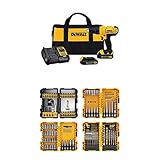
For a single door, a decent 12V drill is usually enough, provided it accepts the required bit and has a battery in good condition. For regular DIY use, an 18V/20V drill offers more margin when using a hole saw, especially in a solid wood door. Compare 12V cordless drill/drivers with 18V cordless drill/drivers by checking tool weight, clutch settings, and whether the kit includes a battery and charger.
Features worth paying for
Variable-speed trigger: Start slowly to keep a hole saw centered, then increase speed as the teeth bite. A drill that jumps to full speed makes wandering and chipped veneer more likely.
Two-speed gearbox: Use the low range for large hole saws and high resistance; use the faster range for small pilot holes and screws. Do not force a stalled bit. Back it out, clear the cut, and try again.
Clutch: Set it low for small screws, then raise it only if the fastener stops short. A clutch helps prevent stripped screws and crushed lock trim. For drilling, switch to the drill setting rather than leaving the clutch engaged.
Chuck capacity: A 3/8-inch chuck is adequate for many household bits, but a 1/2-inch chuck gives more flexibility for larger shanks and hole-saw arbors. Confirm that the chuck can hold the arbor you plan to use.
Battery and balance: One battery can handle a lockset installation, but a second is useful if the drill is shared or used all day. A compact tool is easier to hold square against a door; a heavier drill may feel steadier with a large hole saw but can tire your wrist.
Bits, technique, and common failures
Use a sharp hole saw matched to the template, a 1-inch edge-bore bit when specified, and a small pilot bit for screw holes. A wood door can have a thin veneer that chips when the hole saw exits. To reduce tear-out, drill until the pilot tip just emerges on the other side, then finish the cut from that side. If the template and door access make that impractical, clamp a scrap board behind the exit face.
Keep the drill square to the door. A tilted face bore can leave the lock rose sitting unevenly, while a misaligned edge bore may prevent the latch from seating. Clamp the door securely or have someone hold it; do not try to control a large hole saw while the door swings on its hinges.
Large hole saws can grab suddenly, particularly in solid wood. Use low gear, a firm two-handed grip, and moderate pressure. If the drill stops, release the trigger rather than leaning harder. A brushless motor is not required, though it may run cooler during repeated cuts. For occasional hardware work, the extra cost is often better spent on sharp bits.
Driving screws too far is another common problem. Start each screw by hand or at low speed, then stop when the hardware is snug. Overtightening can strip the wood, distort a latch plate, or bind a lock. If a screw spins without tightening, remove it and assess the hole; a longer screw into sound framing may help at a strike plate, but it is not a fix for every stripped hole.
A sensible buying choice
For occasional door work and ordinary household repairs, choose a compact drill/driver with variable speed, a clutch, two gears, and a 3/8-inch or larger chuck. A budget brushed model is fine for a few holes at a time. Pay more for an 18V/20V kit if you expect repeated hole-saw work, need longer runtime, or already use batteries in that tool platform.
Buy an impact driver only as a companion for larger fastening jobs, not as a substitute for the drill. If you already own a compatible drill, spend first on the correct hole saw, a sharp edge-bore bit, and a spare battery if needed. A powerful drill with dull cutters still makes rough holes and risks damaging the door.