What's inside
As an Amazon Associate I earn from qualifying purchases. This post may contain affiliate links at no extra cost to you.
For ordinary, non-reinforced concrete block, a compact cordless hammer drill is usually enough. The key is a sharp masonry bit, a steady pace and a drill with a clutch you can actually control. You do not need a rotary hammer for a few small anchor holes—but the wrong bit or too much pressure can turn a simple job into a slow, overheated one.
As an Amazon Associate we earn from qualifying purchases at no extra cost to you.


What we cover
Choose by the job
Concrete block is not the same as poured concrete. Its face shell is relatively thin, and the hollow cells behind it can make drilling easier once the bit breaks through. The webs between cells are denser. For shelves or light fixtures, you may only need holes about 1/4 to 3/8 inch wide. Larger holes, many holes in a row or repeated work in dense block favor a more capable drill—or a rotary hammer.
A basic 18- or 20-volt cordless hammer drill with a two-speed gearbox is a practical starting point. Look for a hammer mode, a side handle and a clutch with usable low settings. A brushless motor can extend runtime and improve performance, but it is not essential for occasional drilling. If you already own a compatible battery platform, a bare tool is often the less expensive buy.
For a homeowner drilling a handful of small holes, a cordless hammer drill is generally the sensible purchase. Choose a model with a side handle for larger bits or extended sessions; it gives you better control if the bit catches.
Compare the practical options
| Tool | Best use in block | Main trade-off |
|---|---|---|
| Standard drill/driver | Very small holes in soft block, occasional work | No hammer action; drilling is slower and can overheat the bit |
| Cordless hammer drill | Typical anchor holes, roughly 1/4 to 1/2 inch | More vibration and noise than a standard drill |
| Rotary hammer | Many holes, larger diameters or stubborn masonry | Heavier, costlier and often unnecessary for a few block anchors |
A standard drill can work in soft block with a sharp masonry bit, especially for one or two small holes. It is the cheaper option if you already own it. But without hammer action, expect slower progress and more heat; leaning harder is not a good substitute. If the bit barely advances after a short trial, switch tools rather than forcing it.
Bits and settings matter
Use a carbide-tipped masonry bit, not a general-purpose twist bit. Match the bit diameter to the anchor maker’s instructions: a hole that is too large can leave an anchor loose, while one that is undersized may split the anchor or make installation difficult. For common plastic plugs, diameters around 1/4 inch are typical, but follow the packaging rather than guessing.
Set the drill to hammer mode and low gear for control, then start at low speed to keep the bit from skating. Once the tip has made a shallow seat, use steady, moderate pressure. Let the hammer action do the work. Pull the bit out occasionally to clear dust; packed dust can slow cutting, heat the carbide tip and leave an inaccurate hole. A simple depth mark on the bit helps prevent drilling deeper than the anchor requires.
For a neat hole, place it in the solid web or face shell where the fastener instructions allow, not right on a block edge or mortar joint. Block can chip at edges, and mortar is often weaker than the masonry unit. If you need to install a screw anchor, check whether its instructions call for a specific bit size and minimum embedment. Do not assume a generic wall plug will hold a heavy load in a hollow cell.
When a rotary hammer is worth it
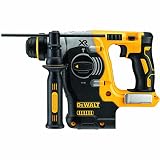
Move up to a rotary hammer if you are drilling a large batch of holes, regularly using bits over about 1/2 inch, or finding that a hammer drill stalls in dense webs. A small SDS-plus rotary hammer usually drills masonry faster with less force from the operator, but it is bulkier and needs SDS-plus bits. For a one-time set of small holes, renting one may make more sense than buying.
Do not choose a tool by voltage alone. Battery capacity affects how long you can work before swapping packs, while motor and hammer mechanism design affect drilling speed. A compact 2.0 Ah battery may be convenient for overhead work; a larger pack can reduce interruptions on a long run but adds weight. If shopping for heavier-duty block drilling, compare a cordless SDS-plus rotary hammer against the cost of renting one.
Avoid the common failures
Wear eye protection: masonry dust and small chips can fly, particularly as the bit breaks through a face shell. Keep both hands on the tool when using a side handle, and do not wear loose gloves that could catch in rotating parts. Check for wiring and plumbing before drilling, and use a dust mask suitable for fine masonry dust. If the drill binds, release the trigger and back the bit out; twisting harder can injure your wrist or damage the tool.
After drilling, clear dust from the hole with a bulb blower or suitable vacuum before fitting an anchor. Dust left inside can prevent an anchor from seating or reduce its grip. For loads that matter—such as a heavy cabinet, rail or overhead fixture—use a fastener rated for the block type and load, and follow its installation directions. Hollow block may require a different anchor from solid masonry. A strong drill cannot make an unsuitable anchor safe.
For most small home projects, buy the hammer drill that fits your existing battery system, add a quality carbide masonry bit in the correct size and take time to clear the hole. Spend more only when the number, size or toughness of the holes justifies it.