What's inside
As an Amazon Associate I earn from qualifying purchases. This post may contain affiliate links at no extra cost to you.
What we cover
Choosing the right drill for brick and block
For a few holes in brick veneer or concrete block, a cordless hammer drill is usually the practical choice. It rotates a masonry bit while pulsing it forward, which helps the carbide tip cut brittle masonry. It is not a small rotary hammer, though: expect slower drilling and more effort, especially in hard concrete or when making holes wider than about 1/2 inch.
First check what is actually behind the surface. Brick veneer is typically a thin outer layer with a cavity and a structural wall behind it. Concrete block may be hollow, grouted, or reinforced. A hole that passes through a hollow block face can behave very differently from one that hits a solid web. If you are unsure, start with a small pilot hole and stop if the bit meets unexpected metal or a void.
As an Amazon Associate we earn from qualifying purchases at no extra cost to you.


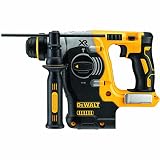
For occasional work, a 18V cordless hammer drill from a battery platform you already own is often enough. Buying into a new battery system just for a couple of anchors may cost more than hiring a contractor or using a corded tool.
What matters when comparing drills
Look for a three-mode tool: drill, driver, and hammer drill. The drill mode avoids hammering when working in wood or metal; the driver mode helps with screws; hammer mode is for masonry. A side handle is useful even on compact tools because the drill can twist when a bit binds. A clutch is helpful for fastening, but it does not control torque in hammer-drill mode.
Voltage labels alone do not tell you how quickly a drill will bore masonry. Battery condition, bit quality, the material, and the tool’s hammer mechanism all matter. A 2.0Ah battery keeps the kit light for overhead or occasional work; a 4.0Ah or larger pack usually gives more holes per charge, at the cost of extra weight. If a tool is sold bare, make sure you have compatible batteries and a charger before comparing its price with a kit.
Cordless hammer drill options by job
| Option | Best use | Trade-off |
|---|---|---|
| Compact 18V hammer drill | Small anchors and occasional holes, commonly 1/4 to 3/8 inch | Light and manageable, but slower in dense block |
| Full-size 18V hammer drill | Repeated holes and larger masonry bits up to roughly 1/2 inch | More power and runtime, but heavier and harder to control |
| Cordless rotary hammer | Frequent drilling, larger holes, or hard concrete | Faster in masonry, but bulkier, costlier, and excessive for a few small anchors |
These are job-fit categories, not guarantees of drilling speed. Brick hardness varies, and a bit that cuts cleanly in soft brick may struggle in a dense block. A cordless SDS-plus rotary hammer makes sense when masonry work is regular or holes are larger than a typical hammer drill handles comfortably. For a handful of small holes, it is usually more tool than you need.
Bits, hole size, and anchors
Use a carbide-tipped masonry bit sized to the anchor maker’s instructions. A worn, overheated, or cheap bit can make drilling slow and leave an oversized hole, so the anchor spins instead of gripping. For common plastic masonry plugs, the required hole is often around 1/4 to 3/8 inch, but follow the package rather than guessing. Keep a spare bit if you have many holes to drill.
In brick veneer, drilling into the brick itself is often preferable to drilling into the mortar joint, which can be weaker and may crumble. Avoid drilling near brick edges; a hole too close to an edge can split the face. For heavy loads, do not assume veneer is structural. Select a fastening method that reaches the structural backing or is specifically rated for the assembly and load. Hollow-block anchors also need to match whether the hole lands in a face shell, web, or grouted section.
A reliable drilling method
Mark the hole and check for pipes, wiring, and other services before drilling. Wear eye protection and a suitable dust mask; masonry dust is hazardous to breathe. Set the drill to hammer mode, use the side handle, and begin slowly so the bit does not skate. Apply steady pressure rather than leaning hard on the tool. If progress stalls, withdraw the bit while it is still spinning to clear dust, then continue. Do not force it: excessive pressure can overheat the bit, stall the drill, or crack a brick.
Drill to the anchor’s specified depth, allowing room for dust at the bottom. A depth stop is useful; otherwise, mark the bit with tape. Clear the hole with a blower or vacuum before inserting the anchor. Dust left inside can prevent full seating. If the drill suddenly stops cutting or the hole produces sparks, stop and investigate rather than pushing through possible rebar or a hidden service.
Which one should you buy?
For occasional mounting in brick veneer or hollow block, choose a compact or mid-size cordless hammer drill with a side handle, a fresh masonry bit, and a battery you already own. A hammer drill kit with a side handle can be the better buy if you need batteries and a charger as well. A less expensive model is fine for a few small holes; spend more for comfort, runtime, and repeated work rather than expecting a premium drill to make every kind of concrete easy.
If you regularly drill many holes, work with bits above 1/2 inch, or encounter hard concrete, step up to a rotary hammer. For a single project with a few small anchors, borrowing or renting one may be more sensible than buying it. Match the tool to the material and workload, and the bit and anchor will often matter as much as the drill.