What's inside
As an Amazon Associate I earn from qualifying purchases. This post may contain affiliate links at no extra cost to you.
Concrete block is easier to drill than poured concrete, but it is still hard on a drill. The hollow cores, dense webs, mortar joints, and aggregate all create different loads. A compact cordless hammer drill can handle anchors and small holes, while larger holes and repeated drilling are better jobs for a cordless rotary hammer.
The right choice depends mainly on hole diameter, depth, and how many holes you need to make. For occasional shelf anchors, buy a good 18V or 20V hammer drill and masonry bits. For dozens of holes for furring strips, conduit, or wall framing, the faster tool is usually a rotary hammer with an SDS-Plus chuck.
As an Amazon Associate we earn from qualifying purchases at no extra cost to you.


What we cover
What to buy for concrete block
A standard cordless drill is not the right tool. Its rotating chuck can turn a masonry bit, but it cannot efficiently break the material in front of the cutting edge. A hammer drill adds a pulsing action. That is enough for small holes in block, especially when drilling through the face shell or mortar.
Look for a cordless hammer drill kit with a two-speed gearbox, a clutch, a side handle, and a hammer mode that can be switched off. A brushless motor is useful, but it should not outweigh battery availability or tool balance. For most renovation work, an 18V or 20V platform is the practical middle ground.
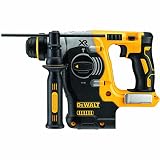
Choose a cordless rotary hammer when holes are larger than about 1/2 inch, deeper than 3 inches, or numerous enough that drilling becomes the slowest part of the job. Rotary hammers use a stronger impact mechanism and usually accept SDS-Plus bits. They remove material much faster, but they are heavier, louder, and less pleasant for small plastic anchors.
Hammer drill versus cordless rotary hammer
| Tool type | Best use in block | Practical hole range | Main trade-off |
|---|---|---|---|
| Compact hammer drill | Small anchors, pictures, light fixtures | 1/4 to 3/8 inch | Slower in deep or repeated holes |
| Full-size hammer drill | General renovation and larger anchors | 3/8 to 1/2 inch | Heavier and easier to overdrive fasteners |
| Cordless SDS-Plus rotary hammer | Furring strips, conduit, masonry screws, many holes | 1/4 to 3/4 inch | More expensive, noisy, and less versatile for ordinary drilling |
These sizes are working guidelines, not hard limits. A powerful hammer drill may make a 5/8-inch hole, but the bit can bind, the battery can heat up, and the job will take much longer than it would with an SDS tool. Conversely, buying a rotary hammer for four 1/4-inch holes is usually unnecessary.
Features that matter more than peak voltage
A side handle is essential once you move beyond small holes. Masonry bits can grab when they encounter a hard piece of aggregate, and the handle keeps the drill from twisting your wrist. A depth stop is also useful for sleeve anchors and plastic plugs, where drilling too deep leaves the fastener unsupported.
Use a variable-speed trigger and start slowly. High speed with too much pressure can polish the hole instead of cutting it, especially with a dull bit. Two-speed gearing gives better control: low gear for large holes or careful starts, high gear for small holes once the bit has established a path.
A clutch is helpful for driving masonry screws, but do not assume its numbered settings protect the block. The clutch limits the tool’s output; it does not prevent a screw from stripping a soft mortar joint or crushing a plastic anchor. Drive fasteners until snug, then stop.
Battery size is a balance. A 2.0Ah battery makes a compact hammer drill easier to control overhead. A 4.0Ah or 5.0Ah pack is better for repeated drilling, but adds noticeable weight. If you are drilling more than 20 to 30 holes, having a second battery is often more useful than buying the most powerful tool in the lineup.
Bits, anchors, and placement
Buy carbide-tipped masonry bits rated for hammer drilling. General-purpose twist bits can overheat and lose their edge quickly. For an SDS rotary hammer, use SDS-Plus masonry bits. Keep a sharp bit for the final size; enlarging a hole with a worn bit often produces a loose, irregular opening.
For light loads, plastic expansion plugs and the matching screw are inexpensive and forgiving. Masonry screws are faster when you need several attachments, but they depend on a clean, correctly sized hole. For heavier loads, use a sleeve anchor or another rated masonry anchor, and follow the manufacturer’s edge-distance and embedment requirements.
Whenever possible, place anchors in the solid face shell or a mortar joint only when the anchor is specifically rated for it. Do not assume the hollow center of a block will support the same load as solid concrete. A toggle-style hollow-wall anchor may be a better choice when access behind the block is available, but many block walls have no accessible cavity.
How to drill block without damaging it
Mark the hole and check for electrical and plumbing hazards before drilling. Avoid drilling close to unsupported edges. As a practical starting point, keep an anchor at least 2 inches from a visible edge unless the anchor instructions allow less. The thin face shell can crack if the hole is too close to a corner or opening.
Start in hammer mode at low speed with light pressure. Once the bit has made a shallow ring, increase speed and apply steady pressure. Do not lean your full body weight into the drill. If progress stops, withdraw the bit every few seconds to clear dust and let the bit cool.
Drill approximately 1/4 inch deeper than the required embedment, then blow or brush dust from the hole. Wear eye protection; block dust and small chips leave the hole at high speed. For deep holes, pause more often. A hot bit can soften plastic plugs, damage its carbide tip, or make the hole larger than intended.
When the cheaper option is fine
A lower-cost cordless hammer drill is adequate for hanging a mirror, mounting a small bracket, or installing a few 1/4-inch anchors in sound block. You do not need a premium brushless tool if the battery platform is already available and the job is occasional. Spend the savings on better masonry bits and correctly rated anchors.
Upgrade to a cordless SDS-Plus rotary hammer when a hammer drill stalls, overheats, or takes more than roughly a minute per hole. For very large holes, chiseling, or continuous renovation work, a corded rotary hammer can still deliver better value because it avoids battery limits and is often lighter for the power it provides.
For most homeowners, the sensible setup is an 18V or 20V hammer drill for small anchors plus a quality set of carbide masonry bits. Rent or borrow a rotary hammer when the project turns into a production job.