What's inside
As an Amazon Associate I earn from qualifying purchases. This post may contain affiliate links at no extra cost to you.
Sheet metal is thin enough to grab a drill bit, distort around the hole, or leave a ragged edge if the tool is poorly supported. A step bit handles many larger holes cleanly, but it does not replace a set of ordinary twist bits: you still need pilot holes, smaller fastener holes, and bits for materials or sizes that a step bit cannot cover. The best buy depends on the hole sizes you need, the metal thickness, and whether you work with sheet metal often enough to justify a more durable set.
As an Amazon Associate we earn from qualifying purchases at no extra cost to you.


What we cover
What to buy for sheet metal work
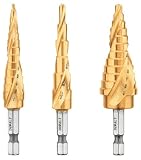
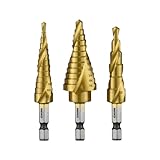
For occasional work on thin steel or aluminum, a basic set of high-speed steel (HSS) twist bits plus one HSS step bit is usually enough. Look for a step bit whose cutting range includes your most-used hole diameters and whose maximum capacity exceeds the metal thickness you plan to drill. A HSS step bit set is a practical starting point when you need several hole sizes but do not need premium coatings.
If you drill stainless steel, make holes regularly, or expect the bits to see heavy shop use, consider cobalt bits. Cobalt-alloy bits cost more, but they tolerate heat better than ordinary HSS when used correctly. They are not indestructible: excess speed, poor pressure, or drilling without lubricant can overheat and dull them too.
For general drilling, a metal-cutting HSS twist bit set should include the common small sizes you use for pilot and fastener holes. If your holes are mostly one or two diameters, buying a compact set with those sizes is often better value than paying for a large assortment you will rarely use.
Step bits versus twist bits
| Bit type | Best use | Trade-off |
|---|---|---|
| Step bit | Clean, larger holes in thin sheet; multiple diameters with one bit | Limited by its step sizes and cutting depth; not ideal for thick stock |
| HSS twist bit | Pilot holes, small fastener holes, and sizes outside a step bit’s range | Can grab or chatter on thin sheet without support and a small pilot |
| Cobalt twist bit | Frequent work, harder metals, and stainless steel | Costs more; still needs controlled speed and heat |
A step bit is especially useful for enlarging a hole in sheet that is roughly 1/8 inch thick or thinner, though the bit maker’s stated capacity is the limit to follow. The broad cutting steps give you control over the final diameter, and the tapered shape can leave a cleaner hole than forcing a large twist bit through thin material. For thicker plate, use a suitable twist bit or hole-making tool rather than assuming the step bit will cut through its full diameter.
Features worth checking
Check the set’s actual size range and step increments before buying. A bit that jumps from 3/8 inch to 1/2 inch is no help if your fitting needs a 7/16-inch hole. For twist bits, a useful general set covers small diameters in roughly 1/16-inch increments, but the exact range matters more than the number of pieces in the case.
Split points can help a twist bit start with less walking, but they do not eliminate the need to secure the work. A round shank works in a standard drill chuck; a hex shank may be convenient in a drill or impact driver, but check the bit’s rating and shank size. For drilling sheet metal, a cordless drill is usually easier to control than an impact driver. The impact mechanism can make the bit chatter or catch, and many ordinary drill bits are not intended for impact use.
Coatings such as black oxide can improve corrosion resistance and reduce friction, but a coating alone does not make a bit suitable for stainless steel or heavy use. Material, geometry, sharpening, and correct operation matter more.
How to drill without wrecking the sheet
Clamp the sheet flat against scrap wood or a backing block. This supports the material, reduces chatter, and helps prevent the bit from tearing through at the exit. Do not hold a small panel by hand: when a bit catches, thin sheet can spin sharply and cut you. Wear eye protection, remove loose gloves and clothing from the rotating tool, and deburr sharp edges after drilling.
Mark the center, then use a small pilot hole if you are starting with a twist bit or making a large hole. A pilot around 1/8 inch is often enough for a larger hole in light sheet, but follow the bit maker’s advice and avoid making it so large that the next bit has little material to guide it. Use moderate speed and steady pressure. If the bit squeals, smokes, or turns the workpiece blue, stop: it is too hot. Reduce speed, clear chips, and use cutting fluid where appropriate, especially on steel and stainless.
When using a step bit, drill straight and stop when the desired step reaches the sheet. Continuing into the next step enlarges the hole. Check the opening with the fitting or fastener rather than relying only on the printed size markings. Burrs are normal; remove them with a deburring tool or a light pass with a larger bit by hand, not by aggressively driving the drill.
Choosing a set by job frequency
For a one-off project in thin aluminum or mild steel, a budget HSS set is fine if the bits are sharp, the sizes match the job, and the sheet is properly clamped. You do not need cobalt just because the material is metal. If you repeatedly drill stainless or burn through ordinary bits, a cobalt drill bit set is a more sensible upgrade than buying another oversized bargain assortment.
Before ordering, compare the step bit’s capacity, the twist-bit sizes you actually need, and whether replacement bits are available individually. A compact, sharp set used at the right speed will generally outperform a large set of dull bits. Store bits dry and separated so cutting edges do not rub against each other; replace or resharpen them when they begin to wander, squeal, or require noticeably more pressure.