What's inside
As an Amazon Associate I earn from qualifying purchases. This post may contain affiliate links at no extra cost to you.
What we cover
The quick answer
For one or two holes in thin sheet metal, an ordinary sharp twist bit is usually the cheaper, more versatile choice. For a larger hole, several different hole sizes, or a clean opening in thin material, a step bit is often easier to control and less likely to grab as it breaks through.
Neither bit is a cure for poor setup. Sheet metal can spin, buckle, or catch the bit, so clamp it securely, use a backing block where practical, and start at low speed. If you’re buying one tool for general drilling, choose a set of metal-cutting twist bits. If you regularly make larger holes in thin panels, a step bit set can save time and reduce burrs.
As an Amazon Associate we earn from qualifying purchases at no extra cost to you.
How the bits cut
A twist bit has a pointed tip and two spiral flutes that carry chips out of the hole. It’s the standard choice for small holes and works in a wide range of materials when the bit is appropriate and sharp. For steel, a standard high-speed steel bit is fine for occasional work; cobalt bits tolerate heat better and can last longer when drilling tougher steel, but they cost more.
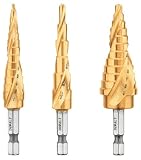
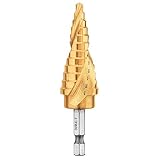
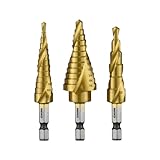
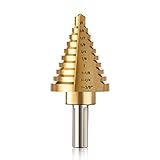
A step bit has a cone-shaped body with a series of cutting diameters. Each step enlarges the hole to a set size, commonly in thin sheet up to around 1/8 inch, though the bit’s specifications vary. One bit can drill several sizes without swapping tools. Because its cutting edge engages progressively, it can be easier to keep steady than a large twist bit in thin material.
Step bit vs. twist bit
| Factor | Step bit | Twist bit |
|---|---|---|
| Best use | Medium and large holes in thin sheet | Small holes and general-purpose drilling |
| Hole sizes | Limited to the steps on the bit | Available in many diameters |
| Thin-sheet control | Often steadier, with less grabbing | Can catch at breakthrough, especially at larger sizes |
| Thicker material | Usually unsuitable beyond its rated capacity | Better choice when length and cutting capacity are adequate |
| Cost and storage | Costs more per bit, replaces several sizes | Cheap individually, but a useful range takes more bits |
| Hole finish | Can leave a relatively clean round hole; edges still need checking | May leave a burr, particularly if the sheet flexes |
Choose by hole size and job
For pilot holes, screws, and holes below roughly 1/4 inch, a twist bit is usually the practical choice. It’s inexpensive, easy to replace, and available in the exact diameter you need. A step bit can’t make every small size, and buying one just for a couple of small holes rarely pays off.
For a 3/8- to 7/8-inch opening in thin steel or aluminum—such as a cable pass-through or a hole for a fitting—a step bit can be more forgiving than trying to drive a large twist bit through unsupported sheet. Check the marked diameters before buying: step spacing varies, and not every bit includes the size you need. A step bit also makes it easy to enlarge a hole gradually, but stop at the correct shoulder. Going one step too far can ruin the fit.
For thick plate or repeated holes in material thicker than the step bit’s rated capacity, use a suitable twist bit or another hole-making tool rated for that thickness. A step bit may cut poorly, overheat, or wear quickly when its full cutting edge is buried in thick stock.
Drill thin sheet without tearing it up
Mark the center and clamp the workpiece to a bench or sacrificial wood backing. A loose panel can spin violently when the bit catches, while unsupported sheet can flex and produce an oversized, ragged hole. Don’t hold small sheet metal in your hand. Keep fingers clear and wear eye protection; sharp chips and burrs are common.
Use a drill rather than an impact driver for cleaner control. An impact driver’s hammering action isn’t needed for sheet metal and can make the bit harder to guide. Set the drill to low speed. For many hand-drilling jobs in thin sheet, about 500–1,000 rpm is a reasonable starting range; larger diameters generally call for slower speed. The right speed depends on bit diameter and material, so reduce speed if the bit squeals, smokes, or heats rapidly.
Let the bit cut with steady pressure rather than forcing it. Too much pressure can distort thin stock or snap a small bit. A center punch can help a twist bit start in steel, but use a light mark: a deep punch can dent or deform very thin sheet. Step bits often start more readily, though a small pilot hole may still help, depending on the design.
Use cutting fluid on steel when appropriate, especially for a series of holes; aluminum is often drilled dry, but a lubricant intended for aluminum can help reduce built-up material. Clear chips and let the bit cool if it becomes hot. After drilling, deburr both sides with a deburring tool or a larger bit turned gently by hand. Don’t run a high-speed bit around the edge to clean it up—you can enlarge the hole or catch the sheet.
Common mistakes and when the cheaper bit is fine
A twist bit’s most common failure in thin sheet is grabbing as it breaks through. The panel may twist, the hole may become ragged, or the bit may bend. Backing the sheet, lowering speed near breakthrough, and easing pressure reduce the risk. Dull bits make the problem worse: they rub instead of cutting, creating heat and requiring more force.
Step bits can also fail. They can overheat under hard pressure, chip if used on material beyond their rating, or cut an uneven opening if the drill is angled. Their diameter markings may wear off, so verify the intended step before drilling. They also don’t replace small twist bits for precise pilot holes.
If you need a few small holes in thin sheet, a sharp, inexpensive twist bit and careful clamping are enough. Spend extra on a step bit when you often make larger holes, need several sizes without changing bits, or want a more controlled way to open thin panels. The best choice is the bit suited to the hole and material—not the one with the longest list of features.