What's inside
As an Amazon Associate I earn from qualifying purchases. This post may contain affiliate links at no extra cost to you.
Melamine is a thin, brittle resin surface over a particleboard or MDF core. The coating chips easily, especially where a bit breaks through the back. For most screw holes and small fittings, a sharp brad-point bit is a good place to start. For larger holes, a Forstner bit or a hole saw may be a better fit. The right choice depends on hole size, location and whether the back face will be visible.
As an Amazon Associate we earn from qualifying purchases at no extra cost to you.



What we cover
Choose the bit for the hole
A brad-point bit has a center spur that locates the hole and outer spurs that score the surface before the cutting edges remove material. That scoring helps limit ragged chips around small holes. A standard twist bit can work for rough or hidden holes, but its cutting lips tend to scrape the coating before the hole is fully established.
For hinges, shelf pins and other larger, flat-bottomed holes, use a sharp Forstner bit. Its rim scores a clean circle, while the center point helps keep it on target. A hole saw is more suitable for larger through-holes, such as cable pass-throughs. It removes a plug rather than producing a flat-bottomed recess, and can tear out the back if you drill through in one pass.
| Bit type | Best use | Trade-off |
|---|---|---|
| Brad-point | Small, precise holes for screws and fittings | Not the right choice for large-diameter holes |
| Forstner | Flat-bottomed holes and hinge cups | Needs a steady drill and more pressure as the hole deepens |
| Hole saw | Large through-holes for cables or pipes | More prone to breakout at the back; use a pilot bit |
| Twist bit | Budget option for hidden or noncritical holes | More likely to chip the melamine surface |
What to buy
For cabinet assembly and ordinary hardware, a quality brad-point set covering roughly 3–10 mm (about 1/8–3/8 inch) handles many common pilot and clearance holes. Check that the set includes the diameters you actually need; a large assortment of dull, rarely used sizes is poor value. If you are fitting concealed hinges, buy the correct Forstner diameter for the hinge specification—often 35 mm, but verify the hardware before drilling.
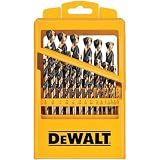
Look for cleanly ground cutting edges and a center spur that is not bent or blunt. High-speed-steel bits are generally adequate for occasional work. A carbide-tipped bit can last longer in abrasive panel materials, but it costs more and is not a cure for poor technique. A brad-point drill bit set is a sensible general purchase if you make small holes in panels regularly. For one hidden hole, a sharp, inexpensive twist bit may be enough.
For hinge cups, compare the price of one suitable 35 mm Forstner bit with a multi-piece set. Buy a set only if you expect to use the other sizes. Avoid choosing a bit just because it is marketed for wood; check the diameter, shank fit and condition of its cutting edges.
Drill without chipping the face
Mark the hole carefully, then clamp the panel to a flat sacrificial board. The backing supports the melamine as the bit exits and reduces breakout on the underside. Keep the panel from moving: a bit that catches can scratch the surface or twist the workpiece. If clamps would damage the finish, put a clean scrap between the clamp pads and panel.
Use a cordless drill or drill-driver in its normal drilling mode, not an impact driver. Impact blows can make the bit wander or chip the surface, and are unnecessary for drilling panel holes. Start at a moderate speed with a brad-point or Forstner bit, keeping the drill square to the panel. Do not lean hard on the drill. Let the cutting edges do the work, and withdraw the bit occasionally to clear chips from a deep hole.
For a through-hole, slow down as the point approaches the back. Better still, stop when the pilot point just breaks through, turn the panel over and finish from the other face using the small opening as a guide. This takes an extra step, but prevents the bit from tearing a cone of material out of the back. With a hole saw, use the same two-sided approach once its pilot bit emerges.
Pilot holes and screws
Choose a pilot bit based on the screw’s core diameter—the solid shaft between the threads—not its full outside diameter. A pilot that is too small can split or bulge the particleboard core; one that is too large gives the threads little material to grip. Test on an offcut when possible, especially near a panel edge. Keep edge holes well supported and follow the hardware maker’s spacing guidance; particleboard has less holding strength near an edge than solid wood.
Drill the pilot hole before driving the screw, and stop when the head is seated. Overdriving can strip the core or crush the surface around the screw head. Use a drill-driver’s clutch at a low setting and increase it only if the fastener stops short. For cabinet hardware that will be removed and reinstalled, a through-bolt or suitable insert may hold more reliably than repeatedly driving a screw into the same particleboard hole.
Common mistakes that spoil the hole
A dull bit often leaves a white, ragged ring where the melamine has fractured. Replace or sharpen it rather than compensating with more force. Excessive speed and pressure can heat the bit, burn the core or make a Forstner bit chatter. Too little support beneath the panel encourages breakout. A worn chuck or loose bit can also cause an oversized or wandering hole, so check that the shank is seated and tightened properly.
If the hole will be visible, test the full setup—bit, speed, backing and feed—on a matching offcut first. For a hidden screw hole, the cheapest sharp bit that makes the required diameter may be perfectly adequate. For visible hinge cups or clean openings on both faces, a sharp Forstner or a two-sided drilling method is worth the extra care.