What's inside
As an Amazon Associate I earn from qualifying purchases. This post may contain affiliate links at no extra cost to you.
Picking a step bit for an electrical enclosure starts with the fitting, not the drill. A conduit connector, cable gland, knockout plug or bulkhead fitting has a specific hole-size requirement. The bit must reach that diameter, but it also needs a usable step for the enclosure’s material and thickness. Check the fitting’s instructions or hole-size marking before buying; nominal conduit size is not necessarily the diameter of the hole it needs.
As an Amazon Associate we earn from qualifying purchases at no extra cost to you.

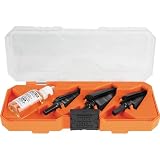
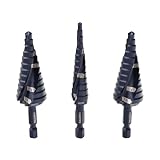

What we cover
Check the required hole size
Measure the opening specified for the fitting, or look it up in the fitting manufacturer’s documentation. Do not size the hole from the outside diameter of the conduit or connector: the fitting’s threaded body and locknut determine the opening. If replacing an existing fitting, measure the hole and confirm it suits the new one.
Compare that measurement with the bit’s printed step sizes. For example, a bit marked from 1/4 inch to 1-3/8 inches can make holes within that range, but only at the listed increments. If the required diameter falls between steps, the bit may leave the hole undersized or oversized. A round file or deburring tool can remove a small amount from an undersized hole; an oversized hole may not seal or hold the connector properly.
Match the bit to the enclosure
For thin sheet-metal enclosures, a high-speed steel (HSS) step bit is generally suitable. A cobalt-alloy bit can be useful for tougher metals and repeated work, but it costs more and is not necessary for occasional holes in mild steel or aluminum. For plastic enclosures, a sharp HSS bit can work, but slow the drill and avoid forcing the cut: heat and pressure can crack or melt the material.
Check the material and thickness before drilling. Many step bits are intended for sheet metal, not thick plate. The widest steps on a bit may also cut less cleanly in thicker stock. If the enclosure is steel, confirm the bit is rated for the material and thickness; if it is stainless steel or unusually thick, use a bit specifically suited to that job. A HSS step drill bit set is a reasonable general-purpose choice for occasional sheet-metal work.
Compare common options
| Option | Best fit | Trade-off |
|---|---|---|
| Single HSS step bit | A few holes in thin steel or aluminum | Lower cost, but limited diameter range |
| HSS step-bit set | Several fitting sizes or occasional varied jobs | More sizes on hand; easy to buy range you will not use |
| Cobalt step bit | Repeated work or harder sheet metal | Higher cost; not a magic fix for excessive speed or pressure |
| Knockout punch | Clean, larger holes in sheet-metal panels | Requires a compatible punch and access for its draw stud |
For a single common fitting size, buying a matching single bit can be cheaper than a large kit. If you regularly install different glands or connectors, compare the bit’s actual step chart with the hole sizes you use—not just its advertised maximum diameter. For larger holes in a metal panel, a knockout punch set can make a more controlled opening, especially when a step bit would need to remove a lot of material.
Check the drill and shank
Most step bits have a round or three-flat shank that fits a standard drill chuck. Check the shank size against your drill, particularly if you use a compact drill with a small chuck. A cordless drill is usually adequate for enclosure sheet metal. Use its low gear if available, and keep the bit straight. An impact driver is a poor first choice: its hammering action can make the bit chatter, enlarge the hole unevenly or damage the cutting edges.
Match speed to the bit maker’s guidance and the material. Step bits are usually used at lower speeds than small twist bits, especially in steel. If the bit squeals, smokes or turns blue, stop: it is too hot, dull, running too fast or being pushed too hard. Lubricant suitable for metal cutting can help with steel; aluminum often cuts readily but still needs a sharp bit and steady feed.
Drill safely and cleanly
Disconnect power and remove the enclosure from service before drilling. Keep metal chips away from wiring, terminals and electronics; ideally, drill a bare enclosure or remove components first. Clamp the enclosure securely to a bench or support it so the panel cannot flex. Wear eye protection, since step bits produce sharp chips, and gloves are useful when handling the cut panel—but keep gloves clear of a rotating drill.
Mark the center, then make a small pilot hole if the bit’s instructions call for one. A center punch helps keep the point from skating on metal. Drill square to the surface with light, steady pressure. Stop as soon as the cutting edge reaches the required step. The next step is larger, and just a little extra drilling can leave the hole too wide for the fitting or its gasket.
Deburr both sides with a deburring tool or a suitable hand tool. Do not leave sharp edges that can cut cable insulation. Clean out every chip before reinstalling components. Fit the connector and check that its locknut, seal or gasket seats fully. If the opening is ragged, out of round or too large, do not rely on tightening harder to make it work; use a fitting designed for the opening or replace the damaged panel.
A practical buying checklist
Before checkout, confirm four things: the fitting’s required hole diameter, that diameter’s presence on the bit’s step chart, compatibility with the enclosure material and thickness, and a shank that fits your drill. For occasional holes in thin mild steel or aluminum, a single HSS bit with the right step is often enough. Pay more for a broader set, tougher bit material or a knockout punch only when the range, material or hole quality justifies it.