What's inside
As an Amazon Associate I earn from qualifying purchases. This post may contain affiliate links at no extra cost to you.
Cedar is soft enough that almost any sharp drill bit can make a hole, but a clean pilot hole takes more care than simply matching the screw’s nominal diameter. Cedar splits readily near ends and edges, and a bit that wanders, tears fibers, or leaves a hole too large can make a screw sit poorly. For most home projects, a sharp brad-point bit is the easiest choice for accurate, tidy holes; a sharp twist bit is a cheaper, perfectly workable alternative.
As an Amazon Associate we earn from qualifying purchases at no extra cost to you.


What we cover
Choose the right bit for the job
A brad-point bit has a small center spur and two cutting edges. The spur helps locate the hole, while the outer spurs score the circumference before the cutting edges remove wood. That combination usually leaves a cleaner entrance and is less likely to skate across a cedar board than a standard twist bit. It is especially useful for visible work, narrow stock, and holes close to an edge.
A conventional high-speed-steel twist bit costs less and is easy to find in a set. It works well for routine framing, fence repairs, and other jobs where a slightly rough entrance will be hidden. Keep it sharp, start slowly, and use a center punch or awl to mark the location. A dull twist bit tends to wander, heat up, and crush fibers instead of cutting them cleanly.
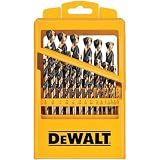
For accurate woodworking, consider a brad-point bit set with common sizes from about 1/16 to 1/2 inch. A small set is a better buy than a large assortment if you only need the sizes used for your screws and hardware.
Bit types compared
| Bit type | Best use in cedar | Trade-off |
|---|---|---|
| Brad-point | Accurate, clean holes in visible boards | Can be damaged by metal; less suitable for masonry or rough demolition work |
| HSS twist | General-purpose pilot holes and hidden work | More likely to skate or leave a ragged entrance |
| Self-centering hinge bit | Centered screw holes in hinge and hardware holes | Limited to its intended hardware and hole sizes |
| Auger bit | Deeper or larger holes in thicker stock | Often excessive for small screw pilots; can grab if pushed hard |
Match the hole to the screw
The pilot hole should be close to the screw’s root diameter—the diameter of the solid core between the threads. In soft cedar, the pilot is generally smaller than the screw’s outside thread diameter, but it should not be so small that the screw forces the board apart. If you can, compare the screw against the bit: the bit should roughly match the screw’s core, with the threads still wider than the hole.
As a starting point, a #8 wood screw often takes a pilot around 7/64 to 1/8 inch in softwood; a #10 often starts around 1/8 to 9/64 inch. Screw design, cedar density, and distance from the edge all matter, so treat these as starting sizes, not rules. For a screw near a board end or edge, use the larger end of the range and test on scrap. For a clearance hole through the top piece of a two-piece joint, choose a bit about as wide as the screw’s shank so the threads pull the lower piece tight instead of separating the boards.
How to drill a clean pilot hole
Mark the hole accurately, then hold the drill square to the surface. A cordless drill is usually the right tool; use its clutch only for driving screws, not drilling. Start the hole at low speed with light pressure, especially with a twist bit. Once the bit has established its position, increase speed steadily. Pushing hard is more likely to bend a small bit, enlarge the hole, or split the wood than to improve the cut.
Match the bit length to the screw’s embedment. The pilot should reach at least as deep as the portion of the screw that enters the receiving board. Put a piece of tape on the bit as a depth mark or use a stop collar. If the hole is too shallow, the screw may bind near the bottom and snap or split the cedar; if it is much too deep, the screw has less wood supporting its threads.
When drilling through a thin board, clamp a scrap block behind it if the back face must stay clean. The backing supports the fibers as the bit exits. For a hole close to an end, stay at least two screw diameters from the edge when the design allows, and drill a pilot rather than relying on the screw to cut its own path.
When a different bit is worth buying
If you are installing hinges or other hardware with countersunk screw holes, a self-centering hinge bit can keep the pilot centered in the hardware opening. It is a convenience tool, not a replacement for a general bit set. For a countersunk screw head in a visible surface, drill the pilot first and use a countersink bit only if the head needs a bevelled seat; over-countersinking can leave a wide, fragile rim in soft cedar.
A hammer drill setting is not appropriate for wood. Keep the hammer action off, and do not use an impact driver to drill delicate pilot holes unless you have a compatible hex-shank bit and can control its speed. An impact driver’s repeated blows are useful for driving fasteners, but they offer little advantage for clean, small holes and can make a bit harder to control. A basic HSS wood drill bit set is enough for many repairs; spend more on brad-point bits if hole placement and appearance matter.
Common mistakes and fixes
If a screw splits cedar, the pilot may be too small, the hole may be too shallow, or the screw may be too close to an edge. Back it out, drill a slightly larger or deeper pilot in a scrap test first, and reduce the drill’s driving torque. If the hole wanders, use a brad-point bit or make a small starter mark with an awl. If the entrance looks fuzzy, check for a dull bit, reduce pressure, and support the exit face when drilling through.
For ordinary concealed work, a sharp twist bit is fine and often the economical choice. For clean, repeatable holes in visible cedar, a brad-point bit is the better purchase. In either case, the right pilot size, controlled drilling, and a test on offcut material matter more than buying an expensive bit.