What's inside
As an Amazon Associate I earn from qualifying purchases. This post may contain affiliate links at no extra cost to you.
What we cover
What you need for hex-head construction screws
Hex-head construction screws are driven with a socket-style bit, not a Phillips or square-drive bit. The right bit fits the screw head closely, stays engaged under impact, and is deep enough to keep the driver from slipping off. For most common structural and exterior construction screws, that means a 1/4-inch hex-shank nut setter. The correct socket size depends on the screw: check its packaging or head dimensions rather than guessing from the screw’s length.
A conventional socket can work in a drill, but an impact driver delivers repeated rotational blows that can wear or split ordinary bits. For regular impact-driver use, choose a nut setter explicitly rated for impact drivers. These are usually made from tougher steel and may have a torsion section intended to flex slightly under load. That does not make them unbreakable, but it can reduce sudden failures compared with a basic hardware-store nut driver.
As an Amazon Associate we earn from qualifying purchases at no extra cost to you.


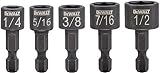
Nut setters, magnetic holders, and socket adapters
A one-piece nut setter is the simplest choice: its hex shank goes into the driver, and its socket fits the screw head. A magnet inside the socket helps retain the screw. This is useful for starting a screw overhead or holding it while positioning a long board, but the magnet does not compensate for a loose-fitting socket. A poor fit can still round the screw’s corners or let the bit slip.
A magnetic bit holder with a separate nut setter gives you more flexibility if you already own compatible 1/4-inch hex bits. It also adds length and another connection, which can wobble or collect debris. A socket adapter lets you use regular sockets, but adds even more length and leverage. That is handy for occasional repairs, not usually the best setup for driving hundreds of fasteners.
For buying, compare impact-rated magnetic nut setter bits against a simple 1/4-inch hex socket adapter. The one-piece bit is generally the better everyday option for construction screws; the adapter makes sense when you need to drive several socket sizes with tools you already have.
Choosing size and length
Match the socket to the screw head exactly. Hex-head construction screws commonly use 1/4-inch, 5/16-inch, or 3/8-inch heads, but standards vary by fastener. A socket that is even slightly oversized can rock on the head. A bit that is too small may not seat fully. Either mismatch raises the chance of rounding the head, especially when the screw binds near the end of the drive.
Short nut setters are compact and resist wobble, making them a good default for open, accessible framing. Long versions reach past a bracket lip, into a recess, or around an obstruction. They also flex more and can wobble, particularly at high speed. Buy the shortest length that reaches the screw squarely. If you routinely work in tight spaces, a longer bit is worth having as a second option rather than using it for every fastener.
Before driving, push the bit fully into the driver’s chuck or collet and check that the screw sits straight in the socket. Start at low speed, then increase speed once the threads have caught. Near the end, ease off the trigger: continuing to hammer after the head is seated can strip the recess, snap the screw, or crush the material under the head.
Which setup makes sense?
| Setup | Best use | Trade-off |
|---|---|---|
| Impact-rated, one-piece nut setter | Frequent driving of one screw-head size | Fast and steady, but each size needs its own bit |
| Magnetic holder and nut setter | Occasional jobs using several bit types | Flexible, but adds a joint that can wobble |
| Socket adapter and standard socket | Infrequent work or using sockets already on hand | Inexpensive, but longer and less stable |
| Deep impact-rated nut setter | Recessed screws or obstructions | Reach improves; leverage and wobble increase |
For a small repair, a set of impact-rated nut setters in common sizes is often cheaper than buying each separately and avoids a mid-job run to the store. If you only drive one size, a single quality bit is usually better value than a large set with sizes you will never use.
Avoiding stripped heads and broken bits
Most problems come from poor fit, a crooked start, or too much trigger pressure—not from a lack of maximum torque. Keep the driver aligned with the screw. If the bit repeatedly jumps, stop and check the socket size, screw head, and whether the fastener is binding. Do not keep hammering a slipping bit; it can round the head quickly and make removal difficult.
Use a pilot hole when the screw maker recommends one, when fastening near the end of a board, or when driving into dense hardwood. The right pilot diameter depends on the screw and material; follow the fastener manufacturer’s guidance rather than applying one drill size to every job. A pilot hole reduces splitting and driving effort, but an oversized hole can weaken the screw’s hold.
Heat and wear are signs to replace a bit. After extended driving, let the bit cool before handling it, and inspect the socket for rounded edges, cracks, or a magnet that no longer holds a screw reliably. A worn bit is more likely to slip and damage fasteners. For occasional DIY use, a basic impact-rated nut setter is usually adequate; premium bits are most worthwhile when you drive many screws, need consistent fit across a long job, or cannot afford repeated failures in hard-to-reach locations.