What's inside
As an Amazon Associate I earn from qualifying purchases. This post may contain affiliate links at no extra cost to you.
Drilling hardened steel is mainly a heat-control problem. A sharp bit can cut through a small hardened fastener or tool, but ordinary high-speed steel bits often lose their edge quickly. For occasional work, a quality cobalt bit is usually the sensible buy. For very hard steel, larger holes, or repeated jobs, carbide can cut faster—but it is brittle and less forgiving of a handheld drill.
As an Amazon Associate we earn from qualifying purchases at no extra cost to you.


What we cover
Identify the steel before buying bits
“Hardened steel” covers a wide range. A hardened bolt may be tough but still drillable; a hardened punch, bearing race, or heat-treated tool can be far harder. If a file skates across the surface rather than biting, expect a slow job and a higher chance of wearing out a bit.
Check first whether the part can be replaced or drilled before hardening. Drilling hardened parts is often the least convenient route. Avoid drilling springs or pressurized parts, and do not drill a part whose failure could cause injury without knowing its material and purpose.
Choose the bit for the job
| Bit type | Best use | Trade-offs |
|---|---|---|
| Cobalt HSS, usually M35 or M42 | Small and medium holes in hardened steel; occasional repair work | Good balance of cost and heat resistance. Can still dull if run fast or allowed to rub. |
| Carbide-tipped masonry bit | Small holes in very hard steel when a cobalt bit will not cut | Can work, but the blunt geometry is less controlled in metal; brittle tip can chip or wander. |
| Solid-carbide bit | Very hard material and repeat production in a rigid setup | Expensive and brittle. A handheld cordless drill is a poor match if the work can move or the bit can bind. |
| Ordinary HSS or black-oxide bit | Soft steel and general household drilling | Cheapest choice, but usually a poor buy for hardened steel; the edge may burn or go dull quickly. |
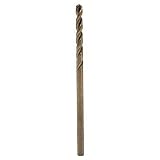
For most buyers, start with a small set of M35 or M42 cobalt drill bits. M42 has more cobalt and better hot hardness, but it costs more and can be more brittle. A good M35 bit is often enough for occasional holes. Look for a clearly stated cobalt grade, not just a gold-colored finish: color alone does not identify the material.
Use a drill that can run slowly
A standard cordless drill is suitable for small holes if it has a low-speed range, a controllable trigger, and a sound chuck. Use the drill setting, not hammer mode. A hammer drill’s impact action is for masonry and can chip a cutting edge or damage the work. An impact driver is also a poor choice: its pulsing torque makes steady pressure and accurate starting harder.
For cobalt bits, start around 100–200 RPM for a 1/4-inch hole in hard steel, and reduce speed as bit diameter increases. The exact workable speed depends on the steel and bit; if the edge squeals, smokes, or turns blue, stop and reassess. A speed chart for mild steel is only a starting point, not a guarantee for hardened stock.
Clamp the work securely in a vise or with clamps. Never hold a small part by hand: if the bit grabs, the part can spin violently. Wear eye protection, keep loose clothing clear, and remove the battery before changing a bit or adjusting the setup.
A reliable drilling sequence
Make a clear starting mark with a center punch if the surface allows it. On a curved or slippery surface, a guide bushing or a carefully placed pilot can help keep the bit from skating. Use a cutting-fluid product intended for metal, or a suitable cutting oil. Lubricant reduces friction and helps carry heat away; it does not make an unsuitable bit work.
For a hole larger than about 1/4 inch, begin with a smaller pilot—often 1/8 inch—and enlarge in steps. Apply firm, steady pressure so the cutting edges make chips, but do not force the drill until it stalls. Every few seconds, ease off to clear chips and add lubricant. Do not let the bit spin against the surface without cutting; rubbing is a common reason the edge loses hardness.
If the bit stops cutting, do not push harder. Let the work cool, inspect the edge, and check that the bit is sharp and the speed is low enough. A dull bit usually polishes or squeals rather than making clean chips. Continuing can work-harden the surface, making the next attempt harder. Replace the bit or switch to a more suitable setup rather than grinding away at the same spot.
When carbide is worth considering
If a sharp cobalt bit at low speed will not form chips, the material may be beyond what a handheld drill can handle reliably. A solid-carbide metal drill bit may be appropriate with a rigid drill press, accurate alignment, and a securely clamped workpiece. Carbide cuts hard material well, but a slight sideways movement or a sudden snag can fracture it. It is not an automatic upgrade for general DIY use.
For an occasional small hole, a carbide-tipped bit may cost less than solid carbide, but results vary with tip shape and steel hardness. If the hole must be accurate, or the part is valuable, a machine shop with suitable tooling may be cheaper than consuming several bits and risking damage.
What to buy—and what to skip
Buy a few commonly used cobalt sizes rather than a large bargain assortment with unclear grades. A split-point tip helps it start with less walking, and a sturdy case protects the edges. If you drill hardened steel only once, one quality bit in the needed size may be a better purchase than a full set. Ordinary HSS bits remain the economical choice for mild steel, wood, and many household jobs; they are not a dependable substitute for cobalt when the steel is truly hardened.