What's inside
As an Amazon Associate I earn from qualifying purchases. This post may contain affiliate links at no extra cost to you.
Drilling mild steel plate is straightforward when the bit, speed, and cutting fluid match the job. It becomes frustrating when a standard hardware-store twist bit is run too fast: the cutting edge overheats, loses its temper, and starts rubbing instead of cutting. For most holes in mild steel, a sharp high-speed steel (HSS) bit is enough. Cobalt HSS bits are the better choice for repeated work, thicker plate, or situations where you cannot keep the bit especially cool.
As an Amazon Associate we earn from qualifying purchases at no extra cost to you.


What we cover
The best bit types for mild steel
| Bit type | Best use | Main advantage | Main drawback |
|---|---|---|---|
| Black oxide HSS twist bit | Occasional holes in thin or medium plate | Low cost and widely available | Overheats quickly if run too fast |
| Titanium-coated HSS | General-purpose drilling with a cordless drill | Lower friction and a harder surface coating | Coating does not repair a dull edge; poor for repeated sharpening |
| Cobalt HSS, usually M35 or M42 | Thicker plate and frequent drilling | Handles heat better and stays sharp longer | More brittle and more expensive |
| Step bit | Thin sheet and larger holes up to its rated size | Makes clean, round holes without changing bits | Not ideal for thick plate or deep holes |
| Annular cutter | Many large holes in thick steel | Fast cutting with less material removed | Requires a compatible magnetic drill or rigid setup |
For a normal drill and a few holes, a black oxide HSS metal drill bit set is the sensible starting point. Choose a set with a 135-degree split point if possible. The split point starts more easily on metal and reduces the tendency to walk across the plate.
When cobalt bits are worth the money
Cobalt bits contain cobalt throughout the HSS rather than merely having a surface coating. M35 cobalt is a common choice for steel; M42 contains more cobalt and generally tolerates more heat, but it is also more brittle. Cobalt is useful when drilling plate around 1/4 inch thick or more, making many holes, or working with a drill that does not offer excellent speed control.
A cobalt bit is not indestructible. Excessive pressure, no lubricant, or a speed that is too high can still burn the cutting edge. It also should not be flexed or used to enlarge an existing hole aggressively. For occasional work in 1/8-inch mild steel, a cheaper HSS bit is usually fine. Spend the difference on cutting oil and a small center punch instead.
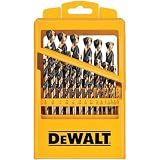
If you want one versatile upgrade, consider a M35 cobalt drill bit set. Avoid confusing titanium nitride coating with cobalt construction. A gold-colored bit may still be ordinary HSS with a thin coating.
Step bits, large holes, and thick plate
Step bits work particularly well in thin sheet steel, electrical boxes, brackets, and automotive panels. They produce clean holes from roughly 1/8 to 1/8-inch material, depending on the bit and the support behind the work. A step bit is also convenient when several hole sizes are needed. Use a metal step drill bit set when convenience matters more than maximum life.
Do not expect a step bit to replace a conventional twist bit in thick plate. Each step has a short cutting edge, and the bit can bind when a large step is buried deep in steel. For holes above about 3/4 inch in thick plate, an annular cutter is faster and puts less load on the drill because it removes a ring rather than the entire center. Annular cutters need a rigid, properly secured machine; they are not a sensible choice in a handheld cordless drill.
Carbide-tipped masonry bits are the wrong tool for ordinary mild steel. Solid carbide metal bits can cut steel, but they are brittle, costly, and poorly suited to a handheld drill. Use them only when the application specifically calls for them.
Use the right speed and cutting fluid
Drill steel slowly. A useful starting point is about 80 to 100 surface feet per minute for ordinary HSS in mild steel. Approximate drill speeds are:
| Bit diameter | Starting speed |
|---|---|
| 1/8 inch | 2,400–3,000 rpm |
| 1/4 inch | 1,200–1,500 rpm |
| 3/8 inch | 800–1,000 rpm |
| 1/2 inch | 600–750 rpm |
These are starting values, not absolute limits. Cobalt bits can tolerate more heat, but slowing down still improves edge life. A cordless drill’s low gear is usually appropriate for bits larger than 1/4 inch. An impact driver can turn hex-shank bits, but its hammering action is unnecessary and can damage the bit or workpiece. Use a regular drill whenever possible.
Apply cutting oil frequently. Sulfurized tapping fluid works well, while ordinary motor oil is better than drilling dry but less effective. For a small hole, a few drops on the cutting edges and another application when the hole deepens are enough. If the oil smokes immediately or the bit turns blue, stop: the edge has been overheated.
A reliable drilling procedure
Clamp the plate securely. Never hold it by hand, especially when the bit is close to breaking through. Mark the hole and make a firm center-punch indentation. For holes larger than about 3/8 inch, drill a pilot hole around 1/8 inch first, then enlarge it. Do not make the pilot hole almost as large as the final hole; the larger bit needs enough material at its cutting edges to bite.
Keep the drill square to the plate and use steady pressure. The bit should produce short, curled chips. Fine dust, squealing, or a polished-looking hole means the bit is rubbing, usually because it is dull, spinning too fast, or being fed too lightly. Near breakthrough, reduce pressure so the bit does not grab and pull the drill forward.
Deburr both sides with a countersink, larger dull bit, or deburring tool. Inspect the hole for a rolled lip or excessive heat discoloration. Replace a bit once sharpening has reduced its diameter or damaged the split point. A sharp, inexpensive HSS bit used at the right speed will outperform an expensive bit abused at high rpm.
Choose the drill to match the bit
A compact cordless drill is adequate for holes up to about 1/2 inch when the plate is thin and the batteries are healthy. For repeated large holes, a corded drill with a side handle provides more sustained power. A hammer drill may be used with the hammer function turned off; its impact mode is for masonry, not steel.
For heavy plate, use a drill with a low-speed range, a secure side handle, and a clutch or mechanical overload protection. Keep loose clothing and gloves away from the rotating bit. The most common failure is not a broken bit but a spinning workpiece, so clamping is part of the tooling—not an optional extra.