What's inside
As an Amazon Associate I earn from qualifying purchases. This post may contain affiliate links at no extra cost to you.
For clean holes in plywood, the hole saw does most of the cutting, but the pilot bit and the way you support the panel decide whether the edges splinter. A sharp hole saw with the right pilot bit is usually a better buy than a premium drill bit paired with a dull saw. Choose the pilot by the saw’s arbor, plywood thickness and whether both faces need to look clean.
As an Amazon Associate we earn from qualifying purchases at no extra cost to you.
What we cover
What the pilot bit does
The pilot bit keeps the hole saw centered and helps prevent it from wandering when the teeth first touch. Most hole-saw arbors accept a standard twist-drill pilot, commonly 1/4 inch, though the arbor’s instructions take priority. Check the shank diameter and usable length before buying; a bit that is too short may not extend beyond the saw teeth, while excessive extension can flex or snag.
For ordinary plywood, a sharp high-speed-steel (HSS) twist bit is usually adequate. A brad-point bit has a center spur that can start neatly in wood, but it may not fit every arbor, and its wider cutting edges provide little benefit once the hole saw is engaged. Don’t assume that a wood-boring bit will fit just because its diameter looks right.
Choose a bit by the job
| Bit type | Best use | Trade-off |
|---|---|---|
| Standard HSS twist bit | General-purpose hole-saw pilot; affordable and widely available | Can wander if dull or started without a firm center point |
| Brad-point bit | Wood-only work where a precise pilot start matters | May not suit the arbor; not necessary for most hole-saw cuts |
| Long pilot bit | Thick panels or setups where the standard bit does not reach far enough | More leverage means more chance of bending or catching |
| Carbide-grit hole saw | Abrasive or coated sheet goods where a toothed saw wears quickly | Often cuts more slowly in plywood; check that it is intended for wood |
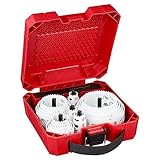
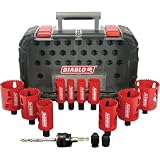
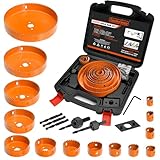
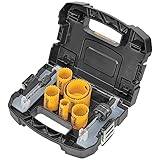
For a replacement, search for a hole-saw pilot drill bit replacement that matches the arbor, not simply the hole-saw diameter. If you are buying a complete setup, a wood hole-saw kit with an arbor and pilot bits can be economical for occasional work. Inspect the kit for the sizes you actually need and whether spare pilots are included.
Reduce tear-out on both faces
Plywood’s cross-grain veneers can chip where the saw exits. Clamp the panel firmly to a sacrificial backer board, with the backer in direct contact with the plywood. The backer supports the exit face and gives the saw somewhere to cut after it passes through. Use clamps clear of the saw’s path, and make sure the panel cannot rotate or lift.
For the cleanest visible edges, drill from one face until the pilot just breaks through the opposite face. Stop, turn the panel over, place the pilot in the small exit hole and finish from the other side. This takes longer, but it avoids asking the teeth to tear through the final veneer unsupported. If only one face matters, cut from that face and use a backer behind the sheet.
Masking tape over the cut line can help hold fragile surface fibers, but it is not a substitute for backing. On veneered plywood, test the method on scrap from the same sheet: surface quality varies, and tape adhesive can pull up a weak finish.
Use controlled speed and feed
Use a drill with a side handle for large hole saws, especially above roughly 2 inches. A hole saw can bind suddenly in plywood, twisting the drill and your wrist. Keep the drill square to the panel, use a steady two-handed grip and do not use hammer mode. An impact driver is a poor choice: its pulsing action makes a hole saw harder to control and can loosen or damage the arbor connection.
Start slowly until the saw has formed a complete groove, then use a moderate speed and light, even pressure. Avoid forcing the saw: a hot, burning cut usually means the teeth are dull, the speed or pressure is excessive, or packed chips are rubbing inside the kerf. Withdraw the saw periodically to clear chips. If the drill bogs down, release the trigger rather than leaning harder.
For a typical 2- to 3-inch hole saw in plywood, a drill’s low gear is often the safer choice. Follow the saw maker’s speed guidance where available; tooth design and diameter vary. Larger saws generally need slower speed. A clutch can reduce the risk of a hard bind, but do not rely on it as a substitute for a secure grip.
Common problems and fixes
Ragged exit edge: add a tight-fitting backer or cut halfway from each face. Hole wanders: check that the pilot is straight and sharp, tighten the arbor, and begin with light pressure. Burning or slow cutting: clear chips and inspect the teeth for resin, wear or missing cutters. Hole saw jams: stop the drill, disconnect its battery before clearing the cut, and remove the plug with a tool rather than putting fingers near the teeth.
For a one-off hole in thin plywood, a basic HSS pilot bit that fits your arbor is usually enough. Spend extra on a better hole saw or a replacement pilot only when you cut often, work with thick panels, or need consistently clean edges. Keep the saw and pilot aligned, support the exit face and let the teeth cut without forcing them.