What's inside
As an Amazon Associate I earn from qualifying purchases. This post may contain affiliate links at no extra cost to you.
What we cover
The short answer
For drilling a few holes in ordinary concrete block, a carbide-tipped masonry bit in a hammer drill is usually the right choice. “Masonry bit” describes the bit’s broad purpose; “concrete bit” is often a label for a tougher masonry bit, not a completely different kind. Check the shank and the drill’s chuck before buying: a bit that fits an SDS-plus rotary hammer will not fit a standard three-jaw chuck without an adapter, and adapters are usually a poor choice for hammer drilling.
Block walls vary. The face shells are relatively thin, while the webs and cores may be hollow or filled with grout. A bit that works well in solid concrete may break through a block face too aggressively, enlarge the hole, or punch into a void. Match the bit and drilling mode to the wall and the anchor, not just the label on the package.
As an Amazon Associate we earn from qualifying purchases at no extra cost to you.



What the names mean
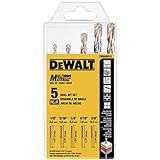
A typical masonry bit has a carbide tip and a steel shank. The carbide cuts brittle material such as concrete, mortar, and masonry block; the spiral flutes carry dust out of the hole. Many general-purpose versions have a relatively narrow tip and are intended for occasional holes in brick or block.
Bits sold as concrete bits may have a more durable carbide head or geometry intended for repeated drilling in harder aggregate. The naming is not standardized, though, so compare the bit’s stated materials, diameter, length, and shank rather than relying on the word “concrete.” A reinforced or multi-cutter head can improve wear resistance, but it cannot make a basic cordless drill behave like a rotary hammer.
For occasional DIY work in hollow block, a basic carbide-tipped masonry bit set is often the economical option. Replace a bit that is blunt, chipped, or visibly bent; forcing it through the wall can produce an oversized hole and a loose anchor.
Masonry bits and concrete bits compared
| Feature | General masonry bit | Heavy-duty concrete bit |
|---|---|---|
| Best fit | A few holes in block, brick, or mortar | Repeated holes or harder, abrasive concrete |
| Typical tip | Carbide tip, often a simple cutting edge | Carbide head may be tougher or more wear-resistant |
| Common drill pairing | Hammer drill; sometimes a standard drill at low speed in softer masonry | Hammer drill or compatible rotary hammer, depending on shank |
| Trade-off | Lower cost; wears faster in hard material | Higher cost; may be unnecessary for a small block-wall job |
| What the label cannot tell you | Whether the shank fits your drill, or whether the bit is suitable for your anchor and hole depth | |
Choose the drill to match the wall
A standard drill rotates the bit but does not provide hammering action. It can drill some softer block, especially with a sharp bit and light pressure, but progress may be slow. A hammer drill adds rapid, short impacts while rotating. It is a practical choice for typical small anchor holes in block.
A rotary hammer delivers a stronger impact through an SDS bit and is useful for many holes, larger diameters, or hard concrete. For a handful of small holes in a block wall, renting or buying one may not be worth the cost. For a larger job, a compatible cordless hammer drill and masonry bits can save time. Don’t assume an impact driver is a substitute: its impacts are rotational, not the forward blows used by a hammer drill.
Use the correct shank for the tool. Standard round or hex shanks fit many three-jaw chucks; SDS-plus bits fit SDS-plus rotary hammers. A conventional masonry bit held in an SDS chuck may require a chuck adapter, but that setup loses the advantage of an SDS bit and can introduce wobble. Use it only where the tool and adapter manufacturer permits it.
Drill block without damaging the hole
First check for wiring and plumbing, and mark the hole location. Avoid drilling close to a block edge or mortar joint unless the anchor instructions allow it. The face shell can be thin, so put the drill square to the wall and start slowly. Once the tip is established, use steady pressure rather than leaning your full weight on the drill.
Use hammer mode for hard block if your drill has it, but consider switching hammer action off for a fragile face shell or a hole near an edge. Too much impact can chip the surface or make the opening wider than the anchor needs. If the bit suddenly breaks through into a hollow core, ease off instead of pushing harder. Stop at the anchor’s specified embedment depth; a depth stop or tape on the bit helps prevent drilling too far.
Clear dust from the hole before installing the anchor. Dust left inside can prevent a sleeve or expansion plug from seating fully. Follow the anchor maker’s specified bit diameter and hole depth: even a small mismatch can matter. For example, an anchor calling for an 8 mm hole needs a bit that actually measures 8 mm, not a nearby imperial size chosen by eye.
Match the hole to the anchor
In hollow block, the anchor’s design matters as much as the bit. A plastic plug may work for a light-duty fastening in the face shell, but it is not automatically suitable for a heavy shelf or a load that could pull outward. Use an anchor rated for hollow masonry and the expected load; some toggle-style anchors grip behind the shell, while other systems are intended for grouted or solid masonry. Follow the maker’s load limits and installation instructions.
For a small number of light-duty holes, the least expensive sound carbide bit is often enough. Spend more for a tougher concrete bit when you are drilling repeatedly, working in unusually hard or abrasive material, or finding that ordinary bits dull quickly. If progress stalls, check for a worn bit, a wrong drill mode, or an unexpected hard inclusion before applying more force. Heat, a slipping chuck, a wandering hole, and chipped block are signs to stop and reassess—not reasons to press harder.