What's inside
As an Amazon Associate I earn from qualifying purchases. This post may contain affiliate links at no extra cost to you.
Fastening deck screws near a board edge is less forgiving than driving into the middle of a joist. The bit must stay seated while the screw enters at a controlled angle, and the driver must not twist the screw sideways. A poor bit can cam out, strip the recess, or leave a screw head proud when you are working close to a corner.
As an Amazon Associate we earn from qualifying purchases at no extra cost to you.


What we cover
Choose impact-rated bits first
For an impact driver, use impact-rated deck screw bits with a 1/4-inch hex shank. These bits are made to flex slightly under the repeated torsional blows from an impact mechanism. Standard brittle bits may work for a few screws, but they are more likely to twist, snap, or wear quickly.
Impact-rated does not automatically mean better for every drill. In a cordless drill or hammer drill used with the hammer function switched off, a quality standard bit can be perfectly adequate. The important features are the correct recess size, a precise tip, and enough torsional strength for the screw and material.
Most exterior wood screws use a Torx-style recess, commonly T20 or T25. Check the screw package rather than guessing. A T25 bit forced into a T20 recess may appear to fit but will wobble and round the socket. A T20 in a T25 screw will usually bottom out before the flutes engage fully. Either mistake increases cam-out, especially near an edge.
Bit length and holder choice
A 2-inch bit is usually the best starting point for deck work. It gives your hand and the driver chuck enough clearance from the board while keeping the bit relatively stiff. Short insert bits in a magnetic holder are compact, but the holder adds another connection that can wobble under side pressure.
| Setup | Best use | Advantages | Drawbacks |
|---|---|---|---|
| 1-inch insert bit and holder | Open access and straight driving | Cheap, easy to replace, compact | More play; holder can collect chips |
| 2-inch impact bit | Most deck-screw work | Good clearance and control | Costs slightly more than inserts |
| 6-inch impact bit | Recessed or obstructed fasteners | Reaches around trim and tight corners | More flex and leverage if held crooked |
| Magnetic bit holder with guide sleeve | Repeated production driving | Fast bit changes; helps retain screws | Can hide poor alignment and add wobble |
For ordinary framing, buy several matching 2-inch bits instead of relying on one worn bit. A fresh bit is often cheaper than a replacement screw or a damaged deck board. A magnetic holder is convenient when loading screws one-handed, but it should not be used as a substitute for keeping the driver in line with the fastener.
How to drive near a board edge
Set the screw location before picking up the driver. As a practical rule, keep the screw center at least 3/4 inch from the side edge of a typical 5/4 decking board. Stay farther in if the board is narrow, brittle, dry, or close to its end. The exact spacing depends on the screw manufacturer and the board dimensions, so follow the decking and fastener instructions where they are more restrictive.
Hold the bit directly in line with the screw. Even a small sideways angle creates a cam-out force. Start the driver slowly until the threads bite, then increase speed while maintaining firm pressure. With an impact driver, use short trigger pulls near the final depth rather than holding the trigger wide open.
Stop when the head is flush with the decking surface, or at the depth specified for the screw. Do not routinely bury the head deep into the wood. Overdriving removes material around the head, weakens the surface, and can leave a funnel that collects water. Near an edge, overdriving also makes splitting more likely.
If the screw starts walking toward the edge, stop immediately. Back it out and try again rather than forcing it sideways. A screw that exits the side of the board may not be visible until the deck moves or the edge breaks away.
When predrilling is worth the time
Predrilling is the most reliable way to reduce splitting near an edge, especially in cedar, redwood, dry pressure-treated lumber, composite trim, and cold-weather work. Use a drill bit sized for the screw’s shank, not its outside thread diameter. The clearance hole should let the smooth shank pass while the threads still bite into the joist below.
For a screw entering a hardwood or a board end, drill a pilot hole through the decking and into the supporting member. A hole depth slightly longer than the screw’s threaded section helps clear chips. Do not use a large bit simply to make driving easier; an oversized pilot hole can reduce holding power.
A combination countersink bit can drill the pilot hole and form a clean recess in one operation. This is useful when the screw head must sit consistently flush, but it adds cost and requires changing tools or bits. For a small repair, a regular pilot bit and careful driving are usually enough.
What to buy for a typical deck
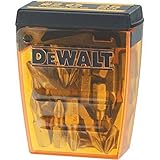
For most homeowners, the sensible kit is a set of 2-inch impact-rated T25 bits, plus the correct T20 size if the screws call for it. Look for a torsion-zone design and a tip that fits the recess without noticeable rocking. A multi-pack is worthwhile because bits wear gradually and become difficult to distinguish from good ones by appearance alone.
If you use a drill rather than an impact driver, a less expensive set of standard hardened bits is fine for occasional work. The cheaper option is also reasonable when you are driving a few dozen screws into softwood with a clutch-controlled drill. Spend more on impact-rated bits when you are installing hundreds of fasteners, using an impact driver at high torque, or working with dense lumber.
Keep a deck screw pilot and countersink bit set nearby for edge locations and end-grain work. The right bit cannot compensate for a screw placed too close to the edge, excessive driver speed, or a board that is already split. Good spacing, a straight grip, moderate depth, and a sharp bit prevent most failures before they happen.