What's inside
As an Amazon Associate I earn from qualifying purchases. This post may contain affiliate links at no extra cost to you.
A folding shelf puts more stress on drywall anchors than a picture frame does. Its brackets hold the shelf away from the wall, so weight on the front edge creates leverage that tries to pull the fasteners out. Choose anchors for the shelf’s loaded weight, bracket layout and wall construction—not just the shelf’s advertised capacity.
As an Amazon Associate we earn from qualifying purchases at no extra cost to you.


What we cover
Check the wall and shelf first
Find out whether the mounting points can land on studs. A stud finder helps, but confirm suspected stud locations with a small pilot hole or by checking for consistent resistance. If brackets line up with wood studs, use suitable structural screws into the studs rather than relying on drywall anchors. A folding shelf may have several brackets; even one bracket screwed into a stud can improve the installation, but follow the shelf maker’s mounting instructions.
For hollow drywall, measure its thickness and check for obstructions behind the mounting area. Many homes have 1/2-inch drywall, while some walls use 5/8-inch board. Also check how many fasteners each bracket requires and whether the bracket holes accept the anchor’s screw. Do not assume the shelf’s stated capacity applies to anchors in drywall; that rating may depend on the wall type and mounting hardware.
Compare common hollow-wall anchors
| Anchor type | Typical advantage | Trade-off for a folding shelf |
|---|---|---|
| Self-drilling plastic anchor | Cheap and quick to install; often needs no pilot hole. | More vulnerable to pull-out and movement under leverage. Best for light loads, not a heavily used shelf. |
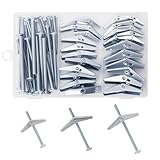
| Metal hollow-wall toggle | Spreads load behind the drywall; useful when there is a cavity behind the mounting point. | Needs a larger hole, and the toggle can fall into the wall if its bolt is removed before the anchor is secured. |
| Strap-style toggle | Broad bearing surface and a controlled installation; commonly available for different drywall thicknesses. | Costs more and requires a hole sized to the specific anchor. Installation can be awkward in tight spaces. |
| Molly bolt | Expands behind the board and can provide a firm, permanent fixing. | Requires the right pilot hole and proper setting. A poorly set molly may spin or fail to clamp the wall. |
For a shelf that will carry books, dishes or tools, a toggle-style anchor is generally a better choice than a basic plastic anchor when studs are unavailable. Compare hollow-wall toggle anchors by their stated drywall thickness range, screw size and load rating. Ratings differ by product and test conditions; use the manufacturer’s instructions rather than treating one number as universal.
Choose for the real load
Estimate the shelf’s total loaded weight, including the shelf itself. Then account for where that weight sits: items near the front edge create more leverage than the same items placed against the wall. A folding shelf may also see downward tugs when people lean on it or lift it into position. Do not size anchors for an occasional light object if the shelf will be used as a work surface.
Use the anchor maker’s published working-load guidance for your exact drywall thickness, and keep a margin below its maximum rating. The weakest part of the installation governs: drywall can crush or tear around an anchor, screws can loosen, and a bracket can bend. Several anchors do not necessarily share load evenly, especially if the wall or bracket is uneven. For heavier or frequently loaded shelves, find studs, add a mounting board secured to studs, or choose another mounting location.
Plastic anchors remain reasonable for a small, lightly loaded shelf with little leverage, provided the anchor is rated for the board and screw being used. They are inexpensive and easy to remove, but they are not the budget choice for a shelf that may be pulled down or loaded at its outer edge.
Install carefully to avoid common failures
Mark every bracket hole with the shelf folded and unfolded, and verify the shelf clears nearby doors or cabinets. Use a level. Check each mark for studs, wiring and plumbing before drilling. If using a toggle, make sure the cavity is clear and deep enough for its wings or strap; a pipe or blocking behind the board can prevent it from opening.
Drill the diameter specified by the anchor manufacturer. A hole that is too large lets the anchor shift; one that is too small can damage the drywall or stop a toggle from passing through. Use a drill bit suitable for drywall and proceed without hammer mode. A cordless drill is usually easier to control than an impact driver for this work. Do not force the anchor or overtighten the screw: crushing the paper face or spinning an anchor in the hole weakens the fixing.
For strap-style toggles, insert and set the anchor as directed before snapping off the excess strap. For metal toggles, keep the wings from turning while tightening. With a molly bolt, use the recommended setting tool if required. If an anchor spins, the hole is damaged, or the drywall face pulls away, stop and relocate the fastener or repair the wall. Do not keep tightening in the hope that it will hold.
What to buy
For most hollow-drywall folding shelves with a meaningful load, start with strap-style toggle anchors sized for your drywall and bracket screws. Buy enough for every required hole, plus a spare or two. If the manufacturer specifies a particular fastener type, follow that specification. A metal molly anchor is another option when its setting method suits the wall and bracket.
Before ordering, confirm the anchor’s minimum and maximum wall thickness, required hole diameter, screw length and stated load conditions. A larger-looking anchor is not automatically stronger if it cannot clamp the drywall correctly. When the shelf will carry substantial weight or people may lean on it, mount into studs or use a stud-secured backing board instead of asking hollow drywall to take the load.