We research everything we recommend. When you buy through our links, we may earn a commission. As an Amazon Associate we earn from qualifying purchases.
Best Dust Collectors for Woodworking Shops in 2026
Compare the best dust collectors for woodworking shops, from portable 660 CFM units to 2 HP canister collectors, wall mounts, and fine filtration picks.
1. WEN DC1300 Woodworking Dust Collector — The Best All-Round Dust Collector
Best for: Table saws, planers, and jointers in a general shop
Power: Standard 120-volt household circuit
The WEN DC1300 earns its place as the best all-round dust collector because it gives a buyer 1,300 CFM, dual inlets, a 50-gallon bag, and a mobile base, at the mid-range tier. It is the strongest airflow-per-dollar figure in this lineup, and the only collector here that keeps two machines plumbed in at once. It filters at 5 microns, which is the coarsest class here, and a buyer who sands fine stock daily should weigh that against the JET canister pick. A buyer who wants one collector for most shop machines should start here.
Motor: 14-amp motor, 10-inch steel impeller at up to 3,450 RPM
Airflow: 1,300 CFM maker rating
Inlets: Dual 4-inch inlets for two machines at once
2. WEN DC3401 Rolling Dust Collector — The Best Portable Dust Collector
Best for: Benchtop machines and one-tool-at-a-time shops
Power: Standard 120-volt household circuit
Warranty: 2-year
The WEN DC3401 earns its place as the best portable dust collector because it gives a buyer 660 CFM, a 12-gallon bag, a 17-pound body with a handle, and an optional wall mount, at the budget tier. It is the lightest and most portable collector here, and the easiest on the shop wiring. It is not a planer collector, and a buyer who mills a lot of stock should look at the WEN DC1300. A buyer who wants a collector that carries to the work and stores out of the way should start here.
Motor: 5.7-amp motor, 6-inch impeller at 4,500 RPM
3. POWERTEC DC5372 Portable Dust Collector — The Best Fine-Filtration Budget Pick
Best for: Small shops and fine-dust work with one machine at a time
Power: Standard 120-volt household circuit
The POWERTEC DC5372 earns its place as the best fine-filtration budget pick because it gives a buyer a 1-micron reusable bag, a 1 HP induction motor, a 4-inch inlet with a grate, and a caster-mounted base, at the budget tier. It is the finest filtration in this guide. It is the lowest airflow here, and a buyer who needs volume should look at the WEN DC1300. A buyer who wants the cleanest air at the budget tier should start here.
Motor: 1 HP induction motor, 12-amp draw, 3,450 RPM
Airflow: 560 CFM maker rating
Inlet: 4-inch inlet port with built-in grate
Filtration: 1-micron reusable bag with dust-level window and zipper
1. WEN DC1300 Woodworking Dust Collector — The Best All-Round Dust Collector
Best for: Table saws, planers, and jointers in a general shop
Power: Standard 120-volt household circuit
The WEN DC1300 earns its place as the best all-round dust collector because it gives a buyer 1,300 CFM, dual inlets, a 50-gallon bag, and a mobile base, at the mid-range tier. It is the strongest airflow-per-dollar figure in this lineup, and the only collector here that keeps two machines plumbed in at once. It filters at 5 microns, which is the coarsest class here, and a buyer who sands fine stock daily should weigh that against the JET canister pick. A buyer who wants one collector for most shop machines should start here.
Motor: 14-amp motor, 10-inch steel impeller at up to 3,450 RPM
Airflow: 1,300 CFM maker rating
Inlets: Dual 4-inch inlets for two machines at once
2. WEN DC3401 Rolling Dust Collector — The Best Portable Dust Collector
Best for: Benchtop machines and one-tool-at-a-time shops
Power: Standard 120-volt household circuit
Warranty: 2-year
The WEN DC3401 earns its place as the best portable dust collector because it gives a buyer 660 CFM, a 12-gallon bag, a 17-pound body with a handle, and an optional wall mount, at the budget tier. It is the lightest and most portable collector here, and the easiest on the shop wiring. It is not a planer collector, and a buyer who mills a lot of stock should look at the WEN DC1300. A buyer who wants a collector that carries to the work and stores out of the way should start here.
Motor: 5.7-amp motor, 6-inch impeller at 4,500 RPM
3. POWERTEC DC5372 Portable Dust Collector — The Best Fine-Filtration Budget Pick
Best for: Small shops and fine-dust work with one machine at a time
Power: Standard 120-volt household circuit
The POWERTEC DC5372 earns its place as the best fine-filtration budget pick because it gives a buyer a 1-micron reusable bag, a 1 HP induction motor, a 4-inch inlet with a grate, and a caster-mounted base, at the budget tier. It is the finest filtration in this guide. It is the lowest airflow here, and a buyer who needs volume should look at the WEN DC1300. A buyer who wants the cleanest air at the budget tier should start here.
Motor: 1 HP induction motor, 12-amp draw, 3,450 RPM
4. JET DC-1100VX-CK Vortex Cone Dust Collector — The Best Canister Dust Collector
Best for: Fine sanding dust, MDF, and long sessions on household power
Power: 115 or 230 volts, prewired 115 volts on a 20-amp circuit
Warranty: 5-year
The JET DC-1100VX-CK earns its place as the best canister dust collector because it gives a buyer a 2-micron canister, a Vortex Cone that keeps the filter clear, 1,100 CFM on 115-volt power, and a five-year warranty, at the premium tier. It is the finest sustained filtration in this guide. It serves one machine at a time through a single inlet, and a buyer who needs two machines plumbed in should look at the WEN DC1300. A buyer who wants the cleanest air through long sessions should start here.
Motor: 1.5 HP continuous-duty motor, 11-inch steel impeller
5. SHOP FOX W1666 Dust Collector — The Best High-Volume Dust Collector
Best for: Permanent ducted systems with planers and jointers
Power: 220-volt single-phase power, dedicated circuit required
Warranty: 2-year
The SHOP FOX W1666 earns its place as the best high-volume dust collector because it gives a buyer a 2 HP motor, 1,550 CFM of airflow, a two-bag setup, and a mobile base, at the premium tier. It is the most powerful collector here. It needs 220-volt power and a permanent home, and a buyer without either should look at the WEN DC1300 or the JET DC-1100VX-CK. A buyer who runs a ducted system and needs volume above all else should start here.
Motor: 2 HP single-phase motor, 12-amp draw at 220 volts, 3,450 RPM
Airflow: 1,550 CFM maker rating
Filtration: Two-bag setup with upper filter bag and lower collection bag
As an Amazon Associate I earn from qualifying purchases. This post may contain affiliate links at no extra cost to you.
⭐ Key Takeaways
Quick answer: Our top pick is WEN DC1300 Woodworking Dust Collector — The Best All-Round Dust Collector, with WEN DC3401 Rolling Dust Collector — The Best Portable Dust Collector as a strong alternative.
A dust collector is the machine that decides whether a woodworking shop stays usable or slowly fills with chips and fine dust. A table saw, a planer, and a jointer throw chips faster than any broom can keep up with, and a sander fills the air with fine dust that settles on the work and on the tools. The five dust collectors in this guide are all sold on Amazon and built for real shop work, and they differ the way buyers actually feel the difference: in the airflow that decides how much material the collector pulls away from the tool, in the filtration that decides how much fine dust goes back into the room, in the form that decides whether the unit rolls between machines or hangs on a wall, in the power that decides whether the unit runs on a standard household circuit or needs a dedicated 220-volt line, and in the bag or canister that decides how often the collector needs emptying. This guide compares five dust collectors on airflow, filtration, form factor, power, and collection capacity, using each maker’s published specifications and the Amazon listing for each product.
The short answer is that the WEN DC1300 Woodworking Dust Collector is the best all-round dust collector here, a 14-amp unit rated at 1,300 CFM with dual 4-inch inlets and a 50-gallon vertical collection bag, for buyers who want one collector that serves a table saw and a planer at the same time. The WEN DC3401 Rolling Dust Collector is the portable pick, a 5.7-amp unit rated at 660 CFM with a 12-gallon bag and a 17-pound body, for buyers who work with one benchtop machine at a time and want to carry the collector to the work. The POWERTEC DC5372 Portable Dust Collector is the fine-filtration pick, a 1 HP unit rated at 560 CFM with a reusable 1-micron bag, for buyers who want the finest filtration in the budget tier. The JET DC-1100VX-CK Vortex Cone Dust Collector is the canister pick, a 1.5 HP unit rated at 1,100 CFM with a 2-micron canister filter and a Vortex Cone, for buyers who want sustained airflow and fine filtration on standard household power. The SHOP FOX W1666 Dust Collector is the high-volume pick, a 2 HP unit rated at 1,550 CFM on 220-volt power, for buyers who run a permanent ducted system with a planer and a jointer.
As an Amazon Associate, we earn from qualifying purchases.
Tier key: the JET DC-1100VX-CK Vortex Cone Dust Collector and the SHOP FOX W1666 Dust Collector sit in the premium tier of this group, the WEN DC1300 Woodworking Dust Collector sits in the mid-range, and the WEN DC3401 Rolling Dust Collector and the POWERTEC DC5372 Portable Dust Collector sit in the budget tier. Tier here describes where each collector sits in this lineup on airflow, filtration class, and build, not a promise about what any seller charges on a given day.
Airflow is the first number to read, because it decides which machines a collector can serve and how much material it pulls away from the cut. Airflow is rated in cubic feet per minute, and the maker’s figure is measured at the inlet with no hose attached, so the airflow at the tool is always lower once hose length, bends, and blast gates take their share. The ratings in this guide run from 560 CFM on the POWERTEC DC5372 to 1,550 CFM on the SHOP FOX W1666. A benchtop sander or a small band saw needs only a few hundred CFM at the tool, a table saw or a miter saw needs a mid-range collector in the 600 to 800 CFM class, and a planer or a jointer, which throws heavy chips in a wide stream, needs a collector rated at 1,000 CFM or more.
The practical rule is to match the collector to the hungriest machine it will serve, not to the average machine. A 660 CFM portable unit like the WEN DC3401 keeps up with one benchtop machine at a time, and it does that job well, but it will leave chips behind if it is asked to serve a full-size planer through a long hose run. A 1,300 CFM unit like the WEN DC1300 has the volume to serve a planer and still pull from a table saw on the second inlet, and a 1,550 CFM unit like the SHOP FOX W1666 has the volume for a ducted run to several machines. Hose length matters as much as the rating: short, straight runs and blast gates that close off the machines not in use are the cheapest airflow a buyer can get.
Filtration: microns, bags, and canisters
Filtration is the second decision, and it decides what happens to the fine dust the collector cannot see. A dust collector pulls chips and dust into a bag or a canister, and the filter medium decides which particle sizes pass through and go back into the shop air. The ratings in this guide run from a 5-micron bag on the two WEN units to a 1-micron bag on the POWERTEC DC5372 and a 2-micron pleated canister on the JET DC-1100VX-CK. A smaller micron number means finer filtration, which means less fine dust returning to the room.
Bag filters and canister filters work differently over a long session. A cloth bag filter, like the ones on the WEN DC1300, the WEN DC3401, the POWERTEC DC5372, and the SHOP FOX W1666, is simple, cheap to replace, and easy to empty, but its pores load with fine dust as the session goes on, and airflow falls as the bag loads. A pleated canister filter, like the one on the JET DC-1100VX-CK, has far more surface area in the same footprint, so it loads more slowly, holds airflow longer, and captures finer particles, and it cleans with a turn of a handle instead of a shake-out. The JET also adds a Vortex Cone below the filter chamber, which drops heavy chips into the lower bag before they reach the canister. A buyer who sands fine stock daily or works with MDF should weigh filtration as heavily as airflow.
Form factor: portable, wall-mount, and floor-standing
Form factor is the third decision, and it is about where the collector lives and how it moves. A portable collector, like the WEN DC3401 at 17 pounds with a carrying handle, rolls or carries to the machine in use, which suits a buyer who works with one benchtop tool at a time and stores the collector on a shelf between sessions. A mobile floor-standing collector, like the POWERTEC DC5372 on casters and the WEN DC1300 on a mobile base with four swivel casters, parks beside a machine and rolls between stations. A wall-mount collector hangs on a bracket and frees the entire floor footprint, which suits a small shop where floor space is the scarcest resource, and the WEN DC3401 includes an optional wall mount for exactly that use.
The choice is also about the ducting plan. A portable or mobile collector connects through a short flexible hose to one machine at a time, which suits a shop where the machines move. A floor-standing collector with dual inlets, like the WEN DC1300, keeps two machines plumbed in at once, which suits a shop where the table saw and the planer sit side by side. A high-volume collector like the SHOP FOX W1666 suits a permanent ducted system, where duct runs overhead to several machines with a blast gate at each drop. Before ordering, measure the floor space, the wall space, and the distance from the collector to the farthest machine, because a collector that does not fit the shop will not get used.
Power: household circuits and 220-volt lines
Power is the fourth decision, and it is the one that can stop an installation before it starts. Three of the collectors in this guide run on standard 120-volt household power: the WEN DC3401 on a 5.7-amp draw, the POWERTEC DC5372 on a 12-amp draw, and the WEN DC1300 on a 14-amp draw. The JET DC-1100VX-CK runs on 115 or 230 volts and arrives prewired for 115 volts on a 20-amp circuit, with the option to rewire for 230 volts. The SHOP FOX W1666 runs on 220-volt single-phase power only, with a 12-amp draw at 3,450 RPM, which means it needs a dedicated 220-volt circuit, and a buyer without one will need an electrician before the collector runs at all.
The circuit matters as much as the voltage. A 14-amp collector on a 15-amp shared circuit will trip the breaker if a second tool shares the same circuit, so a buyer should know which outlets share a breaker before ordering. A 12-amp collector is safer on a shared circuit, and a 5.7-amp collector is the easiest of all, which is part of why the WEN DC3401 suits a garage shop with limited wiring. Check the breaker panel before ordering, and remember that a collector should never share a circuit with the machine it serves if the combined draw exceeds the breaker.
Collection capacity: bags, drums, and emptying
Collection capacity is the fifth decision, and it decides how often the work stops for emptying. The capacities in this guide run from a 12-gallon bag on the WEN DC3401 to a 50-gallon vertical bag on the WEN DC1300. A planer fills a small bag in a single session, because it removes a thick shaving from every board, while a sander fills the same bag slowly. A buyer who planes a lot of stock should treat bag capacity as a headline feature, because a 12-gallon bag on a planer means stopping to empty the bag in the middle of a run, and a 50-gallon bag means finishing the run first.
Emptying matters too. A bag with a zipper and a window, like the POWERTEC DC5372, lets the buyer see the fill level and empty the bag without shaking dust back into the air, and quick-release clamps make bag swaps fast. A canister unit like the JET DC-1100VX-CK separates the job: the lower bag holds the chips and empties like a normal bag, while the canister on top cleans with a handle turn and rarely needs removal. Before ordering, check how the bag attaches and whether spare bags are easy to buy, so a full bag never stops the work.
The 5 Best Dust Collectors
1. WEN DC1300 Woodworking Dust Collector — The Best All-Round Dust Collector
Top Pick
1. WEN DC1300 Woodworking Dust Collector — The Best All-Round Dust Collector
Best for: Table saws, planers, and jointers in a general shop
Power: Standard 120-volt household circuit
The WEN DC1300 earns its place as the best all-round dust collector because it gives a buyer 1,300 CFM, dual inlets, a 50-gallon bag, and a mobile base, at the mid-range tier. It is the strongest airflow-per-dollar figure in this lineup, and the only collector here that keeps two machines plumbed in at once. It filters at 5 microns, which is the coarsest class here, and a buyer who sands fine stock daily should weigh that against the JET canister pick. A buyer who wants one collector for most shop machines should start here.
Motor: 14-amp motor, 10-inch steel impeller at up to 3,450 RPM
Airflow: 1,300 CFM maker rating
Inlets: Dual 4-inch inlets for two machines at once
Table saws, planers, and jointers in a general shop
Power: Standard 120-volt household circuit
The WEN DC1300 earns its place as the best all-round dust collector because it gives a buyer 1,300 CFM, dual inlets, a 50-gallon bag, and a mobile base, at the mid-range tier. It is the strongest airflow-per-dollar figure in this lineup, and the only collector here that keeps two machines plumbed in at once. It filters at 5 microns, which is the coarsest class here, and a buyer who sands fine stock daily should weigh that against the JET canister pick. A buyer who wants one collector for most shop machines should start here.
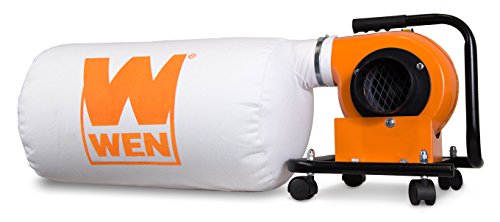
The WEN DC1300 Woodworking Dust Collector is the best all-round dust collector in this guide, and the combination of 1,300 CFM of airflow, dual 4-inch inlets, and a 50-gallon vertical collection bag is the reason to buy it. It is a floor-standing single-stage collector with a 14-amp motor that spins a 10-inch steel impeller at up to 3,450 RPM, and the maker rates it at 1,300 CFM, which is the highest airflow in this guide short of the 220-volt SHOP FOX. The dual 4-inch inlets are the detail that makes it the best all-round pick: a table saw can stay plumbed into one port while a planer waits on the other, and the buyer switches between them by opening one blast gate and closing the other, instead of dragging a hose across the shop.
The 50-gallon vertical bag is the other half of this collector. It holds a long run of planer shavings before it needs emptying, which is the capacity a buyer feels on a day of milling lumber, and the vertical layout keeps the footprint small for the volume it holds. The mobile base with four swivel casters lets the collector roll between machines and park out of the way when the session ends. The 5-micron bag is the coarsest filtration in this guide, and that is the honest trade for the airflow and the capacity at this tier: the finest dust escapes a 5-micron bag that a 1-micron bag or a 2-micron canister would catch, so a buyer who sands MDF daily should pair this collector with an ambient air cleaner or a respirator, or step up to the JET canister pick.
The trade-offs are filtration and floor space. The bag-and-motor footprint eats more floor than any wall-mount unit, and the bag loads with fine dust over a long session, which costs airflow as the pores fill. A buyer who wants the finest filtration should look at the POWERTEC DC5372 for a 1-micron bag or the JET DC-1100VX-CK for a 2-micron canister, and a buyer with no floor space at all should look at the WEN DC3401 with its optional wall mount. For a buyer who wants one collector that serves a table saw and a planer at the same time, with the volume to keep up with a jointer, the WEN DC1300 is the best all-round dust collector in this guide.
The WEN DC1300 earns its place as the best all-round dust collector because it gives a buyer 1,300 CFM, dual inlets, a 50-gallon bag, and a mobile base, at the mid-range tier. It is the strongest airflow-per-dollar figure in this lineup, and the only collector here that keeps two machines plumbed in at once. It filters at 5 microns, which is the coarsest class here, and a buyer who sands fine stock daily should weigh that against the JET canister pick. A buyer who wants one collector for most shop machines should start here.
2. WEN DC3401 Rolling Dust Collector — The Best Portable Dust Collector
Runner-Up
2. WEN DC3401 Rolling Dust Collector — The Best Portable Dust Collector
Best for: Benchtop machines and one-tool-at-a-time shops
Power: Standard 120-volt household circuit
Warranty: 2-year
The WEN DC3401 earns its place as the best portable dust collector because it gives a buyer 660 CFM, a 12-gallon bag, a 17-pound body with a handle, and an optional wall mount, at the budget tier. It is the lightest and most portable collector here, and the easiest on the shop wiring. It is not a planer collector, and a buyer who mills a lot of stock should look at the WEN DC1300. A buyer who wants a collector that carries to the work and stores out of the way should start here.
Motor: 5.7-amp motor, 6-inch impeller at 4,500 RPM
Benchtop machines and one-tool-at-a-time shops
Power: Standard 120-volt household circuit
Warranty: 2-year
The WEN DC3401 earns its place as the best portable dust collector because it gives a buyer 660 CFM, a 12-gallon bag, a 17-pound body with a handle, and an optional wall mount, at the budget tier. It is the lightest and most portable collector here, and the easiest on the shop wiring. It is not a planer collector, and a buyer who mills a lot of stock should look at the WEN DC1300. A buyer who wants a collector that carries to the work and stores out of the way should start here.
The WEN DC3401 Rolling Dust Collector is the portable pick in this guide, and the combination of a 17-pound body, a carrying handle, and 660 CFM of airflow is the reason to buy it. It is a compact single-stage collector with a 5.7-amp motor that spins a 6-inch impeller at 4,500 RPM, and the maker rates it at 660 CFM through a 4-inch dust port, which is enough airflow for one benchtop machine at a time: a small table saw, a band saw, a miter saw, or a sander. The 12-gallon collection bag holds a session of benchtop work, and the lockable swivel casters let the unit roll to the machine in use, while the carrying handle lets the buyer lift it onto a bench or carry it to the job.
The portability is the detail that decides whether this collector fits a buyer whose shop is a garage, a basement, or a shared space. At 17 pounds it is the lightest collector in this guide by a wide margin, and it stores on a shelf or under a bench between sessions. The optional wall mount lets the same unit hang on a wall bracket and free the floor entirely. The 5.7-amp draw is the lightest electrical load in this guide, so it runs on a shared household circuit without the breaker worries that follow a 14-amp unit.
The trade-offs are airflow and capacity. At 660 CFM this is the second-lowest airflow in the guide, and it will leave chips behind if it is asked to serve a full-size planer through a long hose run, so a buyer with a planer or a jointer should look at the WEN DC1300 or the SHOP FOX W1666 instead. The 12-gallon bag fills fast on a planer, and the 5-micron bag is the coarsest filtration class here. For a buyer who works with one benchtop machine at a time and wants the lightest electrical load and the smallest footprint in this guide, the WEN DC3401 is the best portable dust collector here.
The WEN DC3401 earns its place as the best portable dust collector because it gives a buyer 660 CFM, a 12-gallon bag, a 17-pound body with a handle, and an optional wall mount, at the budget tier. It is the lightest and most portable collector here, and the easiest on the shop wiring. It is not a planer collector, and a buyer who mills a lot of stock should look at the WEN DC1300. A buyer who wants a collector that carries to the work and stores out of the way should start here.
3. POWERTEC DC5372 Portable Dust Collector — The Best Fine-Filtration Budget Pick
3. POWERTEC DC5372 Portable Dust Collector — The Best Fine-Filtration Budget Pick
Best for: Small shops and fine-dust work with one machine at a time
Power: Standard 120-volt household circuit
The POWERTEC DC5372 earns its place as the best fine-filtration budget pick because it gives a buyer a 1-micron reusable bag, a 1 HP induction motor, a 4-inch inlet with a grate, and a caster-mounted base, at the budget tier. It is the finest filtration in this guide. It is the lowest airflow here, and a buyer who needs volume should look at the WEN DC1300. A buyer who wants the cleanest air at the budget tier should start here.
Motor: 1 HP induction motor, 12-amp draw, 3,450 RPM
Airflow: 560 CFM maker rating
Inlet: 4-inch inlet port with built-in grate
Filtration: 1-micron reusable bag with dust-level window and zipper
Small shops and fine-dust work with one machine at a time
Power: Standard 120-volt household circuit
The POWERTEC DC5372 earns its place as the best fine-filtration budget pick because it gives a buyer a 1-micron reusable bag, a 1 HP induction motor, a 4-inch inlet with a grate, and a caster-mounted base, at the budget tier. It is the finest filtration in this guide. It is the lowest airflow here, and a buyer who needs volume should look at the WEN DC1300. A buyer who wants the cleanest air at the budget tier should start here.
The POWERTEC DC5372 Portable Dust Collector is the fine-filtration pick in this guide, and the combination of a reusable 1-micron bag, a 1 HP induction motor, and a caster-mounted base is the reason to buy it. It is a portable single-stage collector with a 1 HP induction motor that runs at 3,450 RPM on a 12-amp draw, and the maker rates it at 560 CFM through a 4-inch inlet port, which suits one machine at a time in a small shop. The 1-micron bag is the finest filtration in this guide: it catches fine dust that passes straight through a 5-micron bag, which shows up as cleaner air while sanding and less dust on the bench the next morning, and it is the filtration class a buyer with a small enclosed shop should weigh most heavily.
The bag itself is the detail that decides whether this collector fits a buyer who empties bags often. It is reusable, with a window that shows the dust level without opening the bag and a zipper that lets the buyer empty it without shaking dust back into the air, and quick-release clamps make bag swaps fast. The 4-inch inlet port has a built-in grate that guards the port from large debris, and the casters carry the 43.56-pound unit between machines without lifting. The 1 HP induction motor is quieter and longer-lived than the brushed motor on the WEN DC3401.
The trade-offs are airflow and capacity. At 560 CFM this is the lowest airflow in the guide, and it suits one machine at a time, not a planer fed through a long hose, so a buyer who needs volume should look at the WEN DC1300 or the SHOP FOX W1666 instead. The compact bag fills fast on jointer and planer runs, and the 43.56-pound weight is more than twice the WEN DC3401, so it rolls rather than carries. For a buyer who wants the finest filtration available at the budget tier, in a portable unit that rolls between machines and empties cleanly, the POWERTEC DC5372 is the best fine-filtration budget pick in this guide.
The POWERTEC DC5372 earns its place as the best fine-filtration budget pick because it gives a buyer a 1-micron reusable bag, a 1 HP induction motor, a 4-inch inlet with a grate, and a caster-mounted base, at the budget tier. It is the finest filtration in this guide. It is the lowest airflow here, and a buyer who needs volume should look at the WEN DC1300. A buyer who wants the cleanest air at the budget tier should start here.
4. JET DC-1100VX-CK Vortex Cone Dust Collector — The Best Canister Dust Collector
4. JET DC-1100VX-CK Vortex Cone Dust Collector — The Best Canister Dust Collector
Best for: Fine sanding dust, MDF, and long sessions on household power
Power: 115 or 230 volts, prewired 115 volts on a 20-amp circuit
Warranty: 5-year
The JET DC-1100VX-CK earns its place as the best canister dust collector because it gives a buyer a 2-micron canister, a Vortex Cone that keeps the filter clear, 1,100 CFM on 115-volt power, and a five-year warranty, at the premium tier. It is the finest sustained filtration in this guide. It serves one machine at a time through a single inlet, and a buyer who needs two machines plumbed in should look at the WEN DC1300. A buyer who wants the cleanest air through long sessions should start here.
Motor: 1.5 HP continuous-duty motor, 11-inch steel impeller
Fine sanding dust, MDF, and long sessions on household power
Power: 115 or 230 volts, prewired 115 volts on a 20-amp circuit
Warranty: 5-year
The JET DC-1100VX-CK earns its place as the best canister dust collector because it gives a buyer a 2-micron canister, a Vortex Cone that keeps the filter clear, 1,100 CFM on 115-volt power, and a five-year warranty, at the premium tier. It is the finest sustained filtration in this guide. It serves one machine at a time through a single inlet, and a buyer who needs two machines plumbed in should look at the WEN DC1300. A buyer who wants the cleanest air through long sessions should start here.
The JET DC-1100VX-CK Vortex Cone Dust Collector is the canister pick in this guide, and the combination of a 2-micron pleated canister filter, a Vortex Cone, and a 1.5 HP motor on standard household power is the reason to buy it. It is a single-stage collector with a 1.5 HP continuous-duty motor rated at 1,100 CFM, an 11-inch steel impeller, and a 10-1/2-inch static pressure figure, and it runs on 115 or 230 volts, arriving prewired for 115 volts on a 20-amp circuit, which means it works on a standard household circuit in most shops. The canister captures 98 percent of 2-micron particles and 86 percent of 1-micron particles, which is the filtration class that matters for fine sanding dust and MDF, and the pleated canister holds far more surface area than a cloth bag, so it loads more slowly and holds airflow longer through a long session.
The Vortex Cone is the detail that separates this collector from a plain canister unit. It sits below the filter chamber and drops heavy chips into the lower bag before they reach the canister, so the filter stays cleaner for longer and the airflow holds up instead of fading as the filter loads. The canister cleans with a turn of a handle instead of a shake-out, and the single 6-inch inlet feeds a table saw or a jointer without adapters, with the option of two 4-inch inlets instead. The five-year warranty is the longest coverage in this guide, and the continuous-duty fan-cooled motor is built for all-day planer and jointer sessions.
The trade-offs are inlet count and position in the lineup. The single 6-inch inlet means dedicating the collector to one machine at a time unless a splitter is added, while the WEN DC1300 keeps two machines plumbed in through dual 4-inch inlets. The JET also sits between the mid-range WEN DC1300 and the 2 HP SHOP FOX W1666 on motor size, which makes it the premium choice for filtration rather than for raw airflow. For a buyer who wants the finest sustained filtration in this guide on standard household power, the JET DC-1100VX-CK is the best canister dust collector here.
The JET DC-1100VX-CK earns its place as the best canister dust collector because it gives a buyer a 2-micron canister, a Vortex Cone that keeps the filter clear, 1,100 CFM on 115-volt power, and a five-year warranty, at the premium tier. It is the finest sustained filtration in this guide. It serves one machine at a time through a single inlet, and a buyer who needs two machines plumbed in should look at the WEN DC1300. A buyer who wants the cleanest air through long sessions should start here.
5. SHOP FOX W1666 Dust Collector — The Best High-Volume Dust Collector
5. SHOP FOX W1666 Dust Collector — The Best High-Volume Dust Collector
Best for: Permanent ducted systems with planers and jointers
Power: 220-volt single-phase power, dedicated circuit required
Warranty: 2-year
The SHOP FOX W1666 earns its place as the best high-volume dust collector because it gives a buyer a 2 HP motor, 1,550 CFM of airflow, a two-bag setup, and a mobile base, at the premium tier. It is the most powerful collector here. It needs 220-volt power and a permanent home, and a buyer without either should look at the WEN DC1300 or the JET DC-1100VX-CK. A buyer who runs a ducted system and needs volume above all else should start here.
Motor: 2 HP single-phase motor, 12-amp draw at 220 volts, 3,450 RPM
Airflow: 1,550 CFM maker rating
Filtration: Two-bag setup with upper filter bag and lower collection bag
Collection: Large two-bag capacity for planer and jointer chips
Permanent ducted systems with planers and jointers
Power: 220-volt single-phase power, dedicated circuit required
Warranty: 2-year
The SHOP FOX W1666 earns its place as the best high-volume dust collector because it gives a buyer a 2 HP motor, 1,550 CFM of airflow, a two-bag setup, and a mobile base, at the premium tier. It is the most powerful collector here. It needs 220-volt power and a permanent home, and a buyer without either should look at the WEN DC1300 or the JET DC-1100VX-CK. A buyer who runs a ducted system and needs volume above all else should start here.
The SHOP FOX W1666 Dust Collector is the high-volume pick in this guide, and the combination of a 2 HP motor on 220-volt power and a 1,550 CFM airflow rating is the reason to buy it. It is a floor-standing two-bag collector with a 2 HP single-phase motor that draws 12 amps at 220 volts and spins at 3,450 RPM, and the maker rates it at 1,550 CFM, which is the highest airflow in this guide. That volume is what a permanent ducted system needs: a 13-inch planer throwing chips through twenty feet of pipe, a jointer and a table saw sharing a trunk line, or a shop where the collector stays in one place and the ducting does the moving. The two-bag layout keeps the filter bag on top and the collection bag below, which is the classic arrangement for a high-volume shop, and the mobile base with casters lets the unit roll into position before it is plumbed in.
The motor is the detail that decides whether this collector fits a buyer who already has the wiring for it. A 2 HP motor on 220 volts draws half the current of the same power on 120 volts, which means it runs cooler and steadier through long sessions. The two-year warranty matches the WEN units, and the steel impeller and the heavy bag frame are built for a collector that stays installed for years rather than rolling between machines every session. A buyer who runs a planer and a jointer every day will feel the difference in the first week: the chips clear the machine, the duct stays clear, and the collector does not fade as the bag fills.
The trade-offs are power and placement. This is the only collector in this guide that needs 220-volt power, so a buyer without a dedicated 220-volt circuit will need an electrician before the collector runs at all. It is also the largest commitment here, which suits a permanent installation better than a shop where the machines move every week, and its filtration is a bag rather than a canister, so a buyer who wants the finest filtration should look at the JET DC-1100VX-CK instead. For a buyer with 220-volt power, a ducted system, and a planer and a jointer that need real volume, the SHOP FOX W1666 is the best high-volume dust collector in this guide.
The SHOP FOX W1666 earns its place as the best high-volume dust collector because it gives a buyer a 2 HP motor, 1,550 CFM of airflow, a two-bag setup, and a mobile base, at the premium tier. It is the most powerful collector here. It needs 220-volt power and a permanent home, and a buyer without either should look at the WEN DC1300 or the JET DC-1100VX-CK. A buyer who runs a ducted system and needs volume above all else should start here.
Mistakes to Avoid With Dust Collectors
The first mistake is buying on the CFM number alone. The maker’s CFM figure is measured at the inlet with no hose attached, and the airflow at the tool is always lower once hose length, bends, and blast gates take their share. A 1,300 CFM collector behind twenty feet of flexible hose with three sharp bends can deliver less air at the planer than a 660 CFM collector parked beside it with a short straight hose. Match the collector to the machine, then keep the hose short and straight and close the blast gates on the machines not in use.
The second mistake is choosing a collector that the shop wiring cannot run. A 220-volt collector like the SHOP FOX W1666 does nothing at all on a 120-volt outlet, and a 14-amp collector like the WEN DC1300 trips a shared 15-amp breaker if a second tool shares the circuit. Check the breaker panel and the circuit map before ordering, and remember that the collector should never share a circuit with the machine it serves if the combined draw exceeds the breaker. The 5.7-amp WEN DC3401 is the easiest unit here to power, and the 220-volt SHOP FOX is the hardest, and that difference should be settled before the box arrives.
The third mistake is treating a dust collector as a shop vacuum. A dust collector moves a large volume of air at low static pressure, which is right for chips and dust from woodworking machines with 4-inch ports, and wrong for cleaning a floor or a bench, where a shop vacuum with high static pressure and a narrow nozzle is the right tool. A dust collector also cannot pick up liquids, metal shavings from grinding, or hot embers, and it should never be connected to a machine that throws sparks. Keep the shop vacuum for cleanup and the dust collector for the machines.
The fourth mistake is ignoring the bag. A collector with a 12-gallon bag, like the WEN DC3401, fills in a single planing session, and a buyer who planes a lot of stock will spend more time emptying the bag than milling lumber. A 50-gallon bag, like the one on the WEN DC1300, goes a long stretch between emptyings, and a bag with a window and a zipper, like the one on the POWERTEC DC5372, empties cleanly instead of shaking dust back into the air. Check the bag size against the hungriest machine, check how the bag attaches, and keep spare bags on hand so a full bag never stops the work.
The fifth mistake is ignoring where the fine dust goes. A bag filter returns the finest dust to the room, and a 5-micron bag returns more of it than a 1-micron bag or a 2-micron canister. A buyer who sands MDF daily in a small enclosed shop and buys on airflow alone will still breathe fine dust all day, because the collector catches the chips and returns the dust. Match the filtration to the work: a 1-micron bag or a 2-micron canister for fine sanding and MDF, and an ambient air cleaner or a respirator as a second layer.
The sixth mistake is skipping the grounding and the ducting plan. Flexible hose builds static as dust moves through it, and a long ungrounded run can shock the buyer and, in the worst case, ignite fine dust in the line. Ground the duct run with a bare wire inside the hose or along its length, keep the runs as short and straight as the shop allows, and use metal blast gates where the run is permanent. A collector that is grounded, plumbed with short runs, and gated at each machine collects the way its rating promises, and one that is not will underperform from the first day.
Care, Setup, and Safety Checks
Set the collector up before the first job. Put it where it will live, roll it into position or hang it on the wall bracket, and check that the bag or canister seats fully and the clamps close tight, because a bag that leaks at the rim returns dust straight into the room. Connect the hose to the machine with the shortest run the layout allows, open the blast gate on the machine in use, close the gates on the rest, and check that the hose does not sag, kink, or drag across the floor where it can trip the buyer or catch on a moving part. Turn the collector on before the first cut and let it run for a few seconds after the last cut, so the line clears instead of settling dust in the hose.
Care for the collector is simple and it pays. Empty the bag before it is packed tight, because a full bag costs airflow and strains the motor, and clean the filter on the schedule the manual gives, because a loaded filter is the most common reason a collector that used to work well slowly stops pulling. Check the hose for cracks and clogs, check the impeller housing for a stray screw or offcut, and check the casters so the unit still rolls when it needs to move. Keep spare bags on the shelf, because a collector with no spare bag sits idle on the busiest day.
Safety with a dust collector starts with the dust itself. Wood dust is combustible, and fine dust in the air and in the duct is the hazard that matters most, so never collect dust from metal grinding, never pull hot embers or sparks into the collector, and never use the collector to pick up flammable liquids or solvents. Ground the duct run, keep the shop clean of dust piles, and empty the bag into a metal container outside the shop rather than into a pile beside the collector. Wear a respirator when emptying the bag or cleaning the filter, because that is when the finest dust is in the air, and wear safety glasses whenever the collector runs, because the collector protects the shop air, not the eyes.
On recalls, no CPSC recall covers any of the five dust collectors in this guide as a unit. A search of recall records returns a 2009 CPSC recall on Shop Fox remote dust collector switches, models D3038 and D3346, which covers the remote switch boxes that turn a collector on and off, not the collector units themselves. A United Kingdom recall covers the VonHaus 50L Dust Collector in batches PO005347 and PO005463, which covers faulty carbon brushes that may emit sparks, and which is a United Kingdom product, not any of the five picks here. The DeWalt Elite Series flap disc recall numbered 25-367 covers flap disc accessories, not dust collectors. The DeWalt miter saw recall numbered 22-196 covers DWS779, DWS780, and DHS790 saws with date codes 2019 04 through 2022 04, which are saws, not dust collectors. The Bosch 1380 Slim angle grinder recall numbered 16-158 covers an angle grinder, not dust collectors. None of those records touches the five picks here.
Frequently Asked Questions
What size dust collector do I need for a small woodworking shop?
A small shop running one benchtop machine at a time suits a portable collector rated at 560 to 660 CFM, like the POWERTEC DC5372 or the WEN DC3401, while a shop with a table saw and a planer suits a mid-range collector rated at 1,100 to 1,300 CFM, like the JET DC-1100VX-CK or the WEN DC1300. Match the collector to the hungriest machine it will serve, keep the hose short and straight, and remember that the maker’s CFM figure is measured at the inlet with no hose attached.
Are bag dust collectors or canister dust collectors better?
Canister dust collectors are better for fine dust and long sessions, because a pleated canister has far more surface area than a cloth bag, so it loads more slowly, holds airflow longer, and captures finer particles, and the JET DC-1100VX-CK adds a Vortex Cone that drops chips before they reach the filter. Bag dust collectors are better for simple emptying and lower upkeep, because the bag comes off, empties, and goes back on. A buyer who sands fine stock or MDF daily should choose the canister, and a buyer who planes a lot of stock and wants capacity should choose the big bag.
Can a dust collector replace a shop vacuum?
A dust collector cannot replace a shop vacuum, because the two tools move air differently. A dust collector moves a large volume of air at low static pressure, which is right for chips and dust from woodworking machines with 4-inch ports, and wrong for cleaning a floor or a bench, where a shop vacuum with high static pressure and a narrow nozzle is the right tool. A dust collector also cannot pick up liquids, metal shavings from grinding, or hot embers. Keep the shop vacuum for cleanup and the dust collector for the machines.
Do I need 220V power for a dust collector?
Most dust collectors run on standard 120-volt household power, including the WEN DC3401, the POWERTEC DC5372, the WEN DC1300, and the JET DC-1100VX-CK, which arrives prewired for 115 volts on a 20-amp circuit. Only the SHOP FOX W1666 in this guide needs 220-volt single-phase power, with a 12-amp draw, so a buyer without a dedicated 220-volt circuit will need an electrician before that collector runs. Check the breaker panel before ordering, and remember that a collector should never share a circuit with the machine it serves if the combined draw exceeds the breaker.
Conclusion
The right dust collector is the one whose airflow matches the hungriest machine, whose filtration matches the dust the shop makes, whose form fits the floor and the wall space, whose power matches the circuits the shop already has, and whose bag goes long enough between emptyings. The WEN DC1300 is the best all-round dust collector, a 14-amp unit rated at 1,300 CFM with dual 4-inch inlets and a 50-gallon bag, for buyers who want one collector for a table saw and a planer at the same time. The WEN DC3401 is the portable pick, a 5.7-amp unit rated at 660 CFM with a 12-gallon bag and a 17-pound body, for buyers who work with one benchtop machine at a time. The POWERTEC DC5372 is the fine-filtration pick, a 1 HP unit rated at 560 CFM with a reusable 1-micron bag, for buyers who want the cleanest air at the budget tier. The JET DC-1100VX-CK is the canister pick, a 1.5 HP unit rated at 1,100 CFM with a 2-micron canister and a Vortex Cone, for buyers who want sustained filtration on household power. The SHOP FOX W1666 is the high-volume pick, a 2 HP unit rated at 1,550 CFM on 220-volt power, for buyers who run a permanent ducted system with a planer and a jointer. Whichever collector you choose, match the airflow to the machine, keep the hose short and straight, ground the duct run, empty the bag before it packs tight, and wear a respirator when the bag comes off.
M
Miller the Driller Editorial Team
We compare specs, warranty terms, long-term owner feedback and street pricing before anything earns a spot. Rankings are never paid.
Affiliate disclosure. As an Amazon Associate we earn from qualifying purchases at no extra cost to you. Prices accurate as of the date shown.
Three wireless routers for small offices compared on device capacity, network separation, wired speed, and coverage, with specs taken from their Amazon listings.
Compare 5 mechanic tool sets for car repairs: a 247-piece DEWALT kit, a 450-piece CRAFTSMAN set, a drawer-box GEARWRENCH set, a 170-piece Crescent set and a 450-piece WORKPRO set.
Four splitting axes and mauls that actually split firewood: a long 36-inch axe for tall users, a shorter 28-inch option, and two 8 lb mauls for knotty rounds.
Learn whether a 20V rechargeable drill battery can be repaired, which faults you can check safely at home, and when replacing the pack is the safer choice.
A specs-based review of the officially licensed Retro-Bit Sega Saturn 2.4 GHz wireless controller: dual receivers, Genesis Mini and Switch support, battery, layout, limits, and FAQs.
Find the best drill battery for Power Wheels ride-on toys for families, with DeWalt, Milwaukee and Ryobi adapters, voltage and safety guidance in this guide.
Find the best hole saw for noching dom pipe: bi-metal saws, deep cups, and the right sizes for clean, tight notches in DOM tube for fabrication shops today.
Find the best diy tile saws for home tiling projects. Compare wet tile saws by blade size, cutting capacity, and features for ceramic and porcelain tile.



 4. JET DC-1100VX-CK Vortex Cone Dust Collector — The Best Canister Dust Collector
 5. SHOP FOX W1666 Dust Collector — The Best High-Volume Dust Collector









