Key takeaways
- A hammer drill is brilliant in brick and mediocre in concrete. Knowing the difference saves you a tool.
What's inside
As an Amazon Associate I earn from qualifying purchases. This post may contain affiliate links at no extra cost to you.
Half the people who buy a hammer drill actually needed a rotary hammer, and about a quarter did not need percussion at all. Let me sort that out before you spend money.
The confusion is not the buyer’s fault. Hammer drill, percussion drill, combi drill, rotary hammer, SDS drill — the names overlap and the mechanisms do not. Some of those words describe a tool that shivers its chuck forwards while it spins. One of them describes a tool with a piston inside. They are not two grades of the same idea, and picking the wrong one is how a Saturday job becomes three trips to the store and a handful of dead bits.
As an Amazon Associate we earn from qualifying purchases at no extra cost to you. Product prices and availability are accurate as of the date shown and are subject to change.



So treat this as a decision process rather than a shopping list: get the mechanism right, then the four features that matter, then the bits — which is the part most people underspend on and then blame the tool for.
How the hammer function works
Inside a hammer drill are two ridged plates. In hammer mode they ratchet against each other as the chuck turns, making the whole spindle vibrate forwards thousands of times a minute. It is fast, light chattering rather than real impact.
Two things follow from that. The hammering only happens while the chuck is turning and while you are pushing, because the ridges need load to climb over each other — a hammer drill held gently against a wall does almost nothing. And each individual blow is tiny. The tool is not fracturing material so much as rattling it loose while the carbide scrapes.
That works well in brick, block and mortar — materials that crumble. In poured concrete, which is dense and full of aggregate, it struggles.
What struggling looks like in practice: progress that stalls half an inch down, a bit tip that comes out discoloured, a hot motor smell, and dust that stops flowing because the flutes are packed. You can finish two anchor holes that way. You cannot finish twenty.
| Material | Hammer drill | Rotary hammer | |
|---|---|---|---|
| Drywall / timber | Not needed | No | |
| Brick | Good | Overkill | |
| Concrete block | Good | Fine | |
| Poured concrete <3/8" | Slow but works | Fast | |
| Poured concrete >1/2″ | Poor — will overheat | Correct tool | |
| Rebar contact | Avoid | Handles it |
What to look for
Four things do most of the work. They are listed here in the order I would refuse to give them up, which is not the order the box lists them.
Side handle — non-negotiable. If a bit binds in masonry, the tool tries to spin, and your wrist loses. Check that the handle clamps around the collar rather than screwing into a single threaded hole, and that it locks anywhere through a full rotation so you can set it for overhead and floor work.
All-metal chuck — masonry bits are hard on chucks and cheap ones let bits slip. Want 1/2 inch capacity and carbide jaws. A slipping chuck polishes the flats off a bit shank, and once the shank is round nothing grips it.
Two or three speed gearbox — low speed high torque for large bits, high speed for masonry. Single-speed tools force a permanent compromise: percussion wants revolutions, big holes want grunt, and one gear cannot serve both.
Brushless motor — percussion work generates heat and this is where brushless earns its money. It is also the one of the four I would trade away first if the budget is tight and everything else is right, because a brushed tool with a good chuck and a real handle still drills straight holes.
Secondary criteria worth a look
- Battery platform — buy into the system you already own. A mid-tier tool with good packs and a fast charger beats a flagship stranded on an orphan battery line.
- Depth stop rod — anchor holes need a depth, not an estimate.
- Anti-rotation or kickback control — electronics that cut power when the tool starts to twist. Genuinely valuable off a ladder or overhead.
- Weight and balance — a heavier tool pushes itself into the wall, which helps in masonry and punishes you overhead. Hold it before you commit if you can.
- Dust extraction port or shroud — the difference between drilling indoors and redecorating afterwards.
- Corded versus cordless — the spec sheets are not comparable across the two, so judge by duty cycle instead. Sustained load favours a cord.
How to weigh them against each other
Spend on the interface with the work — chuck, handle, gearbox — before the headline motor spec. Impact-rate numbers only mean something compared with other tools from the same maker, so do not rank brands by them. And weigh the whole kit, not the tool: a spare battery and a decent charger change how the tool feels in use more than an extra gear ever will.
Brushless hammer drill kits
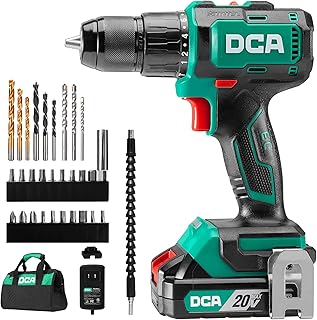
Full-size brushless with a side handle and a metal chuck. Handles brick, block and light concrete anchors comfortably.
What separates a good pick from a bad one at each price band
Entry band. Expect brushed motors, one gear, plastic-bodied chucks and often no side handle in the box. Some of these are honest tools; the bad ones are the ones sold on torque figures with a chuck that cannot hold a bit. If you buy here, accept the limits that come with it: brick, block, small bits, occasional use. Buy one that includes the side handle and skip anything whose chuck flexes when you tighten it by hand.
Middle band. This is where most readers should land. Brushless, two speeds, metal chuck, side handle, established battery platform, spare pack. Good and bad picks here separate on the boring details rather than specs: chuck quality, how the handle clamps, vibration through the grip, and whether the maker sells replacement parts at all.
Top band. Three speeds, kickback control, better damping, dust ports, and gearboxes built for daily percussion. Worth it if you are on tools every day or working in positions where an anti-rotation clutch protects you. If you drill a dozen masonry holes a year, this is money that would do more good spent on a rotary hammer and a set of bits.
Whatever you spend on the tool, the bits decide the outcome. A mid-tier drill with sharp carbide will out-drill a flagship swinging a worn bit every time, and bits are the cheaper half of that equation.
Masonry drill bit sets
Carbide-tipped, sized for common anchors. Cheap masonry bits round over and stop cutting within a few holes.
Technique that saves bits and tools
- ✔ Let the tool do the work — heavy pressure heats the bit and dulls carbide
- ✔ Withdraw periodically to clear dust from the hole
- ✔ Start slowly to establish the hole, then increase speed
- ✔ Use the side handle every time in masonry
- ✔ Blow the hole clear before setting an anchor, or it will not hold
Add one habit to that list: keep the bit square to the surface. A bit entered at an angle bells the mouth of the hole, and a belled hole lets a sleeve anchor spin instead of grip. Marking the depth on the bit with tape works when the tool has no depth rod, and stopping to let a hot bit cool costs less than a new bit.
Common mistakes and how to avoid them
Leaving hammer mode engaged for wood and metal. It wallows the hole, beats the chuck and does nothing useful. Switch it off the moment you leave masonry.
Percussion into glazed tile. The hammering chips the glaze around the hole. Drill through the tile on rotary only with a tile or multi-material bit, then switch hammer on once you are into the substrate behind it.
Leaning on it. Extra body weight does not add blows, it just heats carbide and stalls the motor. Steady pressure and patience drill faster than force.
Forcing through rebar. When progress stops dead and the tool starts to buck, you have found steel. Move the hole over rather than cooking the bit.
Hammering soft or historic masonry. Old lime mortar and soft brick crater under percussion. Drill those on rotary only, into the joint where you can, and repair rather than enlarge.
Buying the bare tool without checking the platform. A cheap body on a battery system you do not own is not a bargain, it is a second charger and two more packs.
Who each option suits, and who should skip it
Homeowners hanging shelves, TV brackets, gates and handrails into brick or block: a mid-band cordless hammer drill is exactly right, and it doubles as the general-purpose drill in the house.
Remodelers and installers setting anchors all day in block and light concrete: mid to top band, brushless, with kickback control and a spare battery. You are the buyer the feature list was written for.
Woodworkers should skip percussion entirely. A hammer drill is heavier, noisier and no better in timber than a plain drill/driver, and the ratchet plates add nothing you will ever use.
Anyone with a concrete-heavy project — slab anchors, a run of penetrations, anything over 1/2 inch — should stop shopping for hammer drills and read the next section.
When to buy a rotary hammer instead
If you drill more than a handful of holes in poured concrete, or anything over 1/2 inch, buy an SDS-Plus rotary hammer. It is a different mechanism — a piston firing a striker — and it will do in seconds what a hammer drill takes minutes to fail at.
SDS-Plus covers almost all anchor and penetration work and many models add a chisel mode for tile and render removal. SDS-Max is a demolition class tool and overkill unless you are breaking concrete for a living. The trade-off is that a rotary hammer is a poor screwdriver and clumsy for small bits, so it supplements a drill/driver rather than replacing it.
FAQ
Can I use a hammer drill without hammer mode? Yes — it works as a normal drill with the percussion switched off.
Can I use SDS bits in a hammer drill? No, the shank is different. Use round-shank masonry bits.
Corded or cordless? Cordless is fine for anchors and brick. Corded gives more sustained power for repeated concrete work — but at that point, buy a rotary hammer.
Is an impact driver the same thing? No. An impact driver hammers rotationally to drive fasteners; a hammer drill hammers along the bit axis to cut masonry. Neither substitutes for the other.
Compare hammer drills →