What's inside
As an Amazon Associate I earn from qualifying purchases. This post may contain affiliate links at no extra cost to you.
Tapcon-style concrete screws are installed with a regular drill and the correct masonry bit, not by driving them with an impact driver. A hammer drill can speed up the hole, especially in hard concrete, but more power is not automatically better: the wrong bit, excess dust, or an oversized hole can leave a screw spinning without gripping.
As an Amazon Associate we earn from qualifying purchases at no extra cost to you.


What we cover
What the job actually needs
For a few screws into a concrete block wall, a standard cordless drill with a sharp carbide-tipped masonry bit may be enough. For repeated holes in poured concrete, a hammer drill is a worthwhile upgrade. Its pulsing action helps the bit cut while you apply steady pressure; it does not replace a proper masonry bit or make the screw-installation step a hammer-drilling task.
Check the fastener maker’s instructions before drilling. Tapcon-style screws are commonly installed in holes drilled with the specified bit diameter, often 3/16 inch for a 1/4-inch screw or 5/32 inch for a 3/16-inch screw. Those are common pairings, not a substitute for the instructions on your particular fasteners. Drill to the required depth, usually deeper than the screw’s embedment so dust has room to collect, and clear the hole before driving.
Choosing a drill
A compact cordless hammer drill is the practical choice for most homeowners who expect to install concrete screws more than occasionally. Look for a hammer-drill setting, a two-speed gearbox, and a clutch or adjustable torque control. A 1/2-inch chuck accommodates common masonry bits, though the chuck size itself does not tell you how well a drill will bore concrete.
For a small, one-time job in relatively soft block or mortar, a regular drill can be cheaper and easier to control. It will work more slowly and may struggle in dense concrete. If it stops making progress, do not lean harder until the bit overheats or the drill stalls: stop, clear dust, check the bit, and consider switching to a hammer drill.
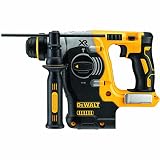
For frequent holes or tough concrete, consider an SDS-plus rotary hammer. It hits harder than a conventional hammer drill and is more efficient at drilling masonry. The trade-off is extra cost, size, and the need for SDS bits. It is usually excessive for installing a handful of small concrete screws.
Drill options compared
| Tool | Best fit | Trade-off |
|---|---|---|
| Standard cordless drill | A few holes in softer block, brick, or mortar | Slower in dense concrete; may stall |
| Cordless hammer drill | General-purpose drilling in concrete and masonry | More vibration and noise than a standard drill |
| SDS-plus rotary hammer | Many holes or repeated work in hard concrete | Higher cost; larger tool and different bits |
What to buy for your workload
If you already own a compatible cordless drill, try it with a fresh, correctly sized masonry bit before buying another tool. A well-maintained standard drill is often adequate for mounting a house number or securing a small bracket to block. Keep the holes few, let the bit cut, and avoid forcing it.
If you are buying a tool specifically for occasional home repairs, a cordless 1/2-inch hammer drill is the versatile middle ground. Battery platform matters: if you already own batteries and a charger, a bare tool from that system can cost less than starting over. For a one-off project, renting a rotary hammer may make more sense than buying one.
Choose an SDS-plus rotary hammer when drilling concrete is routine rather than occasional. It is not necessary just because the fastener is a concrete screw. For either tool, spend attention on the bit: a sharp carbide masonry bit of the diameter specified for the screw is more useful than a high-end drill paired with a worn bit.
Drill and drive without weakening the hole
Mark the hole and check for pipes or wiring before drilling. Set the drill to hammer mode for the hole, use the correct bit, and hold the tool square to the surface. Start slowly to keep the bit from skating, then use steady pressure. Pull the bit out periodically to clear dust, especially in a deep hole. Eye protection is essential; concrete dust and chips come out around the bit.
Do not use hammer mode to drive the screw. Switch to drill mode or use a regular drill or impact driver, following the screw maker’s directions. Use controlled speed and stop as soon as the head seats. Overdriving can strip the concrete around the threads, damage the screw head, or crack brittle material. An impact driver can drive compatible concrete screws, but its high torque makes it easier to overdo; a drill with adjustable clutch is easier to control for a new user.
Common failures and fixes
The screw spins without tightening: The hole may be oversized, dusty, or drilled in weak material. Remove the screw and assess the hole; do not keep turning it. Use a fresh hole at the spacing required by the fastener instructions, or choose a suitable different anchor if the material will not hold a screw.
The bit stops cutting: Clear packed dust and inspect the carbide tip for wear. A dull bit makes drilling slower and can overheat. If a standard drill cannot advance in dense concrete, a hammer drill or rotary hammer is the sensible next step.
The screw will not start or binds early: Check that the hole is the specified diameter and deep enough, and that it has been cleaned. A hole that is too small can overload the fastener; one that is too shallow can leave dust packed at the bottom and prevent full seating.
Match the tool to the number and hardness of the holes, not to the name of the fastener. For a few modest installations, your existing drill may be enough. For repeated concrete work, a cordless hammer drill is a useful all-rounder; reserve the rotary hammer for workloads where its speed and reduced effort justify the extra tool.