What's inside
- Quick picks by dog, space, and grooming routine
- Best overall: a 30-inch folding grooming table
- Best compact choice for small dogs
- Best for large dogs: heavy-duty 36- or 48-inch tables
- Feature comparison: what separates a useful table from a frustrating one
- How to choose the correct size
- Arm and leash adjustability: the safety-critical details
- Surface grip, cleaning, and long-term ownership
- Final buying recommendation
- Quick picks by dog, space, and grooming routine
- Best overall: a 30-inch folding grooming table
- Best compact choice for small dogs
- Best for large dogs: heavy-duty 36- or 48-inch tables
- Feature comparison: what separates a useful table from a frustrating one
- How to choose the correct size
- Arm and leash adjustability: the safety-critical details
- Surface grip, cleaning, and long-term ownership
- Final buying recommendation
As an Amazon Associate I earn from qualifying purchases. This post may contain affiliate links at no extra cost to you.
The best dog grooming tables for home use are a stable, foldable table sized to your dog’s standing length, with a non-slip top, a height-adjustable grooming arm, and a leash loop that can be positioned without pressing against the neck.
For most homes, a 30-inch folding table is the most versatile choice for small-to-medium dogs. Toy breeds can use a compact 18- to 24-inch tabletop, while large dogs generally need a 36- to 48-inch table with a higher weight rating and a wider base. A grooming table is useful for brushing, drying, nail care, and trimming, but it should never be used as an unattended tie-out.
As an Amazon Associate we earn from qualifying purchases at no extra cost to you.

What we cover
- Quick picks by dog, space, and grooming routine
- Best overall: a 30-inch folding grooming table
- Best compact choice for small dogs
- Best for large dogs: heavy-duty 36- or 48-inch tables
- Feature comparison: what separates a useful table from a frustrating one
- How to choose the correct size
- Arm and leash adjustability: the safety-critical details
- Surface grip, cleaning, and long-term ownership
- Final buying recommendation
Quick picks by dog, space, and grooming routine
| Situation | Best table type | Useful target specifications | Typical market range |
|---|---|---|---|
| Toy or small dog in a small apartment | Compact folding tabletop | 18–24 in. long, 12–18 in. wide, 50–100 lb capacity | $45–$100 |
| One medium dog groomed every few weeks | Standard folding table with arm | 30 in. long, 18–24 in. wide, 200–300 lb capacity | $80–$180 |
| Large or long-bodied dog | Heavy-duty folding table | 36–48 in. long, at least 24 in. wide, 250–400 lb capacity | $150–$350 |
| Frequent grooming or multiple dogs | Reinforced professional-style table | 30–48 in. long, welded frame, replaceable non-slip surface | $200–$500+ |
Weight capacity is not the same as comfortable working size. A 70-pound dog may be below a table’s stated limit but still be too long for a 24-inch surface. Measure from the dog’s nose to the base of its tail while standing, then add at least 4 to 6 inches. A table should let the dog stand without its front or rear feet reaching the edge during ordinary brushing.
Best overall: a 30-inch folding grooming table
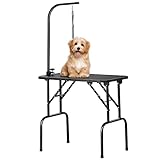
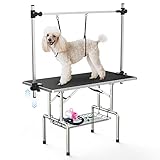
A 30-inch table is the best compromise for many households. It accommodates most small and medium breeds, folds flat enough for a closet, and is usually light enough for one person to move. Models from brands such as Flying Pig, Master Equipment, and Go Pet Club cover this general category, although dimensions and included accessories vary by model.
Look for a tabletop around 30 inches long and 18 to 24 inches wide, a textured rubber or PVC surface, and a metal arm that adjusts both vertically and horizontally. A table with two clamp points or a reinforced arm socket is preferable to one with a thin single-point bracket: dogs pull sideways, and that force can loosen a poorly supported arm.
The principal limitation is length. A 30-inch surface may be adequate for a compact spaniel or terrier but cramped for a long-backed dog. If the dog repeatedly steps off the edge, the problem is usually table size or training—not simply an insufficiently short leash.
Best compact choice for small dogs
A compact tabletop is appropriate for dogs that can stand comfortably within an 18- to 24-inch surface. These tables are easy to store and often cost less than full-size models. Master Equipment makes compact grooming tables in this general format, and similar products are sold with either a fixed arm or a removable adjustable arm.
The trade-off is stability. A small table has less surface area and a narrower stance, so a lively dog can make it rock. Choose rubber-capped legs, a frame that locks open, and a top that is not excessively thick or slippery. For a very small dog, a lower table can also make lifting safer, but the grooming arm still needs enough adjustment to keep the loop above the shoulders rather than pulling upward from the throat.
Best for large dogs: heavy-duty 36- or 48-inch tables
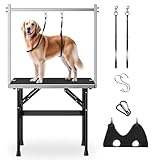
Large dogs benefit from a 36- or 48-inch table because length and width matter as much as load rating. Heavy-duty tables from Flying Pig and other professional-grooming suppliers commonly use steel frames, thicker legs, and broader tabletops than lightweight household models.
Prioritize a 24-inch-wide surface or wider, a stated capacity of at least 250 pounds, and legs that spread far enough to resist diagonal movement. A large dog can produce a considerable sideways load when turning around, so a table with a high numerical capacity but a narrow base may feel less secure than a slightly lower-rated table with better leg geometry.
These tables take more storage space. Measure the folded dimensions, not just the working dimensions. Some 48-inch tables are too long for a standard closet and are better stored against a wall or in a utility room.
Feature comparison: what separates a useful table from a frustrating one
| Feature | Good home-use target | Why it matters | Warning sign |
|---|---|---|---|
| Tabletop dimensions | Dog’s standing length plus 4–6 inches; 18–24 inches wide | Leaves room for brushing and repositioning | Dog’s feet reach the edge during normal work |
| Weight capacity | At least twice the dog’s body weight for active dogs | Provides useful margin for movement and equipment | Capacity barely exceeds the dog’s weight |
| Folding storage | Locking legs; folded depth roughly 4–8 inches | Prevents accidental opening and saves floor space | Legs fold without a positive latch |
| Grooming arm | Approximately 24–36 inches of vertical adjustment | Fits different dog heights and working positions | Arm only moves up and down or slips in its socket |
| Leash or loop adjustment | Sliding loop with quick-release hardware | Allows a light, correctly positioned restraint | Fixed loop forces the dog’s head into one position |
| Surface grip | Textured, water-resistant rubber or PVC mat | Reduces sliding during brushing and drying | Smooth painted wood or glossy plastic |
| Stability | Wide stance, non-slip feet, cross-braced or reinforced frame | Controls rocking and sideways movement | Legs flex when the dog shifts weight |
How to choose the correct size
-
Measure the dog standing naturally from the front of the chest to the base of the tail. Do not measure a curled-up sleeping position.
-
Add 4 to 6 inches for brushing tools, hand movement, and small posture changes. A dog measuring 24 inches therefore needs approximately a 28- to 30-inch tabletop.
-
Check width. A narrow table may fit the dog’s length but leave no safe margin when the dog turns its head or shifts its feet.
-
Compare the dog’s weight with the table rating, then allow extra capacity for movement. For example, a 55-pound active dog is better matched with a table rated around 150 pounds or more than one rated at 75 pounds.
-
Measure the folded table’s storage location and doorway. A table that cannot be carried through the room where it will be used is not a practical bargain.
Arm and leash adjustability: the safety-critical details
The arm should adjust to the dog rather than making the dog adapt to the arm. For brushing, the loop should provide gentle positioning while allowing the dog to lower its head and breathe normally. A second loop or belly strap can help with dogs that sit or back away, but it should not be tightened as a substitute for supervision or training.
Prefer coated cable or soft webbing over bare metal contact at the dog’s neck. Quick-release hardware is useful if the dog panics or becomes entangled. Never leave a dog attached to the arm alone, and do not use a grooming table as a restraint system for transporting or storing a dog.
Surface grip, cleaning, and long-term ownership
The non-slip top is often the first part to show wear. Clipped hair, conditioner, nail dust, and dampness can fill the texture and make the surface slick. Wipe it after every session, then use a mild pet-safe cleaner according to the surface manufacturer’s instructions. Avoid saturating wood-based tops or allowing water to collect around the frame.
Inspect the arm clamp, leg hinges, and leash attachment before each use. Tighten fasteners when necessary, but do not overtighten hardware into thin tubing. Replace a torn mat rather than covering it with a loose towel: a towel can bunch under the dog’s feet and create an unstable surface. Rubber feet also wear down and may need replacement sooner than the metal frame.
A simple ownership calculation helps compare prices. If a $120 table is used twice a month for three years, it costs about $1.67 per use before replacement parts: $120 divided by 72 sessions. A $250 reinforced table used weekly for the same period costs about $1.60 per use. The heavier table may therefore be better value for frequent grooming, while the cheaper compact table makes more sense for occasional small-dog maintenance.
Final buying recommendation
Choose a compact 18- to 24-inch table for a small, calm dog and limited storage; choose a 30-inch folding table for the broadest home-use range; and choose a 36- to 48-inch heavy-duty table for large, long-bodied, or frequently groomed dogs. Across all sizes, prioritize a correctly sized non-slip surface, locking legs, a wide stable base, and an arm with independent height and leash adjustment. Those features matter more than decorative accessories or the highest advertised weight limit.