What's inside
As an Amazon Associate I earn from qualifying purchases. This post may contain affiliate links at no extra cost to you.
Rusted fasteners are usually defeated by the right combination of penetration oil, heat, leverage, and a bit that can survive shock. An impact driver helps, but it does not make a damaged bolt head usable again. The best bit depends on whether the fastener has a Phillips recess, hex head, Torx recess, or a rounded-off head.
As an Amazon Associate we earn from qualifying purchases at no extra cost to you.



What we cover
What to Buy First
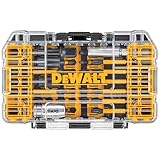
For ordinary rusted screws and bolts, start with a set of impact-rated driver bits containing Phillips, Torx, square, and slotted sizes. Look for 1/4-inch hex shanks marked “impact rated” or “torsion zone.” Standard drill bits and ordinary screwdriver bits are more likely to snap under an impact driver’s rapid hammering.
For hex-head bolts and nuts, use impact sockets rather than driver bits. A 1/4-inch hex-to-square adapter can connect sockets to an impact driver, but a 3/8-inch impact wrench is generally better for large, heavily corroded hardware. An adapter is convenient for automotive brackets, furniture, appliances, and light equipment; it is not a substitute for a high-torque impact wrench on suspension or structural fasteners.
| Fastener problem | Best bit or tool | Main limitation |
|---|---|---|
| Rusty Phillips or Torx screw | Correct-size impact-rated bit | Fails if the recess is already rounded |
| Hex-head bolt or nut | Six-point impact socket | Won’t help if the hex is badly rounded |
| Partly damaged recess | Extractor bit or specialty removal socket | Usually destroys the fastener |
| Broken or seized fastener | Left-hand drill bit and screw extractor | Needs careful drilling and can break in the workpiece |
Impact-Rated Driver Bits
Impact bits are made from tougher alloys and are designed to flex slightly instead of shattering. That matters because an impact driver delivers repeated torsional blows, not just steady rotation. A cheap bit may work on a new screw, then twist or fracture after a few seconds on rusted hardware.
Choose the exact bit size that fills the fastener recess. A Phillips bit that is too small will cam out and chew the corners. A bit that is too large may not seat fully. Press the tool firmly into the fastener, run the driver at low speed, and let the impacts work rather than immediately using full trigger.
Torx and square-drive bits usually hold better than Phillips bits because their sides resist cam-out. If you are buying one set for general repair, prioritize common Torx sizes such as T20 through T40, Phillips No. 2 and No. 3, and a useful range of metric and SAE hex bits. A longer bit is not automatically stronger; short bits usually flex less and keep better alignment.
Impact Sockets for Rusted Bolts
Use six-point impact sockets whenever possible. They grip the flat sides of a hex head and are less likely to round it than a 12-point socket. Six-point sockets are especially important when rust has reduced the corners or when the fastener is already tight.
Do not use chrome hand-tool sockets with an impact driver. Chrome sockets can crack or shatter under impact use. Buy a small set of six-point impact sockets in the drive size that matches your tool. A 3/8-inch drive is a practical middle ground for household and vehicle work. For small machine screws, a 1/4-inch drive socket adapter is more compact.
Deep sockets help when the bolt has a long exposed stud, but they can flex more on extremely tight fasteners. If access allows, use the shortest socket that fully covers the nut. Avoid universal or spline sockets as a first choice; they are useful for damaged shapes, but a correctly sized six-point socket grips better.
Extractor Bits and Removal Sockets
When a recess is rounded, changing to a stronger standard bit usually will not fix the problem. Impact-rated extraction bits have aggressive edges intended to bite into damaged Phillips, Torx, or hex recesses. They can work well on lightly damaged screws, but they need firm downward pressure and low speed.
For rounded external hex heads, use an impact-rated spiral extractor socket. Select one slightly smaller than the damaged head and tap it on with a hammer. The internal spiral cuts into the metal as you turn counterclockwise. Expect the socket to mark or destroy the fastener, and do not use it on a bolt you intend to reinstall.
These tools have a failure mode worth understanding: if the extractor slips, it can make the head even more difficult to drill. A broken extractor is particularly troublesome because hardened extractor steel is difficult to drill with ordinary bits. Stop before the head is completely rounded, and switch tools rather than repeatedly hammering an extractor that is not biting.
Drill Bits for Seized or Broken Fasteners
For a fastener with no usable head, use a left-hand cobalt drill bit if the material and access permit. Run the drill in reverse at moderate speed with cutting oil. Sometimes the bit catches and backs the fastener out before a separate extractor is needed.
If drilling a pilot hole for a screw extractor, keep it centered and straight. Start with a small bit, such as 1/8 inch, then enlarge it according to the extractor instructions. Cobalt bits are a sensible choice for hardened steel and stainless steel; ordinary high-speed steel bits are cheaper and fine for mild steel if kept cool. A left-hand cobalt drill bit and extractor set is useful for occasional repairs, but it is not magic. Extractors can snap when excessive torque is applied.
Technique That Prevents Breakage
Remove dirt and loose scale with a wire brush, then apply penetrating oil and wait at least 10 to 15 minutes. For severe corrosion, repeated applications over several hours work better than flooding the joint once. If the surrounding material is safe to heat, warming the fixed part—not the fastener itself—can expand the joint slightly. Keep heat away from fuel, wiring, seals, and flammable coatings.
Try tightening the fastener a fraction before loosening it. This can break the rust bond without immediately loading the head in the loosening direction. Use the impact driver’s lowest speed setting first. If the bit jumps, stop and reassess. The cheaper option is perfectly adequate for a clean, lightly rusted screw, but serious corrosion justifies a good impact bit, six-point socket, and extraction backup.