What's inside
- Best impact drivers for the money at a glance
- Best value under about $200: Ryobi ONE+ HP PBLID02
- Best compact professional value: DEWALT ATOMIC DCF850
- Best lightweight option: Milwaukee M12 FUEL 3453
- Best refined all-rounder: Makita XDT19
- Best for heavy daily use: Milwaukee M18 FUEL 2853
- Decision matrix: which value fits your situation?
- What actually affects driving speed and fastening quality?
- Ownership costs and maintenance
- Final verdict
- Related Guides
- Best impact drivers for the money at a glance
- Best value under about $200: Ryobi ONE+ HP PBLID02
- Best compact professional value: DEWALT ATOMIC DCF850
- Best lightweight option: Milwaukee M12 FUEL 3453
- Best refined all-rounder: Makita XDT19
- Best for heavy daily use: Milwaukee M18 FUEL 2853
- Decision matrix: which value fits your situation?
- What actually affects driving speed and fastening quality?
- Ownership costs and maintenance
- Final verdict
- Related Guides
As an Amazon Associate I earn from qualifying purchases. This post may contain affiliate links at no extra cost to you.
The best impact driver for the money in 2026 is the Ryobi ONE+ HP Brushless Compact Impact Driver for most occasional and home users, while the DEWALT 20V MAX ATOMIC DCF850 is the better compact professional choice and the Milwaukee M18 FUEL 2853 is the strongest value for frequent heavy fastening.
That answer depends less on peak torque than on the cost of entering a battery platform, how quickly the tool drives common screws, how well it holds bits, and whether its compact size helps you finish work without fatigue. The comparison below separates those factors instead of treating the highest torque number as the winner.
As an Amazon Associate we earn from qualifying purchases at no extra cost to you.


What we cover
- Best impact drivers for the money at a glance
- Best value under about $200: Ryobi ONE+ HP PBLID02
- Best compact professional value: DEWALT ATOMIC DCF850
- Best lightweight option: Milwaukee M12 FUEL 3453
- Best refined all-rounder: Makita XDT19
- Best for heavy daily use: Milwaukee M18 FUEL 2853
- Decision matrix: which value fits your situation?
- What actually affects driving speed and fastening quality?
- Ownership costs and maintenance
- Final verdict
- Related Guides
Best impact drivers for the money at a glance
| Tool | Best use | Published torque class | Maximum speed | Approx. bare-tool weight | Typical kit price range |
|---|---|---|---|---|---|
| Ryobi ONE+ HP PBLID02 | Home projects and occasional construction | Up to about 2,200 in-lb | Up to 3,800 RPM | About 2.4 lb | $130–$190 |
| DEWALT 20V MAX ATOMIC DCF850 | Compact framing, decking, and repair work | Up to about 1,825 in-lb | Up to 3,250 RPM | About 2.1 lb | $170–$250 |
| Milwaukee M12 FUEL 3453 | Cabinetry, electrical, and light assembly | Up to about 1,500 in-lb | Up to 3,600 RPM | About 1.6 lb | $150–$230 |
| Makita 18V LXT XDT19 | Frequent fastening with refined control | Up to about 1,590 in-lb | Up to 3,600 RPM | About 2.1 lb | $190–$280 |
| Milwaukee M18 FUEL 2853 | Heavy daily fastening | Up to about 2,000 in-lb | Up to 3,600 RPM | About 2.2 lb | $220–$330 |
Torque figures are manufacturer maximums, not a promise that one tool will drive a particular screw faster. Battery size, bit quality, material density, screw diameter, and the driver’s electronic mode all change real-world results. Weight also changes with the battery installed; compact 1.5Ah or 2.0Ah packs are much easier to handle than 5.0Ah packs.
Best value under about $200: Ryobi ONE+ HP PBLID02
Ryobi’s brushless ONE+ HP driver offers the most approachable combination of speed, power, and battery-platform cost. Its three-speed electronic control is useful when the job changes from cabinet screws to structural fasteners, and the tool is powerful enough for deck repairs, framing around a workshop, and long wood screws.
The important value is the platform. ONE+ batteries work across a very large range of outdoor, household, and woodworking tools, so a homeowner can buy a driver kit and add bare tools later. That reduces the cost per use if you eventually need an oscillating tool, light, compact saw, or brad nailer.
Bit retention is good when the hex shank is correctly machined, but the collet should not be treated as a substitute for pulling the sleeve forward and checking that the bit has locked. The Ryobi is a sensible pick for someone using an impact driver a few weekends per month. Its main compromise is a less compact and less polished feel than premium professional models.
Best compact professional value: DEWALT ATOMIC DCF850
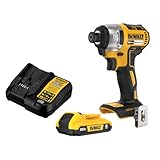
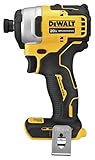
The DCF850 earns its place by being exceptionally short, at roughly 3.97 inches from the front of the collet to the back of the housing. That dimension matters when fastening inside cabinet boxes, between joists, beside blocking, or in narrow framing bays. A shorter tool can save more time than a higher torque rating when access is the limiting factor.
Its three selectable speeds help prevent overdriving smaller screws, while the brushless motor provides enough output for common construction fasteners. The 1/4-inch quick-change hex chuck accepts standard impact-rated bits, and the compact head makes one-handed positioning easy.
Choose the DCF850 if you already own DEWALT 20V MAX batteries or expect to build that platform. Buying into a new system only for this driver can erase its value advantage, particularly if you need several batteries and a charger. For a first tool in a broader battery collection, the kit price is reasonable; for a single occasional-use purchase, Ryobi usually costs less.
Best lightweight option: Milwaukee M12 FUEL 3453
The M12 FUEL 3453 is the smart choice when low weight and access matter more than maximum structural-fastener performance. With a compact 12V battery, it is substantially easier on the wrist during cabinet installation, hardware assembly, electrical work, and repetitive small-screw driving. It also fits spaces where a full-size 18V or 20V driver feels bulky.
Its approximately 1,500 in-lb torque rating is ample for most furniture, cabinetry, trim backing, and general repair work. It is not the best value for building decks or repeatedly driving large structural screws, because the smaller batteries and lower output can make those jobs slower.
The M12 platform is particularly attractive when you want a compact drill, inspection light, ratchet, or rotary tool as well. The trade-off is that M12 batteries are not interchangeable with Milwaukee M18 packs, so choosing this system commits you to a separate voltage family.
Best refined all-rounder: Makita XDT19
Makita’s XDT19 is a strong choice for users who care about controlled fastening as much as raw output. Its assist modes are designed to reduce cam-out and overdriving, and the electronic controls are useful for switching between self-tapping screws, wood screws, and heavier fasteners without relying entirely on trigger discipline.
The XDT19 is not the shortest or cheapest driver here, but its balance, low vibration, and predictable response make it appealing for frequent woodworking and installation work. Makita’s 18V LXT platform is broad and mature, including saws, sanders, routers, and outdoor equipment.
Its value improves when you already own LXT batteries. If you are purchasing a complete platform from nothing, compare the price of the second and third tools you expect to buy rather than comparing the driver alone.
Best for heavy daily use: Milwaukee M18 FUEL 2853
The M18 FUEL 2853 remains a compelling professional value because it combines roughly 2,000 in-lb of maximum torque with a compact body, four electronic modes, and strong control over fastener speed. It is suited to repetitive framing, long structural screws, equipment installation, and other work where an underpowered driver wastes time.
Its advantage is not that it will always finish one screw dramatically faster. Instead, it maintains speed across harder materials and larger fasteners, and its power reserve reduces the need to change tools. For someone using an impact driver every workday, that versatility can justify the higher kit cost.
For occasional users, however, the price premium and M18 battery investment are difficult to recover. A less expensive tool with a fresh battery will handle most household fastening adequately.
Decision matrix: which value fits your situation?
| Your situation | Recommended choice | Why |
|---|---|---|
| Under $200 and starting from zero | Ryobi ONE+ HP PBLID02 | Low platform entry cost and broad future tool selection |
| Already own DEWALT 20V MAX batteries | DEWALT DCF850 | Compact body and no new battery ecosystem required |
| Cabinetry, furniture, and repetitive overhead work | Milwaukee M12 FUEL 3453 | Lowest practical weight and excellent access |
| Frequent woodworking and installation | Makita XDT19 | Fine control and useful fastening modes |
| Daily construction or large fasteners | Milwaukee M18 FUEL 2853 | High sustained output and four-mode flexibility |
What actually affects driving speed and fastening quality?
RPM controls unloaded speed, not finished productivity. A driver with a high maximum RPM can spin quickly between impacts, but the tool must still deliver torque without stalling when the screw enters dense lumber. For ordinary wood screws, a controllable medium setting often produces better results than full speed.
Impact torque helps with resistance but can damage work. Excessive output can strip a screw head, snap a small fastener, or bury the head below a finished surface. Use the lowest mode that reaches the required depth, then finish with a drill-driver and clutch when delicate control is more important than speed.
Bit retention depends on the bit as much as the chuck. Use impact-rated bits with a properly machined 1/4-inch hex shank. Inspect the shank for rounding, keep the collet free of sawdust, and replace bits that wobble. A loose bit transfers impact energy poorly and accelerates wear on both the bit and the chuck.
Ownership costs and maintenance
A useful way to compare value is cost per use. Suppose a $160 kit is used 40 times per year for four years: that is 160 uses, or about $1 per use before consumables. A $260 professional kit used 200 times per year over the same period costs about $0.33 per use. The more often you work, the more important durability, downtime, and battery availability become.
The first consumable to wear is usually the driver bit, not the motor. Keep several impact-rated Phillips, square, Torx, and nut-driver bits available. Let the tool stop before changing direction, avoid using the impact driver as a drill for delicate materials, and do not hold the trigger while a bit is slipping.
After dusty work, remove the battery and brush debris from the collet, vents, and trigger area. Do not flood the tool with compressed air at close range, since excessive pressure can push dust deeper into bearings and switches. Store batteries cool and dry, and avoid leaving a pack fully discharged for long periods.
Final verdict
For the broadest definition of value, buy the Ryobi ONE+ HP PBLID02. It provides enough speed and torque for most household and workshop fastening while opening an inexpensive battery platform. Choose the DEWALT DCF850 when compact access and professional portability matter, the Milwaukee M12 FUEL 3453 when low weight is the priority, the Makita XDT19 for controlled frequent use, and the Milwaukee M18 FUEL 2853 when the tool will earn its keep on demanding daily work.