What's inside
As an Amazon Associate I earn from qualifying purchases. This post may contain affiliate links at no extra cost to you.
What we cover
Why control matters with long timber screws
Long structural screws can pull framing together quickly, but an impact driver can also bury a screw head, strip its recess or snap the fastener before you react. The risk goes up with large-diameter screws, dense or wet lumber, and driving near a board’s edge. For this work, the best driver is not necessarily the one with the highest torque. A useful speed setting, predictable trigger and a clutch or stopping routine matter more.
Impact drivers deliver rotational blows that help drive screws without as much reaction torque at the tool. They are compact and effective for many framing jobs, but most do not have a conventional adjustable clutch like a drill driver. Their low-speed mode reduces the risk of overdriving; it does not guarantee a particular final depth. You still need to ease off the trigger as the head approaches the wood.
As an Amazon Associate we earn from qualifying purchases at no extra cost to you.



What to look for in an impact driver
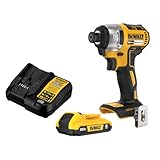
Choose a model with at least two speed or drive modes, a variable-speed trigger and a clear forward/reverse control. A low-speed mode gives more time to stop at the surface. Some drivers offer a dedicated assist mode that slows or stops the tool when it senses a fastener approaching the work; these features can help, but they do not replace watching the screw head. Check that the tool’s battery platform suits your other tools, and compare bare-tool price with the cost of a battery and charger if you are starting from scratch.
A compact 12V driver can be enough for occasional work with moderate-size screws, especially in softwood and predrilled holes. For repeated installation of long structural screws, a 18V/20V-max brushless driver is a more versatile choice. The larger tool is not automatically more controllable; mode selection and trigger feel are more important than the biggest torque figure on the box.
Browse brushless impact drivers with multiple speed modes if you want a general-purpose tool for framing and other fastening. If the job is occasional and the screws are not unusually large, a less expensive brushed driver or compact 12V option can be perfectly adequate.
Driver options at a glance
| Option | Best fit | Control and trade-off |
|---|---|---|
| Compact 12V impact driver | Occasional fastening, smaller screws, lighter handling | Easy to maneuver; may bog down more in dense lumber or with large fasteners. |
| 18V/20V-max driver with two or more modes | Regular framing and long structural screws | Good balance of power and controllability; still requires trigger discipline. |
| Driver with fastener-assist mode | Repeated work where consistent seating matters | Can reduce overdriving, but sensing behavior varies by tool and fastener. |
| Drill driver with adjustable clutch | Small screws or situations needing a mechanical torque limit | Clutch can limit drive force, but may slip before a long screw is fully seated. |
Match the tool to the fastener and material
Follow the screw maker’s instructions for driver-bit type, pilot-hole size and installation. Use the bit specified for the screw head and keep it fully seated; a worn or incorrect bit can cam out, damaging the recess before the screw is tight. For screws several inches long, a pilot hole may reduce splitting and driving effort, especially near an edge or in hardwood. Do not assume a pilot hole is required or choose its size by guesswork: follow the fastener manufacturer’s guidance, since the correct hole depends on screw design and material.
Fastener length alone does not tell you how much power is needed. A long, narrow screw in soft, dry lumber may drive easily, while a shorter, thicker screw in dense or wet wood can demand more force. If the driver repeatedly stalls, chatters without advancing, or overheats, stop. Check for an obstruction, wrong bit, misalignment, unsuitable pilot hole or fastener specification rather than forcing it with a higher setting.
For frequent structural fastening, look at impact-rated bits for structural wood screws. Impact-rated bits are designed for impact-tool use, but they can still wear or break; replace a rounded bit instead of leaning harder on it.
A repeatable way to avoid overdriving
Start with the work clamped or supported so it cannot shift. Put the screw in the correct position, align the driver straight with the fastener and begin in the lowest speed mode. Use a steady, moderate trigger pull. As the head approaches the wood, release the trigger, inspect the seating and use short bursts if it needs a little more travel. The goal is a snug connection and the head position specified by the screw maker—not a crater around the head.
Test the setup on scrap of the same wood when practical. Drive one screw, check the depth and adjust your speed or trigger pressure before repeating the operation. This is especially useful when changing from softwood to hardwood, or when using a fresh battery: a fully charged battery can make the driver feel more forceful than one near empty.
Overdriving can crush wood fibers, weaken the surface around the head and leave a screw difficult to remove. Stopping too early can leave a gap between members or a head that catches. If the joint has not pulled tight, do not keep hammering at the head; back the screw out, check alignment and obstruction, then reinstall according to the manufacturer’s directions. For a long screw that is difficult to control, a drill driver with an adjustable clutch may offer a more gradual alternative, though its clutch may need to be set high or bypassed for large structural fasteners.
Common mistakes and practical limits
Do not use a driver’s highest-speed mode simply because the screw is long. Speed makes it harder to stop at the right moment, and impact action can conceal how forcefully the screw is advancing. Avoid holding the trigger after the head is seated; even a brief extra burst can damage the wood or fastener. If a screw’s recess starts to deform, stop and replace the fastener rather than continuing with a damaged head.
For a small number of screws in ordinary framing, an entry-level driver is usually fine if it has a controllable trigger and you work slowly near final depth. Paying more makes sense when you need repeated use, better low-speed control, a useful assist mode or compatibility with batteries you already own. No feature removes the need to match the bit, fastener and installation method to the job.