What's inside
As an Amazon Associate I earn from qualifying purchases. This post may contain affiliate links at no extra cost to you.
Removing tile adhesive is harder on a drill than drilling a few holes in brick. The work produces constant impact, sideways loading, and heat, especially when you use a scraper or chisel bit. The best tool depends on whether you are breaking up thinset, drilling masonry for anchors, or doing both jobs with one cordless machine.
As an Amazon Associate we earn from qualifying purchases at no extra cost to you.


What we cover
Choose the right tool for the job
A standard drill with a masonry bit can make holes in soft brick, but it is a poor choice for tile removal. A hammer drill adds a pulsing action that helps the bit chip masonry, yet its chuck still holds the bit by friction or jaws. It is designed mainly for drilling, not for driving a chisel all day.
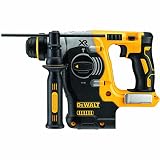
A rotary hammer uses a stronger electro-pneumatic impact mechanism and SDS-Plus or SDS-Max accessories. Most cordless SDS-Plus models also have a hammer-only mode. That mode turns the tool into a compact chipping hammer for removing thinset, tile mortar, and small patches of adhesive. For this work, start with a cordless SDS-Plus rotary hammer rather than a conventional hammer drill.
| Tool type | Best use | Chiseling ability | Typical limitation |
|---|---|---|---|
| Standard drill | Wood, metal, occasional soft masonry | None | Overheats and slips on masonry |
| Hammer drill | Small holes in brick, block, and concrete | Very limited | Awkward for scraping adhesive |
| SDS-Plus rotary hammer | Anchors, concrete drilling, thinset removal | Good for light to medium work | Bulkier than a drill |
| SDS-Max rotary hammer | Heavy concrete and demolition | Excellent | Expensive, heavy, and excessive for most tile jobs |
What to look for in a cordless hammer drill
If masonry drilling is the priority, look for a 18V or 20V-class hammer drill with a brushless motor, a two-speed gearbox, and a metal chuck or solid chuck mechanism. A useful range is roughly 500 to 2,000 RPM, with an adjustable clutch for ordinary drilling. Hammer-drill impact rates commonly run from about 20,000 to 35,000 blows per minute.
Those numbers do not tell the whole story. For drilling concrete, impact energy matters more than advertised RPM. A compact hammer drill may be fine for 1/4-inch holes, but drilling repeated 3/8-inch or 1/2-inch holes in hard concrete can drain batteries quickly and wear out the chuck. If you only need a few holes for wall anchors, a cheaper 20V cordless hammer drill is often the sensible buy.
For tile adhesive, choose a rotary hammer with variable speed, hammer-only mode, and a safety clutch. Variable speed lets you start gently and avoid bouncing the scraper. The clutch reduces twisting if the chisel catches an edge or the bit jams. A side handle is essential: it gives you control and keeps your wrist away from the rotating body.
Removing tile adhesive without damaging the substrate
Use a wide SDS scraper for thinset and a narrow pointed or flat chisel for stubborn ridges. A 2- or 3-inch scraper is generally faster than a narrow chisel because it removes more material per pass. Hold it at a low angle—roughly 10 to 30 degrees—and let the impact mechanism do the cutting. Do not lean your full body weight on the tool.
Work in short passes and inspect the surface often. On a concrete slab, you can usually be more aggressive. On a plaster wall, cement board, or soft block, the chisel can gouge the surface in seconds. The goal is a reasonably flat surface, not bare concrete at any cost. Remaining thin adhesive may be better removed with a hand scraper or floor grinder.
Tile adhesive can conceal wiring, plumbing, and waterproofing membranes. Before chiseling, identify the substrate and check both sides of a wall where possible. Keep the bit away from corners and penetrations. Wear eye protection, hearing protection, gloves, and a properly fitted respirator rated for the dust involved. Use a vacuum attachment or dust extractor; dry concrete and mortar dust are hazardous to breathe.
Bits and accessories that matter
For a rotary hammer, buy SDS-Plus accessories that match the tool. A carbide masonry bit is appropriate for concrete and brick. A wide tile scraper is for adhesive, while a pointed chisel is for breaking thick spots. Do not use a regular round-shank masonry bit in an SDS chuck with an adapter for heavy work; the adapter adds play and reduces impact transfer.
For a hammer drill, use quality carbide-tipped masonry bits. Start with a smaller pilot hole when drilling larger diameters, particularly in hard concrete. Clear dust every few seconds by withdrawing the bit. Dust packed into the hole can slow drilling, overheat the bit, and prevent an anchor from seating fully. For a cleaner anchor installation, consider a SDS-Plus masonry bit and chisel set.
Battery size and runtime
A compact 2.0Ah battery keeps a hammer drill light for overhead anchor work, but it may provide only a limited number of deep concrete holes. A 4.0Ah or 5.0Ah pack is a better match for rotary hammer chiseling. Expect runtime to vary sharply with material: removing soft thinset may be easy, while drilling dense reinforced concrete can empty a pack in a small number of holes.
Keep a spare battery charging if the job involves more than a bathroom backsplash or a few wall anchors. High-output batteries can improve performance, but they also add weight. A corded rotary hammer remains the economical choice for a large floor or whole-room demolition job if you already have power available.
The practical buying decision
Buy a hammer drill if you mainly drill occasional 1/4- to 3/8-inch holes for anchors in brick or block and already own a compatible battery system. Buy a cordless SDS-Plus rotary hammer if tile adhesive removal is a real part of the job, or if you regularly drill concrete. Step up to SDS-Max only for thick mortar, heavy demolition, or large-diameter drilling; it is unnecessary for typical tile work.
Before buying, check that the tool includes a side handle, depth stop, and hammer-only mode if you need to scrape. If it is sold as a bare tool, include the cost of a battery, charger, scraper, chisel, and dust-control equipment. The cheapest tool is fine when the task is three anchor holes. It is false economy when the same tool must spend hours breaking adhesive.