What's inside
As an Amazon Associate I earn from qualifying purchases. This post may contain affiliate links at no extra cost to you.
What we cover
The short answer
For a few small holes in ordinary concrete, a quality hammer drill with a sharp masonry bit is usually enough. It costs less, weighs less, and works with the cordless drill you may already own. A rotary hammer is the better choice when the concrete is hard, you need more than a handful of holes, or a hammer drill is making slow progress.
For common plastic or sleeve anchors, holes are often 1/4 to 3/8 inch wide and roughly 1 to 2 inches deep. Those dimensions are well within a hammer drill’s range in many concrete walls. Don’t judge by the tool’s “maximum drilling capacity” alone: that number doesn’t tell you how quickly it will make a series of holes or how comfortable the job will be.
As an Amazon Associate we earn from qualifying purchases at no extra cost to you.


What changes between the tools
A hammer drill adds a rapid, short hammering action to the bit’s rotation. The hammering happens at the chuck, so it helps the bit chip away at the surface while it turns. You can switch this action off for ordinary drilling.
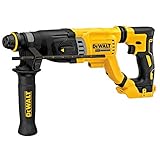
A rotary hammer uses a piston mechanism to strike the bit. The blows are stronger, and the tool does more of the concrete-breaking work for you. Most rotary hammers use SDS-Plus bits rather than the round-shank masonry bits that fit a regular drill chuck. Many also have a hammer-only setting, useful for light chipping.
For anchors, choose a bit that matches the anchor maker’s specified hole diameter. The hole must be deep enough for the anchor, plus a little room for dust at the bottom. Follow the anchor instructions: a hole that is too large can leave the fastener loose, while a shallow or dusty hole can keep it from seating properly.
Hammer drill or rotary hammer?
| Factor | Hammer drill | Rotary hammer |
|---|---|---|
| Best fit | A few small anchor holes in typical concrete | Many holes, harder concrete, or larger and deeper holes |
| Hole-making speed | Slows noticeably as the hole gets deeper or the concrete gets harder | Usually faster and less tiring in stubborn concrete |
| Bits | Commonly round-shank masonry bits held in a chuck | Usually SDS-Plus bits for small anchor work |
| Handling | Often lighter and more familiar | Bulkier; stronger blows can make it less pleasant for delicate work |
| Cost and storage | Often the cheaper choice, especially if already owned | Extra tool and SDS bits add cost and take up space |
When a hammer drill is enough
Use a hammer drill for a few holes in a concrete basement wall, a small bracket, or a light-duty shelf installation when the anchor instructions call for a modest hole. A cordless hammer drill is a sensible buy if you also need a general-purpose drill for wood, metal, and household projects.
For a typical 1/4-inch hole in sound but not unusually hard concrete, work in short bursts and keep the bit straight. Press firmly enough to maintain contact, but don’t lean your full weight on the drill. If the bit stops advancing, pull it out while it is still spinning slowly to clear dust, then continue. Excess pressure can overheat the bit, wear out the clutch or motor, and make it harder to keep the hole aligned.
A drill with a hammer setting is not automatically effective just because it has one. A tired battery, a blunt bit, a low-quality chuck, or very hard aggregate can turn a small job into a long one. If the hole takes more than about a minute of steady work to reach 1 inch deep, stop and check the bit and technique. If both are sound, a rotary hammer may save time and frustration.
When to step up to a rotary hammer
A rotary hammer makes sense for a row of anchors, repeated installations, hard concrete, or holes that are wider or deeper than typical light-duty anchor holes. It is also a good choice when you have already struggled with a hammer drill and don’t want to spend the afternoon pushing against the wall. A compact SDS-Plus rotary hammer is designed for this kind of work; check that its included or compatible bits match the hole sizes you need.
More power is not always better. For a single small hole in soft concrete, buying a rotary hammer and a set of SDS bits may cost more than the job warrants. Its stronger action can also chip the surface around a hole if you start at an angle or let the tool wander. Start with the bit square to the wall, use a light touch until it bites, and let the tool do the work.
Bits, dust, and hole quality
Use a sharp carbide-tipped masonry bit in the diameter specified for the anchor. A worn bit cuts slowly and can polish or enlarge the hole instead of making a clean one. If the bit gets hot, let it cool; quenching a hot bit in water can damage it. Keep the hole free of dust by withdrawing the bit periodically. For critical or heavy-duty anchors, clean the hole as directed by the anchor manufacturer rather than assuming drilling alone is enough.
Mark the required depth on the bit with tape, or use a depth stop. Drill a little deeper than the anchor’s embedment requirement only if its instructions allow it, leaving space for dust without weakening the installation. Avoid drilling into hidden wiring or plumbing; check the wall and the area on the other side before starting.
Wear safety glasses and hearing protection. Concrete dust is a health hazard, so use dust extraction or a suitable respirator, especially when drilling multiple holes indoors. A vacuum held near the bit helps, but it does not replace respiratory protection where dust is accumulating.
A practical buying decision
If you need two or three small holes and already own a hammer drill, try it first with a fresh bit. If you’re buying a tool for occasional home repairs, a hammer drill is usually the more versatile and economical choice. If you expect repeated anchor work, are facing hard concrete, or want a tool that drills without constant pushing, a rotary hammer is worth the added cost.
For an especially small job, renting or borrowing an SDS-Plus rotary hammer can be cheaper than buying one. Whatever tool you choose, the right bit, a clean hole, and the correct anchor matter as much as raw power.