What's inside
- Quick comparison: which drill sander attachment fits your job?
- Drum attachments: the versatile choice for edges and curves
- Disc attachments: fastest on small flat surfaces
- Flap wheels: the best compromise for blending and metalwork
- Detail attachments: control beats speed
- Buying guide: five specifications that matter
- Decision matrix for common users
- How to set up and use a drill sanding attachment
- Safety and ownership realities
- Quick comparison: which drill sander attachment fits your job?
- Drum attachments: the versatile choice for edges and curves
- Disc attachments: fastest on small flat surfaces
- Flap wheels: the best compromise for blending and metalwork
- Detail attachments: control beats speed
- Buying guide: five specifications that matter
- Decision matrix for common users
- How to set up and use a drill sanding attachment
- Safety and ownership realities
As an Amazon Associate I earn from qualifying purchases. This post may contain affiliate links at no extra cost to you.
The best sanding attachment for a drill depends on the job: choose a sanding drum for edges and contours, a disc for flat surfaces, a flap wheel for blending and deburring, or a detail attachment for small corners and profiles.
A drill can power useful sanding accessories, but it is not a dedicated random-orbit sander. Its chuck produces rotation rather than an orbital pattern, so it removes material quickly in a small area and can leave swirl marks or grooves if you stay in one place. The right attachment improves control, while the wrong one can overheat the workpiece, tear abrasive material, or overload the drill.
As an Amazon Associate we earn from qualifying purchases at no extra cost to you.


What we cover
- Quick comparison: which drill sander attachment fits your job?
- Drum attachments: the versatile choice for edges and curves
- Disc attachments: fastest on small flat surfaces
- Flap wheels: the best compromise for blending and metalwork
- Detail attachments: control beats speed
- Buying guide: five specifications that matter
- Decision matrix for common users
- How to set up and use a drill sanding attachment
- Safety and ownership realities
Quick comparison: which drill sander attachment fits your job?
| Attachment type | Typical grit range | Common size | Best materials | Balance and durability | Best use |
|---|---|---|---|---|---|
| Sanding drum | 60–240 grit | 1/2–1 in diameter; 1/4 in shank | Wood, plastic, painted edges | Usually balanced; sleeves wear quickly on sharp edges | Inside curves, holes, and edge shaping |
| Sanding disc | 40–400 grit | 2–5 in diameter | Wood, paint, plastic, light metal with suitable abrasive | Larger discs magnify wobble; backing pads can last months | Small flat areas and spot sanding |
| Flap wheel | 40–120 grit | 1–3 in diameter | Wood, steel, stainless steel, aluminum | More forgiving than a disc; flaps gradually wear away | Blending, rust removal, and deburring |
| Detail sanding head | 80–320 grit | 1–2 in pad or narrow finger | Wood, paint, plastic, delicate profiles | Small pads balance well but wear fastest at the tip | Corners, slots, carvings, and narrow profiles |
These are practical operating ranges rather than universal limits. Always follow the attachment maker’s maximum speed and use only abrasives rated for the material.
Drum attachments: the versatile choice for edges and curves
A sanding drum for a drill uses a cylindrical abrasive sleeve held on a rubber or solid mandrel. It is the most useful general-purpose option for woodworking because the curved surface can smooth a concave edge, enlarge a hole, or shape a template. A 1/2-inch drum gives better access in tight curves; a 1-inch drum removes material faster and leaves a gentler radius.
Look for a mandrel that fits your drill chuck securely, preferably a straight 1/4-inch shank for a standard 3/8-inch or 1/2-inch chuck. A split rubber drum is convenient because sleeves can be replaced without discarding the mandrel. Sanding sleeves with aluminum-oxide abrasive are a sensible choice for ordinary wood. For hardened finishes or metal, use an abrasive specifically labeled for that material.
Limitations of a sanding drum
- It can create a hollow or uneven edge if you press on one point.
- Fine dust quickly clogs low-quality sleeves, especially on paint or resinous wood.
- The rubber drum can swell or crack if exposed to solvents or excessive heat.
- A narrow sleeve may wear out after only a few small projects when used on rough end grain.
Disc attachments: fastest on small flat surfaces
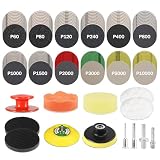
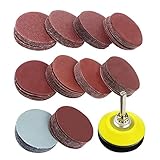
A drill sanding disc uses adhesive-backed paper, hook-and-loop discs, or a flexible sanding pad. It is a useful drill sanding attachment for rounding small panels, removing paint from a localized area, or smoothing a repair. A 2-inch disc is easier to control than a 5-inch disc; the larger the disc, the more a slight chuck wobble becomes visible at the rim.
Disc systems are usually less balanced than drum systems because the abrasive may not be centered perfectly. Use the shortest practical mandrel and tighten the chuck evenly. A flexible pad helps follow a curved surface, while a firm pad keeps an edge flatter. For woodworking, start around 80 or 120 grit and finish by hand or with a random-orbit sander when a broad, mark-free surface matters.
Do not treat a disc sanding attachment as a substitute for a cut-off wheel or grinding wheel. Paper and hook-and-loop discs are designed for sanding pressure, not for cutting or heavy side loading.
Flap wheels: the best compromise for blending and metalwork
A flap wheel consists of overlapping abrasive cloth flaps mounted around a hub. Compared with a rigid disc, it conforms better to a rounded edge and is less likely to dig a sharp track into the work. It is often the best sander drill attachment for deburring steel, removing light rust, blending weld discoloration, or softening rough wooden contours.
Choose aluminum oxide for general steel and wood. Zirconia or ceramic abrasive lasts longer under heavier metal work but is usually unnecessary for occasional woodworking. Flap wheels are sold in coarse grades such as 40 or 60 grit and finer grades around 80 or 120 grit. They are not normally the right choice for a polished finish.
The flaps wear unevenly when the wheel is used only on its outer tip. Move the tool continuously and use the broad face of the wheel where the shape allows. This improves both finish consistency and service life.
Detail attachments: control beats speed
A detail sanding attachment is designed for places a conventional disc or drum cannot reach: inside corners, narrow grooves, fretwork, and small curved profiles. Some use a narrow abrasive finger; others use miniature triangular or round pads driven through a small adapter.
These attachments remove material slowly, which is useful on thin stock and delicate joinery. Their small contact area also means heat builds quickly. Use light pressure and short passes, especially on veneer, plywood edges, plastic, and painted surfaces. If the attachment vibrates, inspect the pad, shank, and chuck before increasing speed.
Buying guide: five specifications that matter
1. Grit range
A useful kit should include at least coarse, medium, and fine options. For wood shaping, 60–80 grit removes material, 120–150 grit refines it, and 180–240 grit reduces visible scratches. Metal deburring commonly starts at 40–80 grit. A kit with many identical coarse sleeves is less useful than a smaller kit covering several grades.
2. Pad or drum size
Match the diameter to the work. Small accessories give better control and fit tight spaces; larger accessories cover more area but place greater leverage on the drill and are harder to keep flat. For most handheld drills, 1/2–1-inch drums and 2–3-inch discs are a practical range.
3. Material compatibility
Check both the abrasive and the backing. Aluminum oxide is a dependable general-purpose abrasive. Silicon carbide is useful for some plastics and finishing applications. Zirconia and ceramic are suited to more demanding metal work. Never assume that an accessory safe for wood is suitable for stainless steel or aluminum.
4. Balance and shank fit
A 1/4-inch shank fits many general-purpose drills, but verify the chuck capacity. A hex shank can reduce slipping in a compatible chuck, while a keyed chuck often grips round shanks more securely than an inexpensive keyless chuck. Reject any attachment with a visibly bent mandrel; vibration wastes abrasive and can damage the drill chuck.
5. Durability and replacement cost
Consumable sleeves, discs, and flaps are the parts that wear first. Compare the cost and availability of replacements, not just the price of the initial kit. A robust mandrel with replaceable abrasive is usually better value than a cheap all-in-one accessory that must be discarded after its abrasive is worn.
Decision matrix for common users
| Your situation | Recommended choice | Why |
|---|---|---|
| Occasional home repairs and a limited budget | 1/2-inch sanding drum kit | Low entry cost and useful for edges, holes, and curves |
| Frequent small woodworking projects | Drum plus 2–3-inch hook-and-loop disc pad | Covers curved and flat work without buying a large system |
| Metal deburring and rust removal | 40–80 grit flap wheel | Blends edges and conforms better than a rigid disc |
| Carving, lattice, or narrow corners | Detail sanding head with 120–240 grit media | Provides access and reduces the chance of flattening nearby surfaces |
| Large panels or finish-quality furniture work | Dedicated random-orbit sander | More even coverage, better dust collection, and less rotational marking |
How to set up and use a drill sanding attachment
- Inspect the shank, pad, drum, and abrasive for bends, cracks, or loose backing.
- Insert the shank fully into the chuck and tighten it at several positions if using a keyed chuck.
- Set the drill to a low or medium speed before touching the work. Increase speed only if the attachment runs smoothly and the material allows it.
- Secure the workpiece and test on scrap or an inconspicuous area.
- Keep the attachment moving. Use the abrasive’s weight rather than forcing it into the surface.
- Clean dust from the accessory and chuck after use; replace clogged or glazed abrasive instead of pressing harder.
As a practical estimate, a 3-inch disc has an abrasive contact circumference of about 9.4 inches, while a 1-inch drum has about 3.1 inches. The disc can cover more surface per pass, but its larger diameter also makes edge control more difficult. For a small 12-by-12-inch repair, a disc may save passes; for a curved cutout, the drum will usually save rework.
Safety and ownership realities
Wear eye protection, hearing protection, and a suitable dust mask or respirator for the material and dust-control conditions. Clamp the work, keep loose clothing away from the rotating accessory, and disconnect the drill before changing sleeves or discs. Sanding painted or treated material may require additional precautions based on the coating.
Common failures are caused by excessive pressure, running a large disc at an unsuitable speed, using a worn abrasive, and allowing dust into the chuck. Store sleeves and discs dry and flat, brush dust from flap wheels, and replace any pad that has lost its flatness or adhesion.
For most woodworkers, the best first purchase is a quality 1/2–1-inch sanding drum kit with several replacement grits. Add a small disc pad for flat spot repairs, choose a flap wheel when metal or blending is central to the work, and buy a detail attachment only when access—not material removal—is the main problem.