What's inside
As an Amazon Associate I earn from qualifying purchases. This post may contain affiliate links at no extra cost to you.
A screw extractor is a last-resort tool for a fastener whose drive is too damaged to turn normally. The right set can save a workpiece, but it cannot make every stuck screw come out. Extractors can snap if driven too hard, and a hardened steel fragment is difficult to drill out. Buy for the fasteners you actually encounter, then use a drill with controlled speed rather than an impact driver.
As an Amazon Associate we earn from qualifying purchases at no extra cost to you.



What we cover
Choose a set for the fastener, not the package size
For small stripped screws in hinges, appliances, or furniture, look for a set with small left-hand drill bits and extractors sized for roughly 2–6 mm fasteners. For larger screws, bolts, and machine fasteners, a set covering about 3–12 mm is more useful. Those ranges are approximate: manufacturers size sets differently, so check the stated pilot-hole and fastener sizes rather than relying on a count such as “10-piece.”
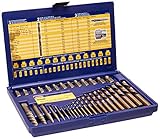
Most conventional extractors need a centered pilot hole. A left-hand drill bit may catch the screw and back it out before you even use the extractor. Sets that include both bits and extractors are convenient for general home and shop use. A left-hand drill bit and screw extractor set is a sensible starting point if you want one kit for mixed repair work.
Common extractor styles and their trade-offs
| Type | Best for | Trade-off |
|---|---|---|
| Spiral-flute extractor | Small- to medium-size screws with a drilled pilot hole | Strong bite, but tightening the tapered extractor can expand a thin fastener and make it harder to remove |
| Straight-flute extractor | Bolts and screws where you want less wedging force | May need a larger pilot hole and careful alignment |
| Left-hand drill bit | Fasteners that may loosen as the hole is drilled | Does not always grip; bits can wander on a rounded head |
| Extractor sockets | Rounded external bolt heads | Not for stripped internal screw drives; need access around the head |
For occasional household repairs, a modestly priced set is usually enough. A more expensive kit can be worthwhile if it has accurately sized bits, clear size markings, and a sturdy case, or if you extract fasteners regularly. Extra pieces do not automatically mean better performance. A basic extractor set with left-hand bits covers common jobs without paying for a large assortment you may never use.
How to remove a damaged fastener
Start by stopping as soon as the driver slips. More spinning usually rounds the recess further. If the fastener is exposed, clean the head and try a correctly fitting bit by hand or at low drill speed. A manual impact driver can sometimes free a stuck screw with less risk of cam-out than a cordless impact driver.
If the drive is unusable, center-punch the fastener. This matters: a pilot hole off-center can damage threads or break through the side of a small screw. Fit the recommended left-hand bit, set the drill to low speed, and apply steady pressure. A range of roughly 200–500 rpm is a useful starting point for small fasteners; avoid high speed and let the bit cut. If the screw starts backing out, stop drilling and remove it with pliers.
If drilling alone does not work, use the extractor size specified for that pilot hole. Turn it counterclockwise with a tap wrench or small hand tool, keeping it straight. Do not use a cordless drill or impact driver to spin an extractor: the sudden torque can snap it. Apply firm, controlled hand pressure, and stop if the extractor slips or twists noticeably. A stuck extractor is a common failure, and its hard steel can defeat ordinary drill bits.
When an extractor is the wrong choice
Extractors work best when the fastener is accessible, the head is large enough to drill centrally, and the fastener is not badly seized. A tiny screw in a delicate part may be better handled by a repair shop. For a screw with a raised head, locking pliers may grip it without drilling. For a rounded external bolt head, use an extractor socket rather than a screw extractor.
Rust, thread-locking compound, and corrosion can hold a fastener more tightly than the extractor can grip it. Penetrating oil may help on metal-to-metal joints; give it time to work, and protect nearby finishes. Gentle heat can loosen some thread-locking compounds, but it is unsuitable near plastics, wiring, fuel, or heat-sensitive finishes. If the fastener is in a valuable part, or the pilot hole is drifting, stop before the damage spreads.
Drill setup and buying checks
Use a corded drill or cordless drill with a controllable clutch and low-speed setting. A hammer drill’s hammer mode is for masonry, not metal fasteners; switch it off. An impact driver is useful for driving screws, but its rapid blows make it a poor choice for drilling an extractor pilot hole or turning the extractor itself. Secure the workpiece, wear eye protection, and clear metal chips as you go.
Before buying, check whether the kit includes left-hand bits, the usable size range, and replacement-bit availability. Confirm that the extractor sizes match the pilot-hole chart, and look for legible markings you can read after the first few uses. If you already own good left-hand bits, a smaller extractor-only set may be cheaper and perfectly adequate. The best set is the one that fits your fasteners and lets you work slowly—not the one with the most pieces.