What's inside
As an Amazon Associate I earn from qualifying purchases. This post may contain affiliate links at no extra cost to you.
Small cabinets are harder on hollow drywall anchors than pictures, shelves, or towel bars. A cabinet creates leverage: its weight pulls outward from the wall, and the load increases when a door is opened or someone grabs the cabinet. The best anchor depends on the cabinet’s weight, the wall thickness, and whether you can reach behind the wall.
As an Amazon Associate we earn from qualifying purchases at no extra cost to you.



What we cover
Choose the anchor by load and cabinet design
First, estimate the loaded weight. A small wall cabinet may weigh 15 to 30 pounds empty, then add dishes, hardware, or tools. Use the cabinet’s mounting rail or back cleat whenever possible, and put at least one fastener into a stud. Anchors should support the remaining load, not compensate for a cabinet that is poorly attached or hanging from one small screw.
For a cabinet that will hold light items, a properly installed self-drilling drywall anchor can be adequate. For heavier cabinets or anything above a workbench, use a toggle-style anchor. Toggle anchors spread the load across a much larger area behind the drywall and tolerate the outward pull better.
| Anchor type | Best use | Advantages | Limitations |
|---|---|---|---|
| Self-drilling plastic or metal anchor | Light cabinets and low-use storage | Fast installation; no access behind the wall | Lower pull-out resistance; can strip or spin |
| Expansion or “molly” anchor | Medium loads in sound drywall | Good bearing area; removable types are useful | Requires a correctly sized hole and careful setting |
| Snap-toggle or strap-toggle | Heavier cabinets and high outward loads | Strong, broad load distribution; reliable in hollow walls | Requires a larger hole; toggle can be lost inside the wall if removed |
| Toggle bolt | Heavy-duty mounting where the bolt can be inserted separately | Strong and inexpensive | Awkward to install through a cabinet; wings need clearance behind the wall |
Best general choice: snap-toggle anchors
For most small cabinets mounted entirely in drywall, a snap-toggle is the safest default. Its metal channel or toggle sits flat against the back of the drywall instead of relying on a small plastic thread. Use two or more anchors through a solid mounting strip, rather than placing anchors through thin cabinet material alone.
Look for a toggle rated for 1/2-inch drywall if that is what you have. Ratings vary widely and are often based on a centered, static load in new drywall. A practical installation should use a substantial safety margin. If the cabinet and contents weigh 40 pounds, do not choose anchors whose combined published rating is only 40 pounds. Aim for at least twice the expected load, and more if the cabinet will be opened frequently.
Some snap-toggles require a hole around 1/2 inch to 3/4 inch in diameter. That is not a problem behind a mounting rail, but it can be difficult to hide in a narrow cabinet back. Drill the hole with a sharp drywall drill bit, keeping the drill square to the wall. Do not use hammer mode on drywall; it enlarges the hole and damages the paper face.
When cheaper anchors are fine
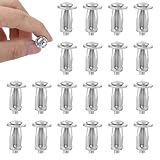
Self-drilling anchors are reasonable for a small medicine cabinet, shallow utility box, or display cabinet holding less than roughly 15 to 20 pounds. They are also useful when the cabinet has several mounting points and the load stays close to the wall. Metal versions generally resist stripping better than basic plastic versions, but they are not automatically suitable for heavy cabinets.
Do not rely on a self-drilling anchor when the cabinet projects far from the wall, has heavy doors, or will store tools, dishes, or books. The problem is not just vertical weight. A 12-inch-deep cabinet can produce considerable leverage at the top mounting screws, especially when the door is pulled open. Plastic threads can tear out of the gypsum, leaving an oversized hole that will not hold a replacement anchor.
Molly bolts are a useful middle ground. A pointed version can be driven into the drywall, while a non-pointed version requires a drilled hole. Once set, the metal sleeve expands behind the panel. Choose the correct grip range for your drywall thickness; an anchor that is too long may not clamp properly, and one that is too short may crush the wall surface.
Find studs before drilling
Use a stud finder, then confirm the location with a small drill bit or finish nail. Typical stud spacing is 16 inches on center, but do not assume it. If a stud lines up with the cabinet’s mounting rail, drive a structural screw into it instead of using an anchor. A 2 1/2- or 3-inch screw is common for drywall over wood framing, but it must enter solid wood without striking wiring or plumbing.
Never drill blindly near switches, outlets, plumbing fixtures, or radiators. Electrical cables are often routed through the center of studs and protected by metal nail plates, but that protection is not a guarantee. If the drill suddenly meets hard metal, stop. Do not force the bit through it.
A reliable mounting procedure
Remove doors and shelves if doing so makes the cabinet lighter. Hold the cabinet level, mark the mounting holes, and check that the holes land on the cabinet’s strongest rail or cleat. A cabinet hanging from its thin back panel can pull the panel loose even when the drywall anchors hold.
Drill the pilot holes to the anchor maker’s specified diameter. A cordless drill with a clutch is preferable to an impact driver for this step because it gives better control and creates less damage. If you must enlarge a hole, use a sharp bit and clean the dust from the opening. Drywall dust can prevent some anchors from gripping properly.
Install the anchors without crushing the drywall paper. For toggle anchors, make sure the channel has fully opened behind the wall before tightening. Tighten the screw until the mounting rail is snug, then stop. Excess torque can compress the gypsum, pull the anchor through the face, or distort the cabinet rail.
Use a mounting rail for heavier cabinets
If the cabinet is near the upper end of a hollow-wall anchor’s practical capacity, install a plywood backer or a continuous French cleat across several studs. A 3/4-inch plywood mounting strip spreads the load and gives you multiple screw locations. This is usually stronger and more forgiving than placing four isolated anchors in drywall.
For cabinets holding power tools, canned goods, or other dense items, use studs or open the wall to add blocking. A heavy-duty French cleat can simplify leveling and distribute the load, but it still needs screws into framing or properly installed blocking. Hollow-wall anchors are convenient; they are not a substitute for structural support when the consequences of failure are serious.