What's inside
As an Amazon Associate I earn from qualifying purchases. This post may contain affiliate links at no extra cost to you.
What we cover
Best Screwdriver Set for Electronics: Precision Picks
The best screwdriver set for electronics for most repairers is a precision kit with accurately machined Phillips and Torx bits, a useful range of small sizes, and a handle that gives controlled fingertip torque. Choose an ESD-safe set if you work on static-sensitive boards; choose a longer-shaft kit if screws sit deep in housings. No single set is ideal for phones, laptops, consoles, and household electronics alike.
Our picks by repair situation
- Best all-around: iFixit Mako Driver Kit. Its 64 bits cover common Phillips, Torx, security Torx, pentalobe, and other specialty profiles, making it a versatile choice for mixed-device repair. It is a strong fit for a bench kit, though the broad selection takes more space than a small everyday set.
- Best for phone and laptop work: iFixit Minnow Driver Kit. Its compact selection is aimed at small-device fasteners, including common Phillips, Torx, and pentalobe sizes. Pick it for portability and familiar repairs; a larger kit is better if you regularly encounter unusual screws.
- Best for electronics benches with ESD precautions: Wiha precision screwdriver sets with ESD-safe handles. Wiha sells multiple configurations, so check the exact included sizes and profiles before buying. An ESD-safe handle can be part of a static-control setup, but it is not a substitute for a grounded mat, wrist strap, or proper handling procedures.
- Best for deep or recessed screws: a precision set with long, narrow shafts and a slim handle. Prioritize reach and clearance over a high bit count; a bulky magnetic bit holder may not fit down a narrow well.
Compare the trade-offs
The figures below describe kit contents and practical selection criteria, not a guarantee that every fastener in a category will fit. Product configurations can change, so confirm the current package contents before purchase.
As an Amazon Associate we earn from qualifying purchases at no extra cost to you.

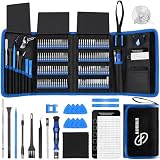


| Option | Bit count | Useful coverage | Best suited to | Key trade-off |
|---|---|---|---|---|
| iFixit Mako Driver Kit | 64 bits | Phillips, Torx, security Torx, pentalobe, and specialty profiles | Mixed electronics and occasional unfamiliar fasteners | More bits and case space than a basic repair kit |
| iFixit Minnow Driver Kit | 16 bits | Common small-device profiles, including Phillips, Torx, and pentalobe | Portable phone and laptop repairs | Less coverage for less-common screw types |
| Wiha ESD precision set | Varies by set; check package | Precision profiles selected for the specific configuration | Bench work where ESD precautions are part of the workflow | Contents and shaft lengths differ across sets |
| Long-shaft precision set | Varies by set | Choose profiles and sizes to match your equipment | Recessed fasteners and narrow access paths | Long shafts can flex more; avoid using them as pry tools |
What matters more than the bit count
Size range and Phillips or Torx fit
A kit with dozens of bits is useful only if it includes the exact profile and size your screw needs. Small electronics commonly use several Phillips sizes, Torx, security Torx, and, in some products, pentalobe or other proprietary profiles. Check repair documentation or inspect a matching screw before buying rather than assuming “precision” means universal coverage.
Fit is especially important with tiny Phillips screws. A bit that is too small may turn inside the recess; one that is too large may sit high and contact only the edges. Both can damage the screw. Seat the bit fully, hold the driver in line with the screw, and stop if it slips. For Torx, the correct size should engage firmly without rocking.
ESD safety and magnetism
Static electricity can damage sensitive components, but an ESD-labeled handle alone does not make a repair station safe. For board-level work, use a suitable grounded ESD mat and wrist strap according to their instructions, and avoid handling contacts unnecessarily. Disconnect power and batteries where the device’s service procedure allows.
A mildly magnetized tip can help keep a tiny screw from falling, but strong magnetism is not necessary for most repairs. Magnetic tips are generally convenient for ordinary screws; keep them away from magnetic media and sensitive components when the device maker’s guidance calls for caution. If a screw is extremely small or sits over an exposed board, control it with tweezers rather than relying on the bit alone.
Shaft access and handle control
Short bits work well in open housings, while long, narrow shafts reach down wells and past brackets. Before choosing, consider the tightest access point you expect to encounter: a long shaft can reach farther, but it cannot compensate for a handle or bit holder too wide to enter the opening. A rotating cap supports fingertip turning; a thicker handle is more comfortable for repeated work, but encourages excess torque if you grip it like a full-size screwdriver.
Choose by your repair pattern
| Your situation | Best direction | Why |
|---|---|---|
| Occasional phone or laptop repair; limited storage | Compact 16-bit-style kit | Covers common small-device jobs without carrying many rarely used profiles |
| Mixed devices or uncertain screw types | Broad kit with 60 or more bits | More likely to include specialty profiles when a standard Phillips or Torx will not fit |
| Frequent board-level bench work | ESD-safe precision drivers plus a grounded work setup | Supports a consistent static-control routine; the handle alone is not the protection system |
| Fasteners deep inside a case | Long-shaft set with slim profiles | Prioritizes reach and clearance instead of unused bit variety |
| Budget-conscious beginner | Small kit with clearly labeled, commonly used sizes | Lower initial cost and simpler selection; expand only when a repair requires a missing profile |
Durability: what wears out first
On a precision set, the bit tips usually take the most abuse. Poor fit, off-axis turning, and using the driver to break loose a stuck screw can round small tips quickly. Handles and cases may last longer, but loose bit retention, worn labels, or a damaged rotating cap can make a kit frustrating even when its bits remain usable.
- Match the bit before applying force. If it rocks or slips, stop and try the correct size rather than pressing harder.
- Keep the driver straight. A tilted bit concentrates force on one edge and can strip both screw and tip.
- Use gentle torque. Small device screws need little force. If one will not move, check for a hidden fastener or thread-locking method instead of using a longer handle for leverage.
- Clean and store bits dry. Wipe away debris after use and return each bit to its labeled slot. This reduces corrosion risk and prevents the wrong profile being grabbed in a hurry.
For frequent repair work, replace a worn bit rather than compensating with extra pressure. A damaged screw can turn a quick repair into a difficult extraction, and a replacement bit is usually cheaper than that lost time.
Bottom line
For one versatile purchase, the iFixit Mako’s 64-bit assortment is a practical choice for varied electronics. For a smaller portable kit, the iFixit Minnow offers a more focused 16-bit selection. Choose a Wiha ESD configuration when its specific bit lineup suits your work and static-control habits are already in place. Before ordering any set, verify the exact sizes, shaft length, and security profiles you need: precise fit matters more than the largest number printed on the case.