What's inside
As an Amazon Associate I earn from qualifying purchases. This post may contain affiliate links at no extra cost to you.
Toggle bolts and molly bolts both grip behind drywall, but they work differently. A toggle spreads its load across a hinged bar; a molly expands a metal sleeve inside the wall. The better choice depends on the item, the cavity behind the wall, and whether you may want to remove the fastener later.
As an Amazon Associate we earn from qualifying purchases at no extra cost to you.


What we cover
How the anchors work
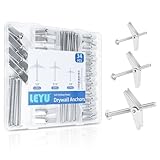
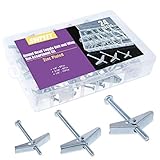
A traditional toggle bolt has a threaded screw and a spring-loaded metal bar. You fold the bar, push it through a hole, and let it open behind the drywall. Tightening the screw pulls the bar against the back of the wall. The bar distributes force over a relatively wide area, which makes toggles useful for heavier loads when the wall is sound and the cavity is clear.
A molly bolt is a metal sleeve with a screw. As you tighten the screw, the sleeve expands and forms legs or folds behind the drywall. The sleeve stays in the hole after you remove the screw, so you can usually take an object down and reinstall it without losing the anchor. Some molly bolts are designed to be set with a dedicated tool; others can be expanded by tightening the screw.
Toggle bolts vs. molly bolts
| Factor | Toggle bolt | Molly bolt |
|---|---|---|
| Behind the wall | Wide hinged bar | Expanding sleeve and legs |
| Hole size | Often larger, sized for the folded bar | Usually smaller; follow the package drill size |
| Removal | Removing the screw often lets the bar fall into the cavity | Sleeve generally remains in the wall |
| Best fit | Heavier static loads with a clear cavity | Light-to-medium loads and items that may be removed |
| Main drawback | Needs room behind the wall; bar can be lost inside | Less forgiving if overtightened or set poorly |
These are broad comparisons, not load ratings. Capacity varies by anchor size, drywall thickness, installation quality, and how the load pulls on the wall. Use the manufacturer’s rating for the exact product and material, and leave a margin rather than treating the listed maximum as a working target.
When a toggle bolt makes sense
Choose a toggle when a bracket, shelf, or other fixed item needs a broad bearing surface behind intact drywall. A common 1/8-inch toggle screw, for example, needs a hole large enough for its folded bar—often around 1/2 inch, though dimensions vary. Check the package before drilling. That larger opening is the trade-off for getting the bar through the wall.
Before installation, confirm the cavity is deep and clear enough for the bar to open. A stud, pipe, insulation, or a second layer of wallboard can block it. When the bar opens, keep gentle outward pressure on the screw as you tighten; otherwise the bar may spin instead of seating. Tighten until the fixture is snug, not until the drywall dimples or crushes.
One important failure mode: if you remove a standard toggle screw, the loose bar can fall into the wall. If the item will need frequent removal, a toggle may be inconvenient. A strap-style toggle is a different design that can retain its channel, but it still needs a fairly large opening. For traditional hardware, compare toggle bolts for drywall by the bar size, screw length, and rated wall thickness.
When a molly bolt makes sense
A molly is a practical choice for towel bars, small shelves, mirrors, and similar fixtures when you want the anchor to stay in the wall after removing the screw. Its smaller hole can also be easier to patch than a large toggle opening. Match the molly’s grip range to the wall thickness; an anchor that is too long may not expand properly, while one that is too short may not clamp securely.
Set the sleeve square to the wall. If the package calls for a setting tool, use it: the tool expands the sleeve without relying on the fixture to hold the anchor still. With screw-set types, stop when the sleeve has expanded firmly. Overtightening can crush gypsum, spin the anchor, or pull the front flange into the paper face. If it spins before setting, stop rather than repeatedly tightening; the hole may already be damaged.
Browse metal molly bolts for drywall by the stated wall-thickness range and screw size, not just the package’s headline load figure.
Drilling and installation basics
Use the drill-bit diameter specified on the package. A cordless drill is enough for drywall; a hammer drill is not appropriate because hammering can break out the gypsum and make an oversized, weak hole. A sharp twist bit and low-to-medium speed give better control. Don’t push hard as the bit breaks through. For a toggle, the hole must pass the folded bar; for a molly, a hole that is too large can prevent the sleeve from gripping.
Check for studs, wiring, and plumbing before drilling. A stud finder helps locate framing, but verify the area and avoid drilling where utilities may run. If you hit resistance that does not feel like drywall, stop. For heavy loads, a fastener into a stud or a properly installed backing board is usually a better choice than any hollow-wall anchor.
Match the anchor to the load
Consider how the load acts. A picture hangs mostly downward, while a shelf bracket can pry outward on its upper screws. A towel bar gets repeated pulls, which can loosen an anchor even if its static weight is modest. Use multiple anchors as the fixture maker specifies, but don’t assume their individual ratings simply add up: uneven mounting and leverage can concentrate much of the force on one fastener.
For cabinets, grab bars, heavy TVs, or anything that could injure someone if it falls, fasten into studs or solid blocking whenever possible. Hollow-wall anchors are not a substitute for structural support. A cheaper molly is fine for a light fixture with modest loads; paying for a larger toggle is worthwhile only when the wall, cavity, and load suit that design.