What's inside
- Quick comparison: the best tagines by material
- Best overall: enameled cast-iron tagine (2.5–3 qt)
- Best classic flavor for the money: glazed terracotta tagine
- Best oven-to-table ceramic: flame-safe ceramic tagine
- Best for traditionalists: unglazed clay tagine
- Best budget and lightest: aluminum tagine with a steel-clad base
- How to choose: the numbers that matter
- Care routine, step by step
- Ownership realities: what wears out first
- Frequently Asked Questions
- Quick comparison: the best tagines by material
- Best overall: enameled cast-iron tagine (2.5–3 qt)
- Best classic flavor for the money: glazed terracotta tagine
- Best oven-to-table ceramic: flame-safe ceramic tagine
- Best for traditionalists: unglazed clay tagine
- Best budget and lightest: aluminum tagine with a steel-clad base
- How to choose: the numbers that matter
- Care routine, step by step
- Ownership realities: what wears out first
- Frequently Asked Questions
As an Amazon Associate I earn from qualifying purchases. This post may contain affiliate links at no extra cost to you.
For most kitchens, the best tagine is an enameled cast-iron model in the 2.5–3 qt (2.4–2.8 L) range: it works on gas, electric, and induction without a diffuser, holds a low simmer for hours, and needs no seasoning. If you want the traditional clay result and a lower entry price, a glazed terracotta tagine is the better buy — provided you always cook it over a heat diffuser. Ceramic and aluminum tagines earn their place only when oven-to-table looks or light weight matter more to you than heat retention.
As an Amazon Associate we earn from qualifying purchases at no extra cost to you.


What we cover
- Quick comparison: the best tagines by material
- Best overall: enameled cast-iron tagine (2.5–3 qt)
- Best classic flavor for the money: glazed terracotta tagine
- Best oven-to-table ceramic: flame-safe ceramic tagine
- Best for traditionalists: unglazed clay tagine
- Best budget and lightest: aluminum tagine with a steel-clad base
- How to choose: the numbers that matter
- Care routine, step by step
- Ownership realities: what wears out first
- Frequently Asked Questions
Our Top Picks


Quick comparison: the best tagines by material
| Pick | Best for | Key specs | Typical price |
|---|---|---|---|
| Enameled cast-iron tagine | Best overall | 2.5–3 qt / 2.4–2.8 L; 3.5–4.5 kg total; all hobs incl. induction; oven to 260 °C / 500 °F | $180–$350 |
| Glazed terracotta tagine | Best classic flavor per dollar | 28–30 cm; 2–3 L; 1.8–2.5 kg; gas or charcoal with diffuser; no induction | $40–$90 |
| Flame-safe ceramic tagine (Emile Henry class) | Best oven-to-table | 2.5–3.5 L; 2–3 kg; direct stovetop and oven to 260 °C per maker’s spec sheet; dishwasher-safe | $120–$190 |
| Unglazed clay tagine | Best for traditionalists | 26–30 cm; 2–3 L; requires soaking and seasoning; gas with diffuser only | $25–$60 |
| Aluminum tagine with steel-clad base | Best budget and lightest | 2.5–3.5 L; 1–1.5 kg; induction only if base is magnetic; nonstick interior | $35–$80 |
Best overall: enameled cast-iron tagine (2.5–3 qt)
Cast iron with an enamel coating is the only tagine material that clears every practical hurdle at once. The base is heavy enough — typically 3.5–4.5 kg (8–10 lb) for the whole pot — that the temperature barely drops when you lift the cone to add olives or preserved lemon, and the enamel means you never season it, never worry about acidic tomatoes or lemons, and can wash it with soap. Le Creuset’s cast-iron tagine is the reference model in this class, and the same format appears from several European enamelware makers.
Who it suits: anyone cooking for two to four people several times a month, on any hob type, who wants one vessel that also works as a small braiser and a serving dish. Trade-off: weight and price. You pay roughly three to five times what a clay tagine costs, and you give up the porous-clay effect that traditionalists argue rounds out the flavor.
Best classic flavor for the money: glazed terracotta tagine
A 28–30 cm terracotta tagine from a Moroccan pottery tradition costs a fraction of cast iron and does the one thing the heavy pot cannot: the thick, slightly porous walls buffer heat so gently that a stew can sit at a bare tremble for two hours without scorching. Glazed interiors need no seasoning, and the conical lid’s interior ridges channel condensation back down onto the food, which is the whole mechanical point of the shape.
Who it suits: gas and charcoal cooks who want the traditional result and don’t mind hand washing. Trade-off: fragility and hob limits. Terracotta cannot go on induction, needs a diffuser on gas, and dies from thermal shock — cold water into a hot pot, or a hot pot set on a cold stone counter, is the most common way these crack. The lid rim is the second most common failure point.
Best oven-to-table ceramic: flame-safe ceramic tagine
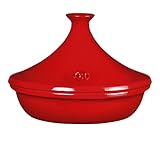
Emile Henry’s Flame line is the clearest example of a ceramic tagine built for real heat: per the manufacturer’s spec sheet, it goes directly on the stovetop and into an oven up to 260 °C (500 °F), and it is dishwasher-safe. At roughly 2–3 kg it is far easier to lift than enameled cast iron, and it comes in finishes you can carry straight to the table.
Who it suits: cooks who want clay-adjacent browning and a serving piece in one, and who value dishwasher-safe cleanup. Trade-off: moderate heat retention. It responds to burner adjustments quickly, which is helpful for sauces and less helpful for a long unattended braise, and it still needs a diffuser on most hobs to avoid a hot ring on the base.
Best for traditionalists: unglazed clay tagine
Unglazed clay is the most porous option, and that porosity is the entire argument for it: the pot absorbs some liquid and releases it as steam, which many cooks describe as a deeper, earthier result. It is also the cheapest way into tagine cooking and the most demanding to own.
Who it suits: cooks on gas who enjoy a maintenance routine and want the most traditional vessel available. Trade-off: it must be soaked before the first use and seasoned, it should never see soap, it holds onto strong smells, and it cracks if heated too fast or cooled too quickly. Budget for a replacement every few years.
Best budget and lightest: aluminum tagine with a steel-clad base
Aluminum tagines are thin, light (1–1.5 kg), and inexpensive, and a steel disc bonded into the base makes them induction-compatible. They heat fast and are easy to store in a small kitchen.
Who it suits: renters, small kitchens, and anyone cooking for one or two who wants to try tagine cooking before investing. Trade-off: low heat retention and a nonstick coating that is a consumable, not a permanent feature — expect one to three years of regular use before it degrades. Thin walls also create hot spots, so keep the heat low.
How to choose: the numbers that matter
Size and capacity math
Measure your burner grate before you buy. If the flame ring or element is wider than the tagine’s base, heat climbs the sides — harmless on cast iron, fatal on clay. As a working rule, a 28 cm tagine serves three to four, and a 30–32 cm tagine serves four to six.
For capacity, plan on 300–350 mL (1¼–1½ cups) of finished stew per serving. A 2.5 L tagine nominally holds seven of those servings, but you should fill it no more than two-thirds so the cone has headroom to condense and return steam. That drops its real working capacity to about four or five generous servings. Cooking for six regularly means buying 3.5 L or larger, or browning meat in batches in a separate pan.
Heat retention and stovetop compatibility compared
| Material | Heat retention | Stovetop | Typical capacity | Weight (28–30 cm) | Care |
|---|---|---|---|---|---|
| Glazed terracotta | High — thick insulating walls | Gas or charcoal with diffuser; not induction | 2–3 L | 1.8–2.5 kg | Hand wash, avoid soap on unglazed rims, never thermal-shock |
| Flame-safe ceramic | Moderate | Gas, electric, halogen; induction with a diffuser | 2.5–3.5 L | 2–3 kg | Dishwasher-safe; oven to 260 °C |
| Enameled cast iron | Very high | All hobs including induction | 2.5–3 L | 3.5–4.5 kg | Hand wash preferred; no seasoning; oven to 260 °C |
| Unglazed clay | High | Gas with diffuser only | 2–3 L | 1.5–2.5 kg | Soak, season, no soap, hand wash, dry fully |
| Aluminum (nonstick) | Low | All hobs if the base is magnetic; otherwise gas and electric only | 2.5–3.5 L | 1–1.5 kg | Hand wash, no metal utensils, coating replaced every 1–3 years |
Cost per use
A $250 enameled cast-iron tagine used twice a month for ten years is about 240 cooks — roughly $1.05 per use, with the pot usually outliving that window. A $60 glazed terracotta tagine used at the same rate typically reaches three to five years, or 72–120 cooks, for about $0.50–$0.83 per use — but a single thermal-shock crack resets that math to zero. If you cook tagine twice a year, the clay pot is the rational buy; if it becomes a weekly habit, cast iron is cheaper per meal within about four years.
Care routine, step by step
- Match the pot to the burner. Keep the flame or element no wider than the base — a flame licking up a clay wall is the leading cause of cracking.
- Use a diffuser under clay and ceramic. A $10–$20 cast-iron or perforated metal plate spreads heat and cuts the temperature gradient across the base, which is what thermal shock feeds on.
- Fill no more than two-thirds. The cone needs open space above the liquid to condense steam and drip it back; a full pot just boils over.
- Cook at 150–175 °C (300–350 °F). Tagine cooking is steam-driven. A rolling boil dries the stew and bakes onto the base.
- Cool before washing, and never add cold liquid to a hot pot. Let it come down to room temperature on a wooden board or folded towel, not stone or tile.
- For unglazed clay, soak the base and lid fully submerged for 30 minutes before the first use, rub the interior with a neutral oil, then bake for one hour at 100–120 °C. Saturated, sealed pores stop the pot from stealing liquid from your stew and reduce cracking.
Ownership realities: what wears out first
- Terracotta and unglazed clay: hairline cracks from thermal shock, glaze crazing on the interior, and chips on the lid rim. The cone is the part you cannot replace on its own in most cases.
- Ceramic: rim chips and handle stress points. The cooking surface itself holds up well and tolerates the dishwasher.
- Enameled cast iron: the enamel chips at the rim and where the lid rests. Interior browning is cosmetic and does not affect performance. Never preheat it empty on high heat.
- Aluminum nonstick: the coating is the consumable. Metal utensils and stacking scratch it, and once it flakes the pot is done.
Frequently Asked Questions
Can you use a tagine on an induction hob?
Only if the base is ferromagnetic. Enameled cast-iron tagines work on induction directly, and aluminum tagines work if a steel plate is bonded into the base — test with a fridge magnet. Terracotta and most ceramic tagines will not heat on induction; if you own an induction hob and want clay-style cooking, choose a cast-iron or steel-clad model instead.
Do you really need a heat diffuser for a clay tagine?
On gas and electric, yes. A diffuser spreads the flame or element across the base instead of concentrating it in a ring, which is what causes the cracks that end most clay tagines. They cost very little and are the single cheapest way to extend the life of the pot.
How do you clean a clay tagine?
Let it cool completely, then wash with warm water and a soft sponge. Glazed interiors tolerate mild dish soap; unglazed clay should not see soap because it absorbs it and can hold the smell. Dry it fully before storing and never stack another pot inside the cone.
What size tagine serves four people?
A 28 cm, roughly 2.5 L tagine is the right size for four modest portions, using the 300–350 mL per serving rule and the two-thirds fill limit. If you want leftovers or your four eaters are hungry, step up to 30–32 cm and 3.5 L.
Is a cast-iron tagine worth the extra cost over clay?
It is if you cook tagine often, use induction, or want one pot that doubles as a braiser and can go in the oven at high heat without a diffuser. Clay wins on price, weight, and the traditional porous-wall character. Neither is objectively better; the choice follows your hob and your cooking frequency.
Can you put a tagine in the oven?
Enameled cast iron and flame-safe ceramic can go in the oven, typically to 260 °C (500 °F) per their spec sheets. Glazed terracotta often can at lower temperatures, but check the maker’s stated maximum, and remove any plastic or wooden knob from the lid first. Unglazed clay generally should not go in a conventional oven unless the maker explicitly rates it for that.