What's inside
- Top 3 Picks
- Quick Comparison
- How We Chose
- 1. Ho Stevie! Surfboard Car Racks – Best for Cars With No Rails at All
- 2. INNO Racks Locking Surfboard Roof Rack – Best for Locking Security and Highway Miles
- 3. COR Surf Aero Roof Rack Pads – Best for Cars That Already Have Crossbars
- 4. BLOCKSURF Surfboard Roof Rack – Best for Heavier Loads on SUVs and Larger Cars
- 5. DORSAL Surfboard Tie Down Straps – Best Budget Strap Set for Surf, Kayak and SUP
- 6. Drytuns Surfboard Rack for Car – Best Budget Complete Soft Rack
- 7. Ho Stevie! Aero Roof Rack Pads – Best for Narrow Crossbar Spreads and SUP Paddlers
- 8. HIKULA Surfboard Roof Racks – Best Ultra-Budget Second Setup
- 9. Dopaka Soft Roof Rack Pads – Best Budget Kit With Bow and Stern Lines Included
- Top 3 Picks
- Quick Comparison
- How We Chose
- 1. Ho Stevie! Surfboard Car Racks – Best for Cars With No Rails at All
- 2. INNO Racks Locking Surfboard Roof Rack – Best for Locking Security and Highway Miles
- 3. COR Surf Aero Roof Rack Pads – Best for Cars That Already Have Crossbars
- 4. BLOCKSURF Surfboard Roof Rack – Best for Heavier Loads on SUVs and Larger Cars
- 5. DORSAL Surfboard Tie Down Straps – Best Budget Strap Set for Surf, Kayak and SUP
- 6. Drytuns Surfboard Rack for Car – Best Budget Complete Soft Rack
- 7. Ho Stevie! Aero Roof Rack Pads – Best for Narrow Crossbar Spreads and SUP Paddlers
- 8. HIKULA Surfboard Roof Racks – Best Ultra-Budget Second Setup
- 9. Dopaka Soft Roof Rack Pads – Best Budget Kit With Bow and Stern Lines Included
As an Amazon Associate I earn from qualifying purchases. This post may contain affiliate links at no extra cost to you.
If your car has no roof rails, the best surf rack for most drivers is the Ho Stevie! Surfboard Car Racks. It is a padded soft-rack system that threads its straps through the door frames of any car with normal framed doors, carries up to three boards, and uses padded “no scratch” buckles so you can cinch a board down hard without denting the deck or chipping roof paint. It suits weekend and twice-a-week surfers in sedans, hatchbacks, wagons and small SUVs — anyone who needs a rack that installs in minutes, folds into a bag, and does not require buying crossbars, towers or a vehicle-specific fit kit.
Two alternatives cover the edges of that decision. If you want your boards locked to the car and you cover real highway miles, the INNO Racks Locking Surfboard Roof Rack is the premium answer, with a listed capacity of three shortboards or two longboards and a locking car-top mount. If budget is the constraint, the Drytuns soft rack and the DORSAL 15 ft strap set do the same basic job for less money. Everything below is organised around the five things that actually decide whether a rack works on a rail-less car: board capacity, door-frame compatibility, padding, tie-down security and highway durability.
What we cover
- Top 3 Picks
- Quick Comparison
- How We Chose
- 1. Ho Stevie! Surfboard Car Racks – Best for Cars With No Rails at All
- 2. INNO Racks Locking Surfboard Roof Rack – Best for Locking Security and Highway Miles
- 3. COR Surf Aero Roof Rack Pads – Best for Cars That Already Have Crossbars
- 4. BLOCKSURF Surfboard Roof Rack – Best for Heavier Loads on SUVs and Larger Cars
- 5. DORSAL Surfboard Tie Down Straps – Best Budget Strap Set for Surf, Kayak and SUP
- 6. Drytuns Surfboard Rack for Car – Best Budget Complete Soft Rack
- 7. Ho Stevie! Aero Roof Rack Pads – Best for Narrow Crossbar Spreads and SUP Paddlers
- 8. HIKULA Surfboard Roof Racks – Best Ultra-Budget Second Setup
- 9. Dopaka Soft Roof Rack Pads – Best Budget Kit With Bow and Stern Lines Included
Our Top Picks


Top 3 Picks
Best overall: Ho Stevie! Surfboard Car Racks
The most sensible starting point for a rail-less car. It needs no crossbars, no rails and no fit kit — the padded blocks sit on the roof skin and the webbing straps pass through the door openings, which means it works on almost any sedan, hatchback or small SUV with framed windows. The padded buckle sleeves are the detail that matters: they let you tension the straps properly without the buckle biting into the rail or the deck, and the listing rates it for up to three boards.
Best budget: Drytuns Surfboard Rack for Car
A universal soft rack that covers surfboards and paddle boards in the same package, which makes it the value pick if you split your time between surfing and flat-water paddling. It is a budget-tier system, so expect lighter foam and simpler hardware than the mid-range and premium options here, but the mounting principle is identical: pads on the roof, straps through the door frames. For someone surfing a handful of times a season, the money saved is real.
Best premium: INNO Racks Locking Surfboard Roof Rack
If you park in public lots, leave the car unattended at trailheads, or drive two hours each way to the coast, a locking hard rack changes the ownership experience. The INNO system mounts to the car top, carries three shortboards or two longboards, and locks — which is the single biggest practical difference between a soft rack and a hard one. It is premium-tier, and you will need to confirm the correct fit kit for your specific vehicle before buying.
Quick Comparison
The table below covers every rack in this roundup. Price tier is a general market band rather than a figure, because listings move daily: budget generally means under about $50, mid-range roughly $50–$120, and premium above that. Capacity figures are the manufacturer’s listed ratings, not measured limits — treat them as ceilings for calm-road use and stay under them on the highway.
| Product | Best for | Key specs | Price tier |
|---|---|---|---|
| Ho Stevie! Surfboard Car Racks | Cars with no rails at all; all-round soft-rack use | Padded soft-rack blocks; door-frame straps; padded “no scratch” buckles; listed for up to 3 boards; tool-free setup | Mid-range |
| INNO Racks Locking Surfboard Roof Rack | Locking security and long highway drives | Hard car-top mount; silver finish; locking; listed for 3 shortboards or 2 longboards; vehicle-specific fit kit required | Premium |
| COR Surf Aero Roof Rack Pads | Cars that already have crossbars | 28 in aero pads; 10 ft no-scratch tie-down straps; requires existing crossbars or a base rack | Premium |
| BLOCKSURF Surfboard Roof Rack | Heavier loads on SUVs and larger cars | Universal soft rack; listed for 2–3 surfboards; heavy-duty construction; cars and SUVs | Premium |
| DORSAL Surfboard Tie Down Straps | Replacing worn straps or building your own setup | 15 ft straps; 2-pack; black; surf, kayak and SUP compatible; straps only — no pads | Budget |
| Drytuns Surfboard Rack for Car | Budget buyers who surf and paddle | Universal soft rack; surfboard and paddle board compatible; fits cars and SUVs | Budget |
| Ho Stevie! Aero Roof Rack Pads (17 in) | Short crossbar spreads and SUP paddlers | Set of 2 aero pads; 28 in or 17 in lengths; 17 in version suits narrow bar gaps; for cars with crossbars | Mid-range |
| HIKULA Surfboard Roof Racks | Spare or second-vehicle setup on a tight budget | Soft-rack class; universal fit; budget hardware and foam | Budget |
| Dopaka Soft Roof Rack Pads | Longboard owners who want bow and stern lines included | Pads plus 2 tie-down straps, 2 tie-down ropes and 2 hood loops; universal fit | Budget |
How We Chose
This roundup is built from product listing specifications, published capacity ratings and the well-documented physics of carrying a board on a car roof — not from road testing. The first filter was category fit for the actual problem: a car with no roof rails. That immediately splits the list into three groups. Soft racks that strap through the door frames work on a rail-less car out of the box. Hard racks like the INNO need a vehicle-specific fit kit but solve security. Pads like the COR Surf and Ho Stevie! aero sets only make sense once crossbars exist, so we flag them as second-stage purchases rather than pretending they are standalone racks.
The second filter was capacity honesty. We compared the listed board counts against the weight those boards actually represent, because “three boards” means something very different for three 6 ft shortboards than for two 9 ft longboards. Third was hardware quality: buckle design, padding class, and whether straps are long enough to route through a door frame with enough tail left to tie off. Fourth was upgrade path — a rack that cannot be tensioned properly, or that forces you to buy a new system the moment you add a paddle board, scores lower than one that grows with you. Finally we weighed ownership realities: what wears out first, what needs re-tensioning, and what a rack costs per trip over its realistic service life.
1. Ho Stevie! Surfboard Car Racks – Best for Cars With No Rails at All
As an Amazon Associate we earn from qualifying purchases at no extra cost to you.

This is the rack to buy if your car has a bare roof and you do not want to spend a weekend installing towers and bars. It is a soft-rack system: two padded blocks sit directly on the roof skin, and webbing straps run from the blocks down through the door openings on both sides, where they clip or buckle inside the cabin. Nothing touches the roof rails because there are none. It suits the driver who surfs one to three times a week in a sedan, hatchback or small crossover and wants a system that lives in the trunk and goes on in about five minutes.
Key specs
- Type: soft rack — padded roof blocks plus door-frame straps
- Listed board capacity: up to 3 boards
- Padding: padded foam blocks with buckle sleeves
- Hardware: “no scratch” buckles designed to be tensioned without damaging the board
- Mounting: door frames — no rails, crossbars or fit kit required
- Setup: tool-free, minutes, removable and storable
- Price tier: mid-range
The single most useful feature here is the padded buckle. Almost every soft rack failure on a nice board comes from the buckle itself: you tension the strap, the metal cam bites into the rail or the deck, and you end up with a crushed edge or a pressure crack in the glass. Sleeving the buckle changes the loading from a point contact into a broad contact, which is why this rack can be pulled genuinely tight — and tight is what keeps a board from shifting at speed. Loose is not safe; a board that can slide laterally will eventually slide off the pad.
Because the rack is entirely removable, it also solves a problem that hard racks cannot: you can take it off in thirty seconds when you are not surfing. That matters for fuel economy and wind noise, both of which degrade noticeably with any roof load above about 45 mph. The trade-off is that a removable rack is also a rack you have to reinstall correctly every time, and soft racks are unforgiving of a lazy install. If the front pad is not positioned forward of the board’s midpoint and the rear pad is not spaced far enough back, a long board will overhang excessively and start to seesaw in crosswinds.
Board capacity deserves an honest reading. “Up to 3 boards” is a realistic ceiling for three shortboards stacked and padded against each other, but stacking boards means they rub, and rubbing means pressure dings on the deck of the middle board. If you regularly carry two or three boards, budget for a padded board bag or a set of rail-saver pads between them. For one longboard or one or two shortboards, this rack is squarely in its comfort zone.
Pros
- Works on a car with no roof rails, no tracks and no factory mounting points
- Padded buckle sleeves let you tension straps properly without crushing the board
- Installs and removes in minutes with no tools
- Stores flat in a bag, so it is out of the weather when not in use
- Listed for up to three boards, which covers most single-surfer quivers
- Mid-range price without the cost of towers, bars and a fit kit
Cons
- No locking mechanism — boards are secured against wind, not against theft
- Requires framed door openings; frameless-window cars are a poor match
- Door seals can be pinched if the straps are routed carelessly
- Straps need re-tensioning after the first 20–30 minutes of driving
- Lower practical highway comfort than a hard rack, especially in crosswinds
- Stacking three boards invites rub marks without extra padding between them
How it compares
Against the Drytuns soft rack, this is the more refined mid-range option: better buckle treatment, more confidence when you tension it hard, and a more established brand behind the padding. The Drytuns wins on price and covers paddle boards explicitly. Against the INNO hard rack, the Ho Stevie! gives up locking and a higher load ceiling in exchange for working on a car that has nothing to bolt to — and for many rail-less drivers that is the whole point. If you already own crossbars, the COR Surf Aero pads are the cheaper way to protect boards on the bars you have.
2. INNO Racks Locking Surfboard Roof Rack – Best for Locking Security and Highway Miles

This is the rack for the driver who leaves the car unattended with boards on top. It is a hard car-top mount system with a locking mechanism, listed for three shortboards or two longboards, finished in silver. It suits the surfer who parks in beach lots, at trailheads, outside a café, or anywhere a soft rack’s clip-inside-the-cabin straps would be trivially undone. It also suits the long-distance driver, because a hard rack holds a board more rigidly at sustained highway speed than any foam-and-webbing system can.
Key specs
- Type: hard roof rack with car-top mount and locking mechanism
- Listed capacity: 3 shortboards or 2 longboards
- Finish: silver
- Category: water-sport car-top carrier
- Fitment: vehicle-specific fit kit required — confirm your car’s fit before ordering
- Security: locking mount, the key functional advantage over soft racks
- Price tier: premium
The locking feature is not a gimmick, and it is worth understanding what it does and does not do. A lock on a roof rack stops opportunistic theft: someone walking past cannot simply unclip your straps and walk off with a board. It does not stop a determined thief with tools, and it does not secure the boards to each other — a single unlocked board sitting loose on the bars can still be lifted off. The practical routine is: lock the rack, and use locking straps or a cable through the leash plug for the boards themselves.
INNO is a Japanese rack manufacturer with a well-established reputation in the roof-carrying category, and the brand’s approach is built around vehicle-specific fit kits rather than one-size-fits-all clamps. That is a strength and a chore. The strength is that a properly fitted rack sits on the car’s structural hard points, which is why hard racks are generally rated for substantially more load than soft racks — commonly in the range of 130–165 lb (about 60–75 kg) for a well-fitted system, against the roughly 50–80 lb total that most soft racks are realistically comfortable carrying. The chore is that you must confirm the fit kit for your exact model year before ordering, and a wrong kit means a rack that will not mount.
Longboard owners should think about crossbar spread before buying any hard rack. Two 9 ft longboards need support spread as wide as the car allows — ideally at least 30–36 in (75–90 cm) between bars — otherwise the board’s middle section is unsupported and will flex in gusty conditions. INNO’s listed “2 longboard” capacity assumes the boards are placed deck-down or fin-up with padding between them, and that the bars are spaced as far apart as your roof allows. On a short-wheelbase car, you may find the maximum spread is tighter than you would like for a 10 ft board.
The other ownership reality is noise. Any hard rack adds wind noise, and a rack carrying two boards adds considerably more. Expect a noticeable hum above 45 mph and a measurable fuel-economy penalty; roof loads commonly cost 5–15% in fuel depending on speed and how much of the board sits in the airflow. The mitigation is to remove the rack or at least the boards when you are not surfing, which is easier on a clamp-style system than on a permanently bolted one.
Pros
- Locking car-top mount is a genuine anti-theft improvement over any soft rack
- Higher practical load ceiling than soft racks
- Listed for 3 shortboards or 2 longboards — the widest capacity in this roundup
- Rigid support at sustained highway speed, with less board movement in crosswinds
- Established rack brand with a structured vehicle-fit system
- Stays on the car, so there is no per-trip installation to get wrong
Cons
- Premium price tier, plus the cost of the correct fit kit
- Requires confirming vehicle fit before purchase — not truly universal
- Heavier and bulkier to store than a soft rack
- Adds wind noise and a fuel-economy penalty when left installed
- Longboards still need generous bar spacing for proper support
- Does not secure the boards themselves unless you add locking straps
How it compares
Against the Ho Stevie! soft rack, the INNO trades portability and universal fit for security and rigidity — the right call if you park in public and drive long distances, the wrong call if you want a rack that fits any car in the household. Against the COR Surf Aero pads, the INNO is a complete system rather than an accessory for bars you already own, so it is the better buy for a car starting from nothing. Against the BLOCKSURF soft rack, the difference is category: BLOCKSURF handles heavier soft-rack loads on SUVs, while INNO handles security and speed.
3. COR Surf Aero Roof Rack Pads – Best for Cars That Already Have Crossbars

These are pads, not a rack, and that distinction matters enormously on a rail-less car. The COR Surf Aero pads are 28 in aero-shaped foam pads supplied with 10 ft no-scratch tie-down straps. They are designed to sit on crossbars you already have. On a car with no rails, that means one of two things: you have already added a clamp-style base rack and bars, or you are about to. If you are starting from a completely bare roof and do not plan to buy bars, this is not the product for you — buy the Ho Stevie! or Drytuns soft rack instead.
Key specs
- Type: aero roof rack pads with tie-down straps (no bars included)
- Pad length: 28 in
- Strap length: 10 ft, no-scratch design
- Requires: existing crossbars or a base rack system
- Shape: aero profile, designed to reduce wind noise versus flat blocks
- Use: surfboards, and by extension SUPs and kayaks on the same bars
- Price tier: premium
The aero shape is the reason these cost more than a plain foam block. A flat rectangular pad creates a bluff face that catches air and generates turbulence; an aero profile tapers so the airflow separates more cleanly. In practice that shows up as less noise at highway speed and marginally less drag. It is not a dramatic difference, but if you drive an hour each way to surf, dozens of trips a year, the cumulative effect on cabin noise is noticeable.
Pad length is the spec people get wrong. A 28 in pad gives you a broad, stable platform for a board to rest on, which spreads the load and reduces the chance of a pressure point under the rail. Shorter pads work fine for shortboards but become a liability with longboards, where a narrow contact patch concentrates load in one spot on the rail. If your crossbar spread is narrow — say the bars are only 24–28 in apart because your car’s roof is short — a long pad helps compensate by giving the board more surface to sit on.
The 10 ft straps are the other number worth checking against your car. Ten feet is generous for a standard sedan or hatchback crossbar setup: you need enough tail to pass over the board, around the bar, back over the board, and still have several feet left to tie off or clip. If you are fitting bars to a wide SUV or a van, or if you want to carry two boards plus a paddle, 10 ft can start to feel tight. That is the point at which the DORSAL 15 ft strap set becomes useful as a supplement — longer straps give you more routing options and more tail to secure.
One practical advantage of pads-on-bars over a soft rack: nothing passes through your door frames. There is no seal to pinch, no strap to route past the window glass, and no risk of a door not closing properly because webbing is trapped in the latch. If your car has frameless windows, thick door seals, or a design where the door frame is a poor host for straps, pads on bars is the cleaner solution. The cost is that you must own bars, which on a rail-less car means buying and correctly fitting a base rack — a step that adds real money and installation time.
Pros
- Aero profile reduces wind noise compared with flat foam blocks
- 28 in pads spread load across a wide contact patch
- No-scratch tie-down straps protect board rails and deck edges
- Nothing routed through door frames, so no seal pinching
- Works for surfboards, SUPs and kayaks on the same bars
- Quick to fit and remove from existing crossbars
Cons
- Useless on a bare roof — crossbars are mandatory
- Premium tier for what is fundamentally a pair of foam pads
- 10 ft straps can be tight on wide vehicles or multi-board loads
- Adds nothing to security; boards are still held only by webbing
- Foam will eventually compress and crack with UV exposure
How it compares
Against the Ho Stevie! aero pads, the COR Surf set is the premium option with a longer pad and a specific 10 ft strap length; the Ho Stevie! pads are the mid-range alternative and come in a 17 in size for narrow bar gaps, which the COR set does not. Against the INNO locking rack, pads are a fraction of the cost but offer no security and no bars. Against the DORSAL strap set, COR Surf is the complete padded solution while DORSAL is the replacement-strap solution.
4. BLOCKSURF Surfboard Roof Rack – Best for Heavier Loads on SUVs and Larger Cars
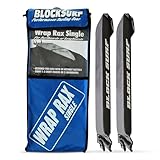
BLOCKSURF’s universal soft rack is aimed at cars and SUVs and listed for two to three surfboards with heavy-duty construction. It suits the driver with a larger vehicle — a mid-size SUV, a wagon, a pickup with a cab roof — who wants the simplicity of a soft rack but needs it to hold more weight than a lightweight kit comfortably manages. It is priced in the premium tier despite being a soft-rack design, which tells you where the money went: heavier foam, sturdier straps and beefier buckles.
Key specs
- Type: universal soft roof rack
- Vehicle fit: cars and SUVs
- Listed capacity: holds 2–3 surfboards
- Construction: heavy-duty pads and hardware
- Mounting: soft-rack strap system, no rails required
- Price tier: premium
The case for a premium soft rack is narrower than it first appears, but it is real. On a small hatchback, a lightweight budget rack is perfectly adequate — the roof is short, the boards are close to the car’s centre of mass, and the aerodynamic loads are modest. On a tall SUV, the situation changes. The roof is higher, so the rack and boards sit further above the roll centre; the vehicle presents a larger frontal area, so crosswind loading on a board is greater; and the roof skin is often a larger, flatter panel that gives foam less natural curvature to grip. A heavier-duty soft rack addresses all three, mostly through stiffer, thicker foam that resists compressing under load.
Foam compression is the failure mode to watch for in any soft rack. Closed-cell foam holds its shape well until it does not: repeated loading, UV exposure and salt water gradually break down the cell structure, and a pad that started at a given thickness will flatten over a season or two of regular use. Once a pad flattens, the board sits closer to the roof, the strap tension drops, and the whole system becomes less stable. This is why premium soft racks are worth considering for heavy users: the foam is the consumable, and better foam lasts longer.
Heavy-duty construction also shows up in the straps. Wider webbing spreads load over more of the board’s surface, and a stronger buckle tolerates higher tension without deforming. The practical test when you receive any soft rack is simple: tension the straps as you would for a real drive, then press down on the pad with your thumb. If it compresses to a fraction of its thickness under moderate thumb pressure, it will flatten under a board at speed. If it springs back with resistance, it will hold.
Two to three boards is the listed range, and on a large vehicle that is a comfortable working figure rather than an optimistic one. The stacking caveat still applies: boards carried against each other will rub, so use a board bag or padding between them. Also consider the load path — on an SUV, the door frames are taller and the straps have further to travel, so check that the supplied straps reach with enough tail to tie off securely. If they come up short, longer straps like the DORSAL 15 ft set solve it cheaply.
Pros
- Heavier-duty foam and hardware suited to taller, larger vehicles
- Listed for 2–3 surfboards, a realistic working capacity on an SUV
- Universal soft-rack mounting needs no rails or crossbars
- Thicker padding resists compression better than budget foam
- Removable and storable, unlike a bolted hard rack
- Good middle ground between a cheap soft rack and a full hard-rack system
Cons
- Premium price for a soft-rack design with no locking
- Still requires framed doors for strap routing
- Foam remains a consumable that will flatten over time
- Straps may be short on very tall or wide vehicles
- No rigid lateral support, so crosswind movement is still possible
How it compares
Against the Ho Stevie! soft rack, BLOCKSURF leans heavier-duty and SUV-focused while Ho Stevie! leans refined hardware and a mid-range price — for a sedan, Ho Stevie! is the better value; for a tall SUV carrying three boards, BLOCKSURF’s construction makes more sense. Against the INNO locking rack, BLOCKSURF gives up security and rigidity for universal fit and a lower price. Against the Drytuns, it is the same concept executed with heavier materials at a higher tier.
5. DORSAL Surfboard Tie Down Straps – Best Budget Strap Set for Surf, Kayak and SUP
This is a two-pack of 15 ft tie-down straps in black, rated for surfboards, kayaks and SUPs. It is a strap set, not a rack: there are no pads and no mounting hardware. It suits three specific buyers. First, someone whose existing straps have stretched, frayed or lost their buckles and who needs replacements without buying a whole new rack. Second, someone building a setup from parts — pads from one source, straps from another. Third, a kayak or SUP owner who needs long straps that reach around a wide hull on existing bars.
Key specs
- Type: tie-down straps (no pads, no bars included)
- Length: 15 ft each
- Quantity: 2-pack
- Colour: black
- Rated use: surfboards, kayaks, SUPs
- Price tier: budget
Fifteen feet is the number that justifies these over a standard 10 ft strap. Ten feet is enough for a surfboard on a sedan crossbar setup. It is often not enough for a sit-on-top kayak, which is wide, deep and awkward, or for a large SUP carried deck-down on a tall SUV. Fifteen feet gives you the tail you need to pass over the load, around the bar, back over the load, and still have several feet to tie off. If you have ever finished a strap routing with four inches of tail and no way to secure it, you already understand why the extra length matters.
The other advantage of buying straps separately is that you can match them to your load rather than to a kit. A soft rack’s included straps are sized for the rack’s intended use; if your use is different, you are stuck. Buying the straps as a standalone item lets you keep a short set for shortboards and a long set for kayaks, or carry a spare pair in the car for the day a buckle jams at the beach. At budget tier, a spare set is inexpensive insurance.
What you do not get is any padding. Straps bear directly on whatever they touch, so if you are running them over a board’s rail without pads or a bar, you will mark the board. This is the reason the DORSAL set works best as a complement to pads rather than as a standalone solution. Pair it with the COR Surf Aero pads or the Ho Stevie! aero pads if you have crossbars, or keep it as the spare set for a soft rack whose original straps have worn.
Cam buckle versus ratchet is the decision to make when buying straps. Cam buckles are the right choice for surfboards: you pull the tail by hand and the cam grips, which makes it very hard to overtighten. Ratchet straps can generate enough force to crush a board’s rail, crack a fin box or dent a hollow deck, and they should be reserved for heavy, robust loads like kayaks and lumber. If your straps are cam-buckle, tension by hand until the board cannot slide, then stop. If you can hear the foam compressing, you have gone too far.
Pros
- 15 ft length suits wide kayaks and large SUPs as well as surfboards
- Two-pack covers both sides of a roof load, with a spare option at low cost
- Budget tier makes it an easy replacement or backup purchase
- Useful for building a custom setup from separate pads and bars
- Works across surf, kayak and SUP categories rather than one niche
Cons
- Straps only — no pads, so it cannot protect a board on its own
- Not a complete rack solution for a bare-roof car
- Unpadded contact points will mark rails if used without pads
- No security feature; webbing can be cut
- Requires you to already own bars, pads or a soft-rack base
How it compares
Against the Drytuns soft rack, DORSAL is not a rack at all — it is the consumable component, and it is the cheaper purchase if all you need is replacement webbing. Against the COR Surf Aero pads, DORSAL supplies the straps while COR supplies the pads and straps together, so COR is the better buy if you need both. Against the Ho Stevie! soft rack, DORSAL cannot mount to a bare roof, but it can extend or replace the straps on one.
6. Drytuns Surfboard Rack for Car – Best Budget Complete Soft Rack

The Drytuns rack is a universal soft rack for cars and SUVs that covers both surfboards and paddle boards. It is the budget-tier answer to the same problem the Ho Stevie! soft rack solves, and it suits the casual surfer — someone who gets out a handful of times a season, drives a normal car with framed doors, and does not want to spend mid-range or premium money on a rack they will use six times a year. It also suits the paddler who wants one system that handles a SUP and a surfboard without buying two racks.
Key specs
- Type: universal soft roof rack
- Vehicle fit: cars and SUVs
- Board compatibility: surfboards and paddle boards
- Mounting: soft-rack strap system, no rails required
- Price tier: budget
The value proposition here is straightforward: you get the same core concept as a mid-range soft rack — foam pads on the roof, straps through the door frames — at the lowest price point in this roundup. For a low-frequency user, that trade is usually the right one. A rack that lives in a bag ten months a year does not need premium foam; it needs to be safe for the trips you actually take, and to be cheap enough that you do not resent owning it.
The SUP compatibility is worth more than it sounds. Paddle boards are wider, heavier and more awkward than surfboards: a typical inflatable or hard SUP is substantially bulkier than a shortboard, and it presents a much larger flat surface to the wind. Carrying one on a soft rack is entirely feasible, but the load must be positioned so the board’s midpoint sits between the pads and the straps cross over the board at points where the deck is flat rather than tapered. On a tapered nose or tail, a strap can slip. If you carry a SUP regularly, plan on adding a bow line to the front of the car and, where possible, a stern line to the rear, so the board cannot lift or rotate.
Budget-tier soft racks ask you to be a bit more careful about two things. First, foam thickness: thinner foam compresses sooner, so check the pads each season and replace them when they stop springing back. Second, buckle quality: budget buckles can have sharper edges, which is exactly what causes rail damage. A simple fix that costs almost nothing is to wrap the buckle contact area with a scrap of closed-cell foam or a piece of old wetsuit neoprene, which converts a point load into a broad one.
Speed discipline matters more with budget hardware. A soft rack holding a board is not a highway-cruising system at any price, but the practical ceiling is lower with lighter foam and simpler buckles. Keep to moderate speeds where you can, re-check strap tension after the first twenty minutes of any drive, and re-check again after any stop. The failure sequence in soft racks is almost always the same: foam compresses, strap slackens, board shifts, and the driver does not notice until the board is moving.
Pros
- Lowest-cost complete rack option in this roundup
- Handles both surfboards and paddle boards with one system
- Universal fit for cars and SUVs with framed doors
- No rails, bars or fit kit required
- Packs away small when not in use
- Cheap enough to keep as a second rack or a travel spare
Cons
- Budget foam compresses faster than mid-range or premium padding
- Simpler buckles need padding to avoid marking rails
- No locking and no rigid lateral support
- Lower comfortable speed ceiling than a hard rack
- Strap length and hardware quality are the first things to feel cheap
How it compares
Against the Ho Stevie! soft rack, Drytuns wins on price and matches on concept, but Ho Stevie! offers better buckle protection and a more refined mid-range build — worth the upgrade if you surf weekly. Against the HIKULA budget racks, both occupy the same tier and the difference comes down to whichever padding and strap set you prefer. Against the DORSAL strap set, Drytuns is a complete rack rather than a component, so it is the correct first purchase for a bare-roof car.
7. Ho Stevie! Aero Roof Rack Pads – Best for Narrow Crossbar Spreads and SUP Paddlers

This is a set of two aero roof rack pads available in 28 in or 17 in lengths, intended for cars that already have crossbars. The 17 in version is the interesting one, because it is sized for narrow bar gaps — short roofs, small hatchbacks, and compact crossbar spreads where a 28 in pad would either overhang the bar ends or bunch up. It suits the driver who has bars, carries a board or a paddle board, and needs padding that fits the bars they actually own rather than the bars a generic kit assumes.
Key specs
- Type: aero roof rack pads, set of 2
- Length options: 28 in or 17 in
- Intended fit: cars with crossbars
- Shape: aero profile for reduced wind noise
- Use: surfboards and SUPs on existing bars
- Price tier: mid-range
The 17 in option solves a real fitment problem. On a compact car, crossbar spread is often limited by roof length, and the bars themselves may only span a short distance between the towers. A 28 in pad on a bar with a 20 in usable span looks fine in a product photo and behaves badly in use: the overhanging foam flutters at speed, the pad can rotate around the bar, and the effective contact area for the board is smaller than the pad’s length suggests. A 17 in pad matched to a narrow bar sits flush, stays put, and puts all its foam under the board.
Pad diameter relative to bar shape also matters. Aero pads are shaped to hug aerodynamic bars; if your bars are round or square, an aero pad can leave a gap underneath, and a gap means the pad can roll when the board shifts sideways. The fix is simple: wrap the bar with a strip of foam or rubber before fitting the pad, or choose a pad profile that matches your bar. It is a two-minute job that eliminates a whole class of movement problems.
SUP use is where these pads earn their mid-range price over a basic set. A paddle board is a long, heavy, high-windage load. It needs support spread as wide as your bars allow, and it needs padding that will not collapse under a heavier board. On a roof with a short spread, a SUP is also more likely to overhang front and rear, which is where a bow line becomes mandatory rather than optional. Check your local rules on overhang: many jurisdictions restrict how far a load may extend beyond the front bumper, and require a warning flag on substantial rear overhang.
Compared with the COR Surf Aero pads, the Ho Stevie! set is the mid-range alternative with the crucial advantage of a 17 in size for narrow bar gaps, and the COR set’s advantage of a longer 28 in pad plus included 10 ft straps. If your bars are widely spaced and you need straps too, COR Surf is the cleaner single purchase. If your bars are short, or you already own good straps, the 17 in Ho Stevie! pads are the better fit.
Pros
- Available in 17 in for narrow crossbar spreads that longer pads do not suit
- Aero profile reduces wind noise compared with flat blocks
- Sized for cars that already have crossbars — no door-frame routing
- Works for both surfboards and paddle boards
- Mid-range price sits below the premium pad options
- Set of two covers both bars, front and rear
Cons
- Requires existing crossbars — no use on a bare roof
- No straps included in the pad-only configuration
- Aero shape may not seat perfectly on round or square bars
- No security feature
- Foam is still a wear item that flattens over seasons
How it compares
Against the COR Surf Aero pads, Ho Stevie! offers the narrower 17 in option and a lower price tier, while COR offers a longer pad and included 10 ft straps. Against the Ho Stevie! soft rack, these pads are a second-stage purchase for a car that already has bars, not a standalone solution. Against the DORSAL strap set, the pads supply the cushioning while DORSAL supplies the webbing.
8. HIKULA Surfboard Roof Racks – Best Ultra-Budget Second Setup

HIKULA’s surfboard roof racks sit in the budget soft-rack class: universal pads and straps intended for cars that have no rails. It suits a specific buyer well — someone who needs a rack for a second vehicle, a borrowed car, a rental, or a trip where the rack will be used a few times and then stored. It is not the rack to buy if you surf four times a week and drive an hour each way, because budget hardware and foam wear out faster and tolerate less abuse.
Key specs
- Type: soft-rack class, universal fit
- Mounting: strap-based, no rails or crossbars required
- Construction: budget-tier pads and hardware
- Use: surfboards on cars and small SUVs
- Price tier: budget
The honest case for an ultra-budget rack is opportunity cost. If the choice is between buying a premium rack you cannot justify and not surfing at all, the budget rack wins every time. A soft rack’s job is to hold a board safely at the speeds you actually drive, and even a basic set does that if you install it correctly and check the tension. The failure modes of budget soft racks are predictable and manageable: thinner foam compresses sooner, simpler buckles can have sharper edges, and straps may be shorter than you would like.
All three are addressable. Compressed foam is fixed by replacing the pads — the cheapest part of the system. Sharp buckle edges are fixed by wrapping the contact area in neoprene. Short straps are fixed with a longer set like the DORSAL 15 ft pair. What you cannot fix is a rack that was never tensioned properly, which is a driver problem rather than a product problem. The routine is: pads positioned wide, board centred between them, straps over the board and around the pads, tensioned until the board cannot slide, then re-checked after twenty minutes of driving.
One thing worth checking on any budget soft rack is whether the pads are truly closed-cell. Open-cell foam absorbs water, and a rack that soaks up salt water will stay damp, smell, and break down faster. If the foam feels like a sponge rather than like a yoga block, expect a shorter service life and plan to store the rack dry rather than leaving it in a wet bag in the trunk. Rinsing with fresh water after coastal use and drying fully before storage roughly doubles the useful life of any soft rack’s padding.
If you are deciding between this and the Drytuns, both are budget-tier universal soft racks and the choice comes down to which padding and strap set you prefer, plus whether you need explicit paddle-board coverage — Drytuns lists it, HIKULA’s listing is surfboard-focused. If you can stretch to mid-range, the Ho Stevie! soft rack’s padded buckles are the single most meaningful upgrade in the soft-rack category.
Pros
- Lowest-cost way to get a complete soft rack onto a bare-roof car
- Universal strap mounting needs no rails, bars or fit kit
- Cheap enough to keep as a second setup for a second car or a rental
- Packs down small for storage and travel
- Consumable parts are inexpensive to replace
Cons
- Thinner foam compresses faster than mid-range or premium padding
- Simpler buckles may need padding to avoid rail marks
- Strap lengths can be limiting on larger vehicles
- No locking, no rigid lateral support
- Not suited to frequent, long-distance, high-speed use
How it compares
Against the Drytuns rack, both are budget universal soft racks; Drytuns explicitly covers paddle boards while HIKULA’s listing is surfboard-focused. Against the Ho Stevie! soft rack, HIKULA saves money and gives up padded buckle protection and mid-range foam. Against the DORSAL strap set, HIKULA is a complete rack rather than a component, making it the better first purchase for a car with nothing on the roof.
9. Dopaka Soft Roof Rack Pads – Best Budget Kit With Bow and Stern Lines Included

The Dopaka soft roof rack system bundles pads with two tie-down straps, two tie-down ropes and two hood loops. It is the most complete budget kit in this roundup, and the hood loops are the reason it deserves its own entry. It suits longboard owners in particular, because a long board on a soft rack genuinely needs front and rear restraint — and most budget kits make you buy that separately.
Key specs
- Type: universal soft roof rack pad system
- Included: 2 tie-down straps, 2 tie-down ropes, 2 hood loops
- Mounting: soft-rack strap system, no rails required
- Best suited to: longboards and larger boards needing bow/stern restraint
- Price tier: budget
Hood loops are a small accessory with an outsized effect on safety. They anchor under the bonnet, giving you a fixed point at the front of the car to run a bow line from the nose of the board down to the bumper area. The equivalent at the rear — a stern line to a tow point or the boot lid — stops the tail from lifting or swinging. On a shortboard, bow and stern lines are nice to have. On a longboard, they are close to essential: a