We research everything we recommend. When you buy through our links, we may earn a commission. As an Amazon Associate we earn from qualifying purchases.
Best Torque Wrenches for Cars, Bikes and Precision Work
Find the best torque wrenches for lug nuts, engine work and bike parts, with click and micrometer picks for cars, trucks and precision jobs.
As an Amazon Associate I earn from qualifying purchases. This post may contain affiliate links at no extra cost to you.
⭐ Key Takeaways
Quick answer: Our top pick is TEKTON 1/2 Inch Drive Click Torque Wrench (24335), with EPAuto 1/2 Inch Drive Click Torque Wrench as a strong alternative.
Torque is not about tightening a bolt as hard as possible. It is about clamping force: too little and a wheel, caliper bracket or cylinder head works loose; too much and threads strip, rotors warp or a small bolt snaps clean off. A torque wrench removes the guesswork by signaling exactly when a fastener reaches the value the manufacturer specified, which is why one belongs in every garage that handles wheels, brakes or engine work.
The five wrenches below cover the jobs home mechanics and cyclists actually face, from 20 inch-pounds on a carbon bike stem to 250 foot-pounds on a truck axle nut. Four are half-inch drive models for automotive work, and one is a quarter-inch inch-pound wrench for delicate fasteners.
As an Amazon Associate, we earn from qualifying purchases.
For most car owners, the TEKTON 24335 covers lug nuts and chassis work with a 10 to 150 ft-lb range. The LEXIVON LX-184 reaches 250 ft-lb for trucks, while the EPAuto matches the TEKTON’s range as a value pick. CDI’s 2503MFRPH suits daily professional use, and the LEXIVON LX-181 handles delicate inch-pound jobs on bikes.
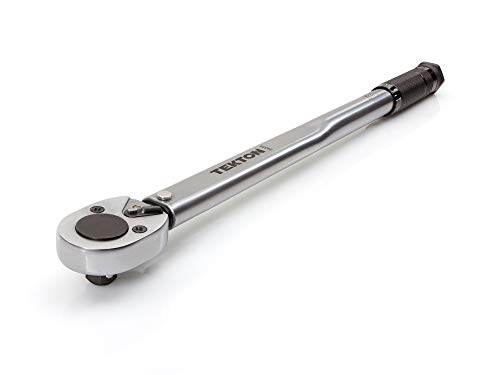
TEKTON 1/2 Inch Drive Click Torque Wrench (24335)
Top Pick
TEKTON 1/2 Inch Drive Click Torque Wrench (24335)
Best for: car owners who want one dependable wrench for lug nuts, brakes and general chassis work.
The TEKTON 24335 is the default recommendation for a first torque wrench. The all-steel micrometer body has a high-contrast dual-range scale marked in foot-pounds and newton meters, a reversible 24-tooth ratchet head, and a click that can be both heard and felt when the set value is reached. Settings adjust in 1 ft-lb increments, so dialing in a lug nut specification is quick and repeatable.
It ships pre-calibrated to plus or minus 4 percent accuracy with a calibration certificate, in a fitted storage case that protects the mechanism in a drawer. The 18-3/8 inch length gives enough leverage for wheel work without feeling clumsy around brakes and suspension. There are no batteries or plastic internals, just a mechanical design that asks only to be stored at its lowest setting.
Specs:
– Drive size: 1/2 inch
– Torque range: 10-150 ft-lb (13.6-203.5 Nm)
– Accuracy: plus or minus 4 percent, pre-calibrated
– Increment: 1 ft-lb
– Ratchet: 24-tooth, reversible
– Construction: all steel, chrome vanadium head
– Includes: storage case, manual with torque conversion chart
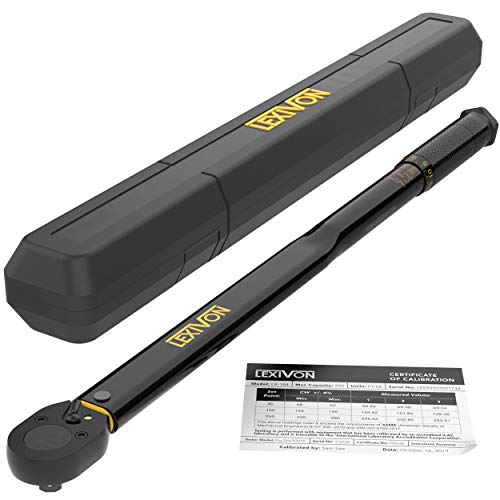
Where the TEKTON stops at 150 ft-lb, the LEXIVON LX-184 keeps going to 250 ft-lb, which suits truck lug nuts, axle nuts, trailer hitches and larger suspension hardware. The reinforced ratchet head is heat-treated chrome vanadium steel, and the Electro-Black finish resists rust and corrosion. At roughly 25 inches long, it delivers the leverage that high settings demand without straining.
LEXIVON prints the dual-range scale in bright yellow on a dark barrel, which stays readable in dim garage light, and it ships pre-calibrated to plus or minus 4 percent with a calibration certificate tied to a traceable serial number. The trade-off sits at the bottom end: settings below 25 ft-lb are off its scale, so pair it with a smaller wrench if you also do engine work.
Specs:
– Drive size: 1/2 inch
– Torque range: 25-250 ft-lb (33.9-338.9 Nm)
– Accuracy: plus or minus 4 percent, pre-calibrated
– Scale: dual range, high-contrast yellow print
– Ratchet head: heat-treated chrome vanadium steel
– Finish: Electro-Black anti-rust coating
– Includes: storage case, calibration certificate with serial number
Best for: truck and SUV owners and anyone whose fasteners regularly exceed 150 ft-lb.
EPAuto 1/2 Inch Drive Click Torque Wrench
Runner-Up
EPAuto 1/2 Inch Drive Click Torque Wrench
Best for: budget-conscious DIYers who rotate tires and service brakes a few times a year.
The EPAuto covers the same 10 to 150 ft-lb range as the TEKTON and is the value pick in this group. The head is hardened chrome vanadium steel with a satin finish, the knurled handle keeps its grip with oily gloves, and the dual-range scale is easy to read. It is pre-calibrated to plus or minus 4 percent and produces a clear click at the set value.
What lifts it above bare-bones rivals is the kit in the case: alongside the wrench you get a 5-inch extension bar and a 1/2 inch to 3/8 inch reducer, which helps reach recessed fasteners and drive smaller sockets in a pinch. At about 16 inches it is a little more compact than the TEKTON, handy in tight wheel wells. The painted scale markings may wear sooner than etched ones under heavy daily use, but for seasonal tire swaps and weekend repairs it has everything most people need.
Specs:
– Drive size: 1/2 inch
– Torque range: 10-150 ft-lb (13.6-203.5 Nm)
– Accuracy: plus or minus 4 percent, pre-calibrated
– Material: hardened chrome vanadium steel, satin finish
– Handle: knurled, non-slip
– Includes: storage case, 5-inch extension bar, 1/2 to 3/8 inch reducer
CDI 1/2 Inch Drive Micrometer Torque Wrench (2503MFRPH)
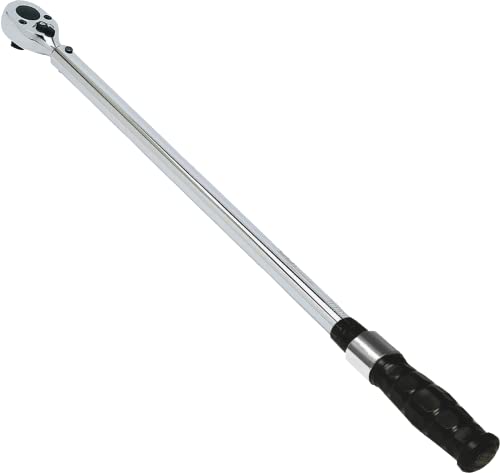
CDI 1/2 Inch Drive Micrometer Torque Wrench (2503MFRPH)
Best for: professional mechanics, engine builders and serious hobbyists who need certified accuracy.
CDI is Snap-on’s industrial torque brand, and the 2503MFRPH is built for daily professional use. The range runs from 30 to 250 ft-lb on a dual scale that is calibrated in both directions, and accuracy is rated at plus or minus 4 percent clockwise across the working span. A spring-loaded pull-down lock ring keeps the setting from drifting while you work.
Every CDI wrench is individually serialized and ships with a certificate of calibration traceable to NIST, documentation that matters in professional shops. The comfort grip handle and the long body suit repeated high-torque pulls, and the mechanism is built to hold calibration through far more cycles than a homeowner-grade tool. The premium over the other wrenches here buys durability and documentation rather than extra features, exactly the right trade for a working mechanic.
Specs:
– Drive size: 1/2 inch
– Torque range: 30-250 ft-lb, dual scale
– Accuracy: plus or minus 4 percent clockwise
– Calibration: individually serialized, NIST-traceable certificate included
– Setting lock: spring-loaded pull-down lock ring
– Handle: comfort grip
– Maker: CDI Torque Products (Snap-on Industrial Brands)
LEXIVON 1/4 Inch Drive Inch Pound Torque Wrench (LX-181)
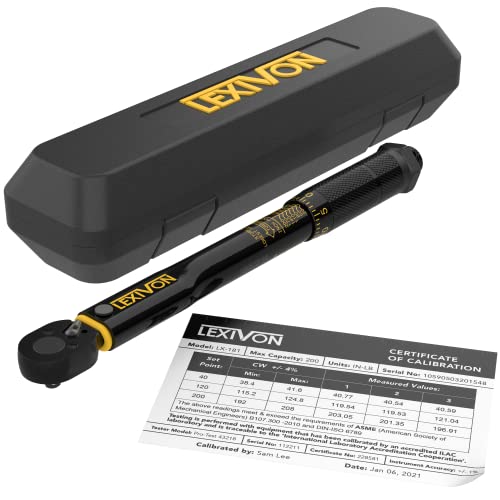
LEXIVON 1/4 Inch Drive Inch Pound Torque Wrench (LX-181)
Best for: cyclists and anyone torquing small, delicate fasteners on bikes, small engines and equipment.
Small fasteners fail quietly: a crushed carbon seatpost, a stripped valve cover bolt or a cracked scope ring usually traces back to torquing by feel. The LX-181 works in inch-pounds instead, covering 20 to 200 in-lb, which translates to roughly 1.7 to 16.7 ft-lb. That is the territory of bicycle stems, seatpost clamps, derailleurs, small engine covers and hardware needing a gentle, exact touch.
The compact body is about 10.75 inches long, so it fits into tight spaces where a longer wrench would swing into the frame. Its dual-range scale reads in inch-pounds and newton meters with the same high-contrast yellow print as the larger LEXIVON models, and it ships pre-calibrated to plus or minus 4 percent with a certificate and traceable serial number. A protective case is included. The click is subtle near the bottom of the range, so work slowly and stop at the first break you feel rather than listening for a loud snap.
Specs:
– Drive size: 1/4 inch
– Torque range: 20-200 in-lb (2.26-22.6 Nm)
– Accuracy: plus or minus 4 percent, pre-calibrated
– Scale: dual range, high-contrast yellow print
– Length: about 10.75 inches
– Includes: protective case, calibration certificate with serial number
How to choose
Start with drive size and range, because they decide which fasteners a wrench can even attempt. A 1/4 inch drive inch-pound wrench like the LX-181 suits bicycles, small engines and precision assemblies. A 3/8 inch drive wrench in the 10 to 80 ft-lb band covers most engine bay and motorcycle work. A 1/2 inch drive wrench is the automotive standard: a 10 to 150 ft-lb model handles lug nuts and brakes, while a 25 to 250 ft-lb model adds trucks and axle hardware.
Next, pick a mechanism. Click wrenches are the best all-round choice: you set the value, pull steadily, and stop when the mechanism clicks. Beam wrenches are simple, inexpensive and never need calibration, but you must watch a needle while pulling, awkward under a car. Digital wrenches display the reading and often beep or light up at the target, which helps in noisy shops, but they need batteries and cost more.
Accuracy is stated as a percentage of the indicated value, and plus or minus 4 percent is typical for good homeowner and mid-range tools, with professional models holding it over more of the scale. A calibration certificate, ideally with a serial number traceable to a national standard, shows the individual wrench was checked before it shipped. Whatever you buy, work in the middle of its range: click wrenches are least accurate near their minimum and maximum, so choose a wrench whose scale puts your target value comfortably inside, roughly between 20 and 100 percent of full scale. Finally, store a click wrench at its lowest setting, never use it to break fasteners loose, and have it recalibrated periodically if you rely on it for critical work.
Who should skip
Skip this roundup if your only fasteners are furniture bolts and flat-pack fittings; a basic hand wrench is enough there. If you regularly torque beyond 250 ft-lb on heavy equipment, you need a 3/4 inch drive wrench instead. Drivers who only swap seasonal tires may be fine with the EPAuto alone. If you want a readout screen and audible alarms rather than a mechanical click, look at digital models instead.
FAQ
What size torque wrench do I need for lug nuts?
A 1/2 inch drive wrench with a range that includes your vehicle’s specification, usually 80 to 100 ft-lb for cars and more for trucks. A 10 to 150 ft-lb model covers most passenger cars; choose a 250 ft-lb model for larger trucks and SUVs.
Can I use a torque wrench to loosen bolts?
No. Loosening, especially breaking loose corroded fasteners, can exceed the wrench’s capacity and knock it out of calibration. Use a breaker bar or ratchet to loosen, and reserve the torque wrench for the final tightening pass only.
How often does a torque wrench need recalibration?
A common guideline is every 12 months or about 5,000 clicks, whichever comes first, and immediately after any drop onto a hard floor. Wrenches with serialized certificates, like the LEXIVON and CDI models here, make professional recalibration easier to arrange.
What happens if I keep pulling after the click?
Every extra degree of rotation adds torque beyond the setting, defeating the purpose of the tool. Pull smoothly and stop the instant you feel and hear the click. On small inch-pound settings the click is faint, so slow down and feel for the break in the handle.
Final verdict
Most readers should buy the TEKTON 24335: it covers the lug nuts, brakes and chassis bolts that make up the bulk of home car work, with certified accuracy and an all-steel build. Step up to the LEXIVON LX-184 if your vehicles are trucks, or to the CDI 2503MFRPH if you earn a living with one. The EPAuto is the value alternative, and the LEXIVON LX-181 is the right second wrench for bikes and delicate hardware. Buy the range that matches your fasteners, store it at its lowest setting, and every bolt stays at the tightness the manufacturer intended.
M
Miller the Driller Editorial Team
We compare specs, warranty terms, long-term owner feedback and street pricing before anything earns a spot. Rankings are never paid.
Affiliate disclosure. As an Amazon Associate we earn from qualifying purchases at no extra cost to you. Prices accurate as of the date shown.
Three wireless routers for small offices compared on device capacity, network separation, wired speed, and coverage, with specs taken from their Amazon listings.
Compare 5 mechanic tool sets for car repairs: a 247-piece DEWALT kit, a 450-piece CRAFTSMAN set, a drawer-box GEARWRENCH set, a 170-piece Crescent set and a 450-piece WORKPRO set.
Four splitting axes and mauls that actually split firewood: a long 36-inch axe for tall users, a shorter 28-inch option, and two 8 lb mauls for knotty rounds.
Learn whether a 20V rechargeable drill battery can be repaired, which faults you can check safely at home, and when replacing the pack is the safer choice.
A specs-based review of the officially licensed Retro-Bit Sega Saturn 2.4 GHz wireless controller: dual receivers, Genesis Mini and Switch support, battery, layout, limits, and FAQs.
Find the best drill battery for Power Wheels ride-on toys for families, with DeWalt, Milwaukee and Ryobi adapters, voltage and safety guidance in this guide.
Find the best hole saw for noching dom pipe: bi-metal saws, deep cups, and the right sizes for clean, tight notches in DOM tube for fabrication shops today.
Find the best diy tile saws for home tiling projects. Compare wet tile saws by blade size, cutting capacity, and features for ceramic and porcelain tile.


 LEXIVON 1/4 Inch Drive Inch Pound Torque Wrench (LX-181)
 LEXIVON 1/2-Inch Drive Click Torque Wrench 25-250 Ft-Lb/33.9-338.91/2"DR. 25-250 FT-LB3 x 3 x 24 inches6.4 PoundsCheck on Amazon









