What's inside
As an Amazon Associate I earn from qualifying purchases. This post may contain affiliate links at no extra cost to you.
The best tripod for astrophotography is a 3- or 4-section carbon fiber or wood tripod with no tall center column, a 3/8″-16 head stud, and a payload rating at least twice the weight you actually hang on it — the Really Right Stuff TVC-34L is the most rigid all-rounder, the Gitzo GT3543LS Systematic is the best premium lightweight option, and Berlebach’s ash-wood Report 332 damps vibration better than any metal leg for less money. If you are shooting a star tracker rather than a full equatorial mount, a much cheaper tripod is genuinely enough. Everything below is about matching those numbers to the mount you own.
As an Amazon Associate we earn from qualifying purchases at no extra cost to you.


What we cover
Our Top Picks
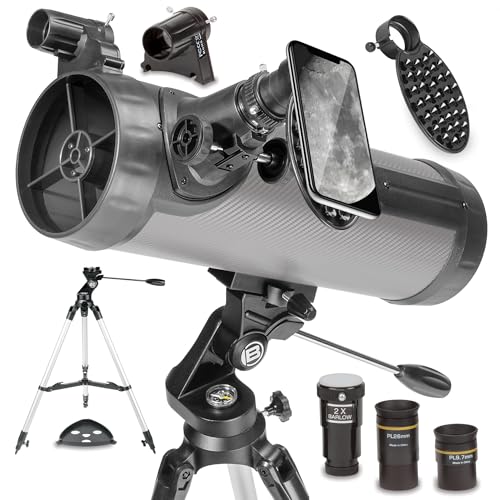 National Geographic 114mm Reflector Telescope with Eyepieces Mount27 x 6.5 x 11.5 inchesCheck on Amazon

Quick comparison: best tripods for astrophotography
| Tripod | Best for | Key specs (manufacturer figures) | Typical price range |
|---|---|---|---|
| Really Right Stuff TVC-34L | Best overall rigidity | Carbon fiber, 4 sections, ~175 cm max height, ~62 cm folded, ~2.0 kg, 36 kg (80 lb) load rating, 3/8″-16 stud, no center column | ~$1,100–1,350 |
| Gitzo GT3543LS Systematic Series 3 | Best premium lightweight | Carbon eXact, 4 sections, 158 cm max height, 61 cm folded, 2.06 kg, 25 kg payload, no center column | ~$950–1,150 |
| Berlebach Report 332 | Best vibration damping | Ash wood, 3 sections, ~150 cm max height, ~4.5 kg, roughly 18–20 kg load rating | ~$500–750 |
| Sirui W-2204 | Best value carbon | Carbon fiber, 4 sections, ~165 cm max height, ~52 cm folded, ~1.5 kg, 18 kg load rating | ~$350–450 |
| Leofoto LS-364C | Best tall option | Carbon fiber, 4 sections, ~180 cm max height, ~60 cm folded, ~1.9 kg, 20 kg load rating, no center column | ~$400–500 |
| Benro Mach3 TMA27A | Best budget | Aluminum, 3 sections, ~165 cm max height, ~2.0 kg, 12 kg load rating, center column | ~$180–260 |
| Sky-Watcher Star Adventurer tripod | Best for star trackers | Aluminum, ~90 cm max height, 3/8″-16 and 1/4″-20 studs, integrated leg spreader | ~$150–220 |
Specs vary slightly by production run and by which feet, spikes, or short column you fit, so confirm the current sheet before ordering.
The picks in detail
Best overall: Really Right Stuff TVC-34L
RRS builds this one for people who never want to think about the tripod again. Four carbon sections, a 36 kg load rating, and a machined apex with no center column at all, so the only flex points are the four leg joints and the ground. Per the manufacturer’s spec sheet it stands about 175 cm and folds to roughly 62 cm at around 2 kg, which means it is both tall enough to put a GoTo mount head at chest height and short enough to strap to a pack. It suits anyone running an equatorial mount with a small refractor or a long telephoto. The trade-off is price: this is the most expensive pick here by a wide margin, and the 80 lb rating is far more capacity than a star tracker needs.
Best premium lightweight: Gitzo GT3543LS Systematic Series 3
If you want Systematic rigidity without the RRS price, the GT3543LS is the obvious alternative. Gitzo rates the payload at 25 kg and lists the weight at 2.06 kg with a 158 cm maximum height and a 61 cm folded length, so it is a genuinely packable tripod that will still carry a mid-size mount plus counterweights. The Systematic apex accepts Gitzo’s leveling bases and flat plates directly, which matters for polar alignment because you can level the head without fiddling with individual legs. Trade-off: the 25 kg figure is a working payload, not a 3× safety margin, so heavy imaging trains should look at Series 5 or the RRS instead.
Best vibration damping: Berlebach Report 332
Wood is not nostalgia — it is a damping material, and Berlebach’s ash tripods are the reason long-focal-length observers still buy them. The Report 332 is a three-section wooden tripod with roughly a 150 cm maximum height, about 4.5 kg of mass, and a load rating in the 18–20 kg range, and its extra weight is the point: more mass means a gust or a shutter actuation moves the whole assembly less. It suits permanent-ish setups, balcony and garden imagers, and anyone fighting wind. The trade-off is portability — 4.5 kg plus a mount is not a hiking kit, and the folded length is much longer than a carbon four-section tripod.
Best value carbon: Sirui W-2204
This is the sweet spot for most star-tracker and light-mount users. Sirui rates it at 18 kg with a roughly 1.5 kg body weight, a 165 cm maximum height, and a folded length near 52 cm, and the “W” series legs are sealed against water and grit — useful on dewy nights and sandy desert sites. It has a center column, but it ships with a short column you can swap in, and using the short column is what makes it stable enough for imaging. Who it suits: anyone with a Sky-Watcher Star Adventurer, iOptron SkyGuider, or a small GoTo mount. Trade-off: the column is still there, and the leg locks are good rather than exceptional.
Best tall option: Leofoto LS-364C
At around 180 cm maximum height and roughly 1.9 kg, the LS-364C solves a specific problem: shooting over a balcony rail, a fence, or a hedge, or imaging with a refractor whose eyepiece ends up near the ground on a shorter tripod. Leofoto rates it at 20 kg and the LS series has no center column at all, so the rigidity per kilogram is high for the money. Trade-off: 180 cm of leverage means wind has more to work with, so it wants a weight bag on the hook in anything above a light breeze.
Best budget: Benro Mach3 TMA27A
Aluminum is heavier and rings longer than carbon, but it costs a fraction as much and it is what most people should start with. Benro rates the TMA27A at 12 kg with a roughly 2.0 kg body and a 165 cm maximum height. Twelve kilos is plenty for a star tracker, a camera, a lens, and a counterweight, and the three-section legs are stiffer than a four-section design of the same height. Trade-off: the center column, which you should leave down, and aluminum’s slower vibration settling compared with carbon or wood.
Best for star trackers and small GoTo mounts: Sky-Watcher Star Adventurer tripod
If your payload is under about 6 kg, a purpose-built tracker tripod is cheaper and shorter than a camera tripod and comes with both 3/8″-16 and 1/4″-20 studs plus a leg spreader that locks the stance. It tops out around 90 cm, which is exactly right for a tracker you operate from a kneeling or seated position. Trade-off: it cannot be extended tall enough for visual use or a large mount, and the aluminum legs transmit vibration more than carbon.
How to choose: the numbers that actually matter
Start with the 2× payload rule
Add up everything the tripod carries: mount head, counterweights, dovetail, telescope or lens, camera, guide scope, and cables. Then double it. A worked example: a Sky-Watcher Star Adventurer GTi head is about 2.5 kg, one 2 kg counterweight plus shaft is roughly 2.3 kg, and a camera with a 135 mm lens is about 1.5 kg — call it 6.3 kg total. A 12 kg tripod gives you a 1.9× margin, which is fine in calm air. Swap in a 4 kg refractor and the same load hits 8.8 kg, and now the 12 kg tripod is at 1.4× — too thin. The same load on an 18 kg tripod sits at 2.0×, and on a 25 kg tripod at 2.8×. Use 2× as the floor and 3× if you image in wind or past about 400 mm focal length, where every micro-movement shows up as trailed stars.
| Your situation | What to prioritize | Suggested class or pick |
|---|---|---|
| Star tracker + DSLR/mirrorless, under 6 kg total | Payload ≥ 12 kg, short folded length, 3/8″ stud | Sky-Watcher tracker tripod, Benro Mach3 TMA27A |
| GoTo mount + small refractor, 6–15 kg total | Payload ≥ 25 kg, no center column, sealed legs | Gitzo GT3543LS, Sirui W-2204 |
| Heavy mount or long focal length, 15 kg+ total | Payload ≥ 36 kg, maximum mass and damping | RRS TVC-34L, Berlebach Report 332 |
| Backpacking to a dark site | Folded ≤ 50 cm, weight ≤ 1.6 kg, payload ≥ 12 kg | Sirui W-2204, Leofoto LS-364C |
| Windy coastal, ridge, or desert site | Mass, damping, low maximum height, weight hook | Berlebach Report 332, any tripod + weight bag |
Leg sections and the center column
Every telescoping joint is a flex point. A three-section tripod of a given height is stiffer than a four-section one in the same material and diameter because it has two fewer joints — but it folds to roughly 65–70 cm instead of 48–55 cm. If you drive to your site, take three sections. If you carry the tripod, take four. The center column is the bigger issue: a raised column is a cantilever, and it is the single most common reason a “stable” tripod still produces trailed subs. Leave it down, or buy a tripod with no column at all.
Height math for polar alignment
You want the head plate somewhere around 120–145 cm for most mounts: high enough that you can kneel to look through a polar scope instead of lying on the ground, low enough that wind has less leverage. A 150–160 cm tripod with the column down typically lands in that window. Taller is not better unless you are shooting over an obstacle.
Head compatibility and threads
Almost every astro-capable tripod uses a 3/8″-16 stud; some tracker tripods also offer 1/4″-20, and a few budget heads ship with a reversible stud. For imaging, a ball head with a separate panning base is the usual choice because you can level, then pan without disturbing altitude. A leveling base under the head is better still for polar alignment on uneven ground. If you are mixing camera plates and telescope dovetails, standardize on Arca-Swiss and buy an adapter once rather than juggling two systems in the dark.
What wears out first, and the mistakes that cost you subs
- Leg locks. Twist-lock collars are the first thing to fail — the plastic or rubber grip wears, or grit gets into the threads and the lock stops holding. Wipe the leg sections and the inside of the collar after every sandy or dusty session.
- Rubber feet. They harden, crack, and fall off. Keep a spare set of spikes; spikes bite into soil and grass and reduce the leg’s tendency to creep during a two-hour exposure run.
- Wood finish. Berlebach-style ash tripods want the finish touched up if it chips, and they should not be stored wet. Wood swells, and a swollen leg will not slide freely.
- Carbon resin. Do not leave a carbon tripod in a hot car for months, and do not overtighten the locks — you are compressing resin and fiber, not steel.
- The three classic errors: extending the center column for a better view, hanging a weight bag from the center column hook so it swings like a pendulum in the breeze, and tightening twist locks as hard as you can instead of just firmly.
Frequently Asked Questions
Can I use an ordinary photography tripod for astrophotography?
Yes, within limits. The problem is not strength but damping and the center column — a lightweight travel tripod with a raised column will let a shutter actuation or a gust produce visible trailing over multi-minute subs. A mid-range aluminum tripod with the column down and a weight bag hung from the apex will get you started with a star tracker. If you are carrying a full equatorial mount, buy a tripod rated for the job.
Is carbon fiber worth it over aluminum for night shooting?
Carbon fiber damps high-frequency vibration faster than aluminum, weighs noticeably less, and does not conduct cold the way metal does, which matters when you are handling the legs bare-handed at 2 a.m. The catch is price: a carbon tripod typically costs two to three times its aluminum equivalent. If your budget is tight, spend the difference on a better mount or a lighter payload, both of which help image quality more than the leg material.
What payload rating do I need for a star tracker or a GoTo mount?
Weigh everything the tripod carries, then double it. A tracker plus camera plus counterweight usually lands between 5 and 7 kg, so a 12–18 kg tripod is comfortable. A small GoTo mount with a refractor and guide scope can easily reach 12–15 kg, which points you at a 25 kg or higher rating. Manufacturers publish these figures on the spec sheet; treat them as a working limit, not a stunt number.
Do I really need a tripod with no center column?
Not always, but it is the cheapest stability upgrade available. A tripod with a removable or short column gives you the same rigidity as a column-free design in most configurations, as long as you leave the tall column in the bag. Only buy a column-free tripod if you know you will never need the extra height.
How do I stop a tripod vibrating in the wind?
Lower the maximum height, add mass low down rather than high up, and use spikes on soft ground. Hang a weight bag so it rests against or just touches the ground instead of swinging free — a swinging bag adds movement rather than removing it. On very exposed sites, a wooden tripod’s damping and a shorter stance beat a lighter, taller carbon tripod every time.
Can one tripod cover both landscape and astrophotography?
Usually yes, if you choose for the heavier job. A 15–20 kg carbon tripod with a short column works as a landscape tripod on the same night, and the astro requirement — rigidity and damping — is the stricter one. The reverse is not true: a tripod bought for hiking weight will struggle under a mount and counterweights, which is the one purchase mistake that is hard to work around.