What's inside
As an Amazon Associate I earn from qualifying purchases. This post may contain affiliate links at no extra cost to you.
What we cover
Start with the shelf and its load
The right anchor depends less on the shelf’s size than on what it will hold and how far the load sits from the wall. A small shelf carrying a few light decorations puts modest force on its fasteners. A shelf loaded with books, jars, or tools puts more downward force on them—and pulls outward at the top as the shelf tries to rotate away from the wall.
Check the shelf maker’s instructions for the number and spacing of mounting holes. Add up the shelf’s weight and the items you expect to store, then leave a margin rather than choosing an anchor whose advertised rating barely covers that total. Ratings vary by anchor, drywall thickness, installation, and test method; they are not a guarantee for every wall. For a shelf that will carry heavy or valuable items, fasten into studs or use a mounting rail fixed to studs.
As an Amazon Associate we earn from qualifying purchases at no extra cost to you.



Before drilling, check for wiring and pipes, particularly near outlets, switches, plumbing fixtures, and the areas directly above or below them. A stud finder with live-wire detection can help, but it is not a substitute for caution.
Which anchor should you buy?
| Anchor type | Best fit | Installation | Main trade-off |
|---|---|---|---|
| Plastic expansion plug | Very light shelves and decoration | Drill a pilot hole, insert the plug, and drive the screw | Cheap and simple, but offers limited resistance to pull-out and can loosen in damaged drywall |
| Self-drilling threaded anchor | Light to moderate loads in sound drywall | Drive the anchor into the board, then install its screw | Fast, but the wide body can crumble drywall if overtightened |
| Metal hollow-wall anchor | Moderate loads where you cannot reach a stud | Insert through a correctly sized hole and expand behind the board | Secure when set properly, but removal can damage the wall |
| Toggle bolt or snap toggle | Heavier loads or a shelf bracket with suitable holes | Pass a toggle through a larger hole so it opens behind the wall | Strong hold in sound board, but larger holes and bracket compatibility matter |
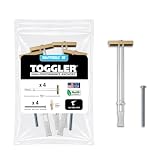
For most small shelves on drywall, a properly installed metal hollow-wall anchor or toggle is a more reassuring choice than a plastic plug. A metal hollow-wall anchor kit is a practical choice when you want a compact fastener that expands behind the board. If you can reach the cavity and the bracket has room for a larger hole, snap toggles spread the load over a broader area.
When a cheaper anchor is enough
A plastic expansion plug can be fine for a very light shelf holding only a small, non-breakable item, especially if the shelf has several mounting points and the drywall is in good condition. It is also easy to remove and inexpensive to replace. Do not treat it as a suitable choice just because the package lists a high maximum load: that figure may come from a straight pull test, while a projecting shelf creates leverage.
Self-drilling anchors are a useful middle ground for light-duty work. They avoid a separate pilot hole in many cases and are quick to install with a screwdriver or drill. The risk is overdriving: once the anchor starts spinning, crushing the paper face, or enlarging its hole, its grip is compromised. Stop as soon as its flange sits flush; do not keep turning to make it “extra tight.”
For a shelf holding dishes, books, or other heavy objects, skip the bargain plug. Either use anchors rated for the application and compatible with the bracket, or locate studs and fasten into them. If the bracket holes do not line up with studs, a short mounting board screwed to two studs can give you a solid base for the shelf.
Tools and installation tips
A tape measure, pencil, level, and screwdriver are enough for many installations. A cordless drill makes pilot holes faster, but use a light touch. Check the anchor package for the required hole diameter: an undersized hole can prevent a metal anchor from seating, while an oversized hole can leave it loose. A drill-bit set with clearly marked sizes is helpful; use the specified bit rather than guessing.
Mark the bracket holes and level the shelf before drilling. For a metal hollow-wall anchor, drill straight through the drywall without pushing hard, then insert and set it according to the instructions. Some need a setting tool to expand the body correctly. For a toggle, make the specified opening, pass the toggle through, and keep it from spinning while tightening the screw. Tighten until the bracket is snug against the wall, not until the drywall dimples or cracks.
A hammer drill is generally unnecessary for ordinary drywall. It is for masonry, not a way to make holes in gypsum board more reliably. If your shelf needs to be attached to brick or concrete instead, use a masonry bit and anchors specified for that material.
Common failures to avoid
The most common mistake is trusting the anchor’s headline load rating without accounting for shelf depth, spacing, and load placement. Keep heavy items close to the wall, spread the load across the brackets, and avoid hanging or pulling on the shelf. Another frequent failure is reusing an enlarged hole: move the fastener to sound drywall or repair the hole before installing an appropriately sized anchor.
Watch for signs that an anchor is slipping: a growing gap behind the bracket, a screw that turns without tightening, cracking around the flange, or a shelf that begins to tilt. Remove the load promptly. Do not solve a spinning anchor by forcing in a larger screw unless the anchor maker explicitly allows it; that can split the anchor or further damage the board.
If the wall is plaster, tile over drywall, or unusually thin board, standard drywall-anchor instructions may not apply. Identify the wall construction first and choose a fastener designed for it. For a shelf where failure could injure someone or break expensive items, a stud-mounted fixing is the sensible default, even if it takes more measuring.