What's inside
As an Amazon Associate I earn from qualifying purchases. This post may contain affiliate links at no extra cost to you.
What we cover
The short answer
For a TV bracket, the best anchor is usually no anchor at all: drive the bracket’s lag screws into wood studs. If the wall is drywall over metal studs, use a bracket and fasteners approved for that framing. If the TV must go on drywall with no usable framing, a toggle-style anchor is generally a better choice than a basic plastic expansion plug—but only when its rated capacity, installation instructions, and the bracket’s load all check out.
TV weight is only part of the load. A full-motion mount pulls outward on the wall as the arm extends, creating leverage that can loosen or tear out anchors. For a heavy TV or an articulating mount, do not treat drywall anchors as a substitute for finding framing or adding proper backing.
As an Amazon Associate we earn from qualifying purchases at no extra cost to you.


Choose by wall construction
| Wall and mount | Preferred attachment | What to watch for |
|---|---|---|
| Wood studs, fixed or tilting mount | Lag screws into studs | Confirm stud locations and follow the mount maker’s screw and pilot-hole instructions. |
| Wood studs, full-motion mount | Lag screws into the required number of studs | Extension increases pull-out force. Use only a mount rated for the TV and follow its framing requirements. |
| Metal studs | Fasteners and mounting method specified for metal-stud installation | Ordinary wood-stud lag screws are not a solution. A plywood backer attached across multiple studs may be appropriate if installed correctly. |
| Hollow drywall, no stud at the bracket | Rated metal toggle or strap-style anchors, if permitted by the mount maker | Capacity depends on drywall thickness, condition, anchor spacing, and load direction. A pull-out rating alone does not establish suitability for a TV mount. |
| Brick or concrete behind the wall surface | Fasteners rated for that masonry | Use the specified masonry bit and installation method; drywall anchors are irrelevant. |
Which drywall anchors are worth considering?
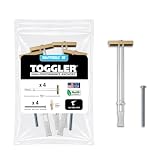
Metal toggle anchors open behind the drywall and spread the load over a wider area than ordinary plastic plugs. Strap-style toggles can be easier to position and tighten, while traditional spring toggles require room behind the wall and can be awkward to keep in place. Either can fail if the drywall is damaged, the hole is oversized, or the screw is tightened so hard that it crushes the board.
Self-drilling plastic or metal anchors are useful for lighter items such as small shelves, cable clips, or a modest picture frame. They are not my pick for a TV bracket. Their holding strength is more sensitive to installation quality, and a bracket’s repeated leverage is a tougher job than a static, close-to-wall load. Basic plastic expansion plugs are cheaper still, but should not be used to carry a TV mount in drywall.
Rated drywall toggle-anchor kits are a reasonable purchase for suitable light-duty hollow-wall jobs, but do not simply add up the package’s per-anchor figures and assume that total is a safe TV-mount capacity. Ratings may refer to ideal test conditions, and the actual bracket can load some anchors more than others. If the mount instructions require attachment to studs, follow that requirement.
Find the structure before drilling
Use a stud finder, then verify likely stud edges with a small test hole or another reliable method. Studs are commonly spaced 16 inches on center, but spacing varies. Check for wires and plumbing before drilling; a detector that identifies live electrical wiring is useful, but it is not a guarantee that the entire path is clear. Avoid drilling vertically or horizontally from outlets without checking what may run through the wall.
Mark the bracket holes and make sure they actually land in the center of the studs. A screw near the edge can split wood or provide poor purchase. Follow the mount instructions for screw diameter, length, and pilot-hole size. A cordless drill is suitable for the pilot hole; a driver can install lag screws, but use controlled torque and stop when the bracket is snug. Overdriving can strip the wood or damage the bracket. Do not use an impact driver as an excuse to skip the pilot hole.
If no stud lines up
First consider a different bracket or a wider mounting plate that reaches studs. That is usually safer and more forgiving than trying to support the whole assembly on drywall. Another option is installing a plywood backer secured to multiple studs, then fastening the bracket to the backer. This takes more work, but it creates a solid attachment surface and can solve awkward stud spacing.
If the wall is hollow drywall and the TV is small, the mount is fixed or tilting, and its instructions allow hollow-wall attachment, use a suitable toggle system installed exactly as directed. Check drywall thickness and minimum edge distances on the anchor packaging. Keep anchors away from damaged, patched, or crumbling areas. Do not mix anchor types casually or substitute screws that do not fit the anchor.
For full-motion mounts, large screens, or any setup where failure could injure someone or damage valuable equipment, get the bracket into framing or have a qualified installer assess the wall. A seemingly strong anchor can pull through a sheet of drywall, and that failure may happen suddenly rather than giving much warning.
Installation checks that prevent failures
Use the fasteners supplied with the mount unless the manufacturer specifies an alternative. Keep the bracket flat against the wall; a gap or uneven surface can put extra bending force on the screws. Tighten evenly, and do not crush drywall by overtightening. After hanging the TV, confirm that the mount locks or tilts as intended and that every connection is secure. Recheck the hardware after the first few days of use, especially on an articulating mount.
Stop if an anchor spins, the drywall flexes, a screw will not tighten, or the bracket shifts when gently tested before the TV is installed. Those are signs to remove the load and choose a better attachment—not to add more torque. For a clean installation into framing, a stud finder with wire detection can help locate framing and flag some electrical hazards, but verify before drilling and treat its readings as a guide rather than proof.