What's inside
As an Amazon Associate I earn from qualifying purchases. This post may contain affiliate links at no extra cost to you.
For a curtain rod in hollow drywall, the right anchor depends on the load, the rod’s leverage, and whether you can reach a stud. A light sheer curtain is an easy job; heavy lined curtains pulled open every day put more strain on the brackets, especially when the rod projects far from the wall. If a bracket can land on a stud, screw it there. If not, use an anchor rated for hollow walls and sized for the bracket holes—not a plastic plug meant for solid masonry.
As an Amazon Associate we earn from qualifying purchases at no extra cost to you.


What we cover
Check the load and wall
Weigh the curtains if you can, and count the rod and hardware. Consider the load at each bracket, but don’t assume it divides evenly: pulling a curtain can briefly load one end, and a center support may carry much of a long rod’s weight. A bracket standing 3 inches from the wall also creates more leverage than a picture frame sitting flush against it.
Use a stud finder, then confirm likely stud locations with a small pilot hole or by checking an outlet location. Standard wood studs are commonly spaced 16 inches on center, but openings and framing can vary. If a bracket hole lines up with a stud, use a screw long enough to penetrate the framing by about 1 inch. Use an anchor only for holes that fall in hollow drywall.
Before drilling, check for wiring and plumbing, particularly above outlets, switches, and sinks. Identify drywall thickness if possible: 1/2 inch is common, while some walls use 5/8-inch board. Anchor capacity varies by anchor design, wall thickness, installation, and loading direction; the package rating is not a guarantee for a curtain rod that gets tugged.
Compare the anchor options
| Anchor type | Best fit | Trade-off |
|---|---|---|
| Self-drilling plastic anchor | Light curtains and small bracket loads | Quick and inexpensive, but easier to strip or pull loose in weak drywall |
| Threaded metal drywall anchor | Light to moderate loads when no stud is available | Installs quickly; still relies on the strength of the drywall around its threads |
| Molly bolt (hollow-wall expansion anchor) | Moderate loads and brackets that may be removed later | Needs the correct hole and setting; removal can leave a larger repair |
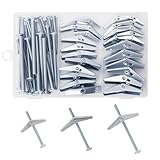
| Toggle bolt or strap toggle | Heavier curtains, longer rods, or higher leverage | Strong grip behind the wall, but requires a larger hole and clearance in the cavity |
Choose by the job
For a short rod holding a lightweight sheer, a correctly installed plastic or metal drywall anchor may be sufficient. A self-drilling anchor is convenient because it usually needs no pilot hole, but it can chew up the drywall if driven crooked or overtightened. A basic self-drilling drywall anchor set is a reasonable low-cost choice for this limited use. Stop turning as soon as the anchor is flush; driving it deeper can crush the paper face and weaken its hold.
For medium-weight curtains, a threaded metal anchor or a properly set molly gives a more secure attachment than a small plastic plug. A molly’s sleeve expands behind the drywall, spreading the load over a wider area. It is more work to install, and it still cannot compensate for damaged, damp, or crumbly board. Follow the specified hole size and setting instructions. If the anchor spins while you tighten the screw, don’t trust it—remove it and use a different hole or a better anchor.
For heavy drapes, wide windows, or brackets that will be pulled often, use a toggle-style anchor where studs are unavailable. The wings or strap sit behind the drywall and distribute force across a larger area. A strap toggle anchor kit can be easier to position than a traditional toggle bolt, though both need an opening large enough for the hardware. Check that there is clear space behind the drilling point; insulation, a pipe, or a stud can block the toggle from opening.
A toggle is not a reason to ignore the rod layout. On a long span, add a center bracket as the rod maker recommends, and fasten that bracket to a stud if possible. If the curtains are unusually heavy or the wall is damaged, anchoring the rod to framing—or choosing a different mounting location—is safer than relying on drywall hardware alone.
Install without weakening the wall
Mark the bracket holes with the rod level and check the spacing against the bracket before drilling. Use the bit diameter specified on the anchor package; a hole that is too large can let an anchor rotate or pull out. A cordless drill with a standard twist bit is usually enough for drywall. Set the drill to a low speed and keep it straight. Do not use hammer mode on drywall: the impacts can break up the edge of the hole. A cordless drill/driver with a clutch makes it easier to stop before you strip the anchor or crush the board.
Insert each anchor square to the wall. For a molly or toggle, make sure its rear section has opened or set as intended before tightening the bracket screw. Tighten until the bracket is secure, not until the screw stops moving under force. Over-tightening can deform the anchor, strip its threads, or fracture the drywall face. Then hang the rod and curtains gently; watch for movement, new cracks, or a bracket pulling away from the wall.
When to redo the mounting
If an anchor spins, the screw won’t tighten, the drywall paper tears, or the bracket shifts under a light hand pull, take the load off. Don’t put a larger screw into the same damaged hole and hope it grips. Move the bracket if the rod layout allows, use a suitable toggle in sound drywall, or fasten into a stud. Patch abandoned holes with an appropriate drywall repair product.
For a normal light curtain, spending extra on toggles may add little value. For heavy curtains, frequent use, or a bracket with noticeable leverage, the larger hole and slower installation are a fair trade for a more secure hold. When in doubt, prioritize a stud-mounted bracket over a higher advertised anchor rating.