We research everything we recommend. When you buy through our links, we may earn a commission. As an Amazon Associate we earn from qualifying purchases.
Best Wood Routers for Trim, Edges and Joinery Projects
Compare the best wood routers for trim, edges and joinery, from versatile combo kits to compact palm routers, with help on bases, collets and speed.
As an Amazon Associate I earn from qualifying purchases. This post may contain affiliate links at no extra cost to you.
⭐ Key Takeaways
Quick answer: Our top pick is Bosch 1617EVSPK 2.25 HP Combination Plunge and Fixed-Base Router Kit, with DEWALT DWP611PK 1.25 HP Compact Router Combo Kit as a strong alternative.
A router turns plain boards into finished work: rounded edges, clean dadoes, hinge mortises and joinery that fits the first time. Routers come in very different sizes, and the right choice depends on the bits you plan to spin. A compact trim router will struggle with a wide panel-raising bit, while a full-size combo kit is more than a laminate job needs.
Safety belongs in the buying decision, not just the setup. Bit speed must match bit diameter, because a large cutter run at full speed is stressed beyond its design limits. Workpieces should be clamped or held against a fence, never held by hand near the cutter, and eye and hearing protection are essential.
As an Amazon Associate, we earn from qualifying purchases.
For most workshops, the Bosch 1617EVSPK combo kit is the top pick: one 2.25 HP motor, fixed and plunge bases, and both collet sizes cover nearly every routing task. The DEWALT DWP611PK and Makita RT0701CX7 suit lighter trim and joinery work, the Bosch PR20EVS Colt is built for one-hand edge routing, and the SKIL RT1323-00 delivers full-size power for less.
The best wood routers in detail
Bosch 1617EVSPK 2.25 HP Combination Plunge and Fixed-Base Router Kit
Top Pick
Bosch 1617EVSPK 2.25 HP Combination Plunge and Fixed-Base Router Kit
Best for: Woodworkers who want one router for edges, joinery and future router-table use.
The 1617EVSPK answers the fixed-versus-plunge question with one motor. Its 12-amp, 2.25 HP motor drops into the RA1161 fixed base for edge profiles and table mounting, then swaps into the RA1166 plunge base for stopped cuts and mortises. Variable speed from 8,000 to 25,000 RPM lets it spin small roundover bits quickly and slow down for larger cutters.
Constant Response circuitry holds speed under load, and soft start keeps the motor from twisting at startup. Both collet sizes are included in self-releasing form, which matters because larger bits are safer and smoother on 1/2-inch shanks. With coarse and microfine depth adjustment, wide aftermarket support, and enough power that most home and small-shop work never outgrows it, this is the kit to build a routing setup around.
Specs:
– Motor: 12 amp, 2.25 HP (max)
– Speed: 8,000 to 25,000 RPM, variable with soft start
– Bases: fixed base and plunge base included
– Collets: 1/4 inch and 1/2 inch, self-releasing
– Depth adjustment: coarse and microfine on the fixed base
– Motor weight: about 7.7 lb
DEWALT DWP611PK 1.25 HP Compact Router Combo Kit
Runner-Up
DEWALT DWP611PK 1.25 HP Compact Router Combo Kit
Best for: Trim carpenters, cabinet installers and hobbyists who want compact size with a plunge option.
The DWP611PK pairs DEWALT’s compact 1.25 HP motor with fixed and plunge bases, making it unusually capable for a trim-size tool. Variable speed from 16,000 to 27,000 RPM, electronic feedback that maintains speed through the cut, and dual LEDs serve one brief: a small router that behaves like a precision instrument.
Its plunge base offers about 2 inches of travel for hinge mortises and stopped grooves, and the fixed base’s adjustment ring gives consistent depth control. At 4.6 lb in the fixed base, it is easy to guide one-handed along an edge. The limits are honest: a 1/4-inch collet only, so large-diameter bits are off the table, and deep cuts in dense hardwood call for several shallow passes.
Specs:
– Motor: 1.25 HP (max), 7 amp
– Speed: 16,000 to 27,000 RPM, variable
– Bases: fixed base and plunge base included
– Collet: 1/4 inch
– Plunge travel: about 2 inches
– Extras: dual LED work lights, clear sub-base
– Weight: 4.6 lb with fixed base, 6.2 lb with plunge base
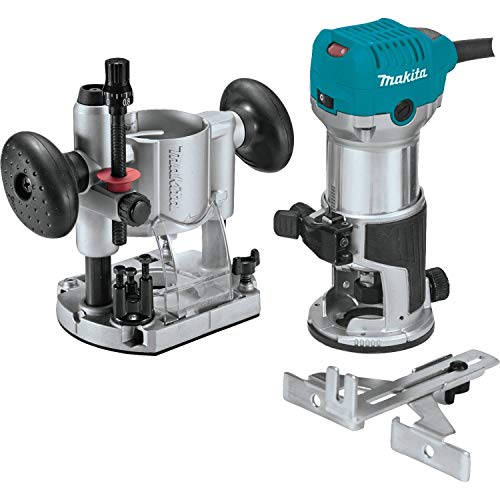
Makita RT0701CX7 1-1/4 HP Compact Router Kit
Makita RT0701CX7 1-1/4 HP Compact Router Kit
Best for: Woodworkers who want the lightest compact kit with the widest speed range.
Makita’s RT0701CX7 pairs the RT0701C compact motor with a trimmer base and a plunge base, so the same 1-1/4 HP motor can ease an edge one minute and plunge a mortise the next. The speed dial runs from 10,000 to 30,000 RPM, the widest range in this group, useful for slowing down in figured hardwood or speeding up for small bits in softwood.
A rack-and-pinion system makes depth changes on the trimmer base predictable, and a quick-release cam lock makes base swaps fast. The aluminum housing keeps it rigid, and at about 3.9 lb the motor is light enough for long edge-profiling sessions. The trade-offs are plunge travel of about 1-3/8 inches, shorter than the DEWALT kit’s, and a 1/4-inch collet only.
Specs:
– Motor: 1-1/4 HP (max), 6.5 amp
– Speed: 10,000 to 30,000 RPM, variable with soft start
– Bases: trimmer (fixed) base and plunge base included
– Collet: 1/4 inch
– Plunge capacity: about 1-3/8 inches
– Depth adjustment: rack-and-pinion fine adjustment
– Weight: about 3.9 lb (motor unit)
Bosch PR20EVS Colt 1.0 HP Variable-Speed Palm Router
Bosch PR20EVS Colt 1.0 HP Variable-Speed Palm Router
Best for: One-handed edge profiling, flush trimming and laminate work.
The Colt is the specialist here: a 1.0 HP, 5.6-amp palm router shaped to be gripped in one hand and run along an edge. Variable speed from 16,000 to 35,000 RPM, soft start and constant-response electronics are unusual at this size, keeping the tool controlled rather than frantic when a small bit meets end grain.
The fixed base uses a quick-clamp system, so the motor locks in fast, and a fine-adjustment knob sets a depth that stays put. The base keeps the bit visible, which matters for flush-trimming veneer and laminate and routing small roundovers where the cut line is the whole job. With no plunge base and no 1/2-inch collet option, this is the second router many shops add so the combo kit can stay in the table while trim is handled freehand.
Specs:
– Motor: 1.0 HP (max), 5.6 amp
– Speed: 16,000 to 35,000 RPM, variable with soft start
– Base: fixed base with quick-clamp system
– Collet: 1/4 inch
– Maximum cutter diameter: about 1-5/16 inches
– Weight: about 3.3 lb
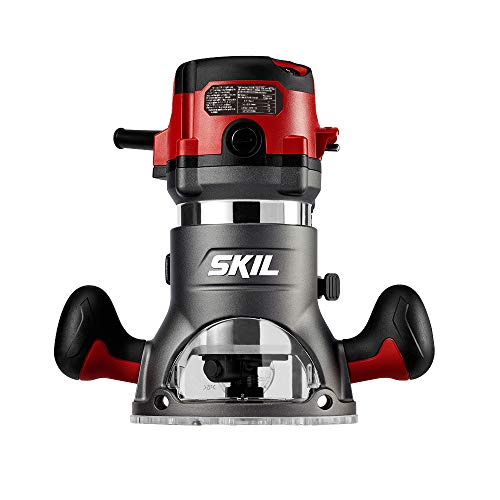
SKIL RT1323-00 10 Amp Fixed Base Router
SKIL RT1323-00 10 Amp Fixed Base Router
Best for: Budget-conscious buyers who want 1/2-inch collet capacity for edges and table mounting.
The RT1323-00 makes a simple case: full-size power does not have to come in a full-size kit. Its 10-amp, 2.0 HP motor accepts both 1/4-inch and 1/2-inch collets, ahead of every compact router here for large bits, and variable speed up to 25,000 RPM with soft start covers small edge bits through mid-size panel cutters.
The die-cast fixed base includes coarse depth settings, microfine adjustment, a live tool indicator, and dual LED lights for the cut area. At about 7.7 lb it has the planted feel that table work and long edge runs reward. It gives up a plunge base, so stopped cuts must start from an edge or a pre-drilled entry; buyers who mostly profile edges or mount a router under a table will rarely miss it.
Specs:
– Motor: 10 amp, 2.0 HP
– Speed: variable, up to 25,000 RPM, with soft start
– Base: fixed base only
– Collets: 1/4 inch and 1/2 inch
– Depth adjustment: three coarse settings plus microfine adjustment
– Extras: live tool indicator, dual LED work lights
– Weight: about 7.7 lb
How to choose
Fixed vs plunge bases and combo kits. A fixed base holds the bit at a set depth, suiting edge profiles, dadoes and router-table mounting. A plunge base lets the bit start and stop inside the workpiece, which mortises, stopped grooves and inlay work require. A combo kit pairs one motor with both bases and is the smartest first purchase for most shops. Single-base tools make sense only when the job list is narrow.
Compact palm vs mid-size horsepower. Compact routers in the 1 to 1.25 HP class are light, easy to guide with one hand, and ideal for trim, roundovers and hinge mortises. Mid-size routers around 2 to 2.25 HP swing bigger bits and double as router-table motors. The dividing line is bit diameter: work that stays under about 1-1/4 inches of cutter suits a compact, while panel raising and wide profiles belong to the bigger motors.
Variable speed. Bit speed should fall as bit diameter grows: small bits run happily at 25,000 RPM and beyond, while a wide panel-raising bit may need half that or less, for cut quality and because overspeeding a large cutter is a safety hazard. Every router here offers variable speed; treat the dial as part of the setup at every bit change.
Collet sizes. A 1/4-inch collet is standard on compact routers and covers most trim and edge bits. A 1/2-inch collet accepts stiffer shanks that flex less and run smoother, preferred for large bits. If a bit comes in both shank sizes, the 1/2-inch version is the better buy. Check the included collets before ordering.
Dust collection and edge guides. Routing throws chips into the cut line, so a dust port that fits a shop vacuum keeps the work visible and the air cleaner. An edge guide turns any of these routers into a straight-line tool for dadoes, rabbets and grooves. Some kits include a guide; others sell it separately.
Who should skip
Skip the compact and palm routers if the plan involves raised panels, wide profile bits or deep single-pass cuts in hardwood; those jobs need mid-size power and a 1/2-inch collet. Skip a fixed-base-only router if mortising and stopped joinery are core work; tilting a spinning bit into a cut is a poor substitute for plunging. And skip a router for occasional edge softening, where a block plane and sandpaper handle the job with less noise, dust and setup.
FAQ
Is a fixed base or plunge base better for a first router?
A combo kit with both bases is the safest first purchase: edge work favors the fixed base, while mortises and stopped cuts need the plunge base. If the budget forces one base, let the first projects decide: edges and table work point to fixed, joinery to plunge.
Can a compact trim router cut joinery?
Yes, within limits: hinge mortises, small box joints, shallow dadoes and dovetail setups with 1/4-inch shank bits, in several light passes. Deep mortises in dense hardwood and large panel work exceed what a 1.25 HP motor should do.
What speed should a router bit run at?
Match speed to bit diameter: small bits under about 1 inch run near full speed, mid-size bits need a step down, and panel-raising bits need the slowest settings offered. Bit makers print maximum speeds on packaging; those limits come first.
Do I need both 1/4-inch and 1/2-inch collets?
Only if the work includes large bits. Trim and small joinery bits are widely available on 1/4-inch shanks, so a compact router loses little. For wide profiles and panel raising, 1/2-inch shanks flex less and run smoother, making a dual-collet mid-size router the better platform.
Final verdict
The Bosch 1617EVSPK is the router kit most workshops should buy first: real power, both bases, both collets and the speed range to use them safely. The DEWALT DWP611PK and Makita RT0701CX7 split the compact vote, the DEWALT on plunge travel and visibility, the Makita on weight and speed range. The Colt is the dedicated edge specialist, and the SKIL RT1323-00 is the value route to full-size, 1/2-inch-shank routing.
M
Miller the Driller Editorial Team
We compare specs, warranty terms, long-term owner feedback and street pricing before anything earns a spot. Rankings are never paid.
Affiliate disclosure. As an Amazon Associate we earn from qualifying purchases at no extra cost to you. Prices accurate as of the date shown.
Three wireless routers for small offices compared on device capacity, network separation, wired speed, and coverage, with specs taken from their Amazon listings.
Compare 5 mechanic tool sets for car repairs: a 247-piece DEWALT kit, a 450-piece CRAFTSMAN set, a drawer-box GEARWRENCH set, a 170-piece Crescent set and a 450-piece WORKPRO set.
Four splitting axes and mauls that actually split firewood: a long 36-inch axe for tall users, a shorter 28-inch option, and two 8 lb mauls for knotty rounds.
Learn whether a 20V rechargeable drill battery can be repaired, which faults you can check safely at home, and when replacing the pack is the safer choice.
A specs-based review of the officially licensed Retro-Bit Sega Saturn 2.4 GHz wireless controller: dual receivers, Genesis Mini and Switch support, battery, layout, limits, and FAQs.
Find the best drill battery for Power Wheels ride-on toys for families, with DeWalt, Milwaukee and Ryobi adapters, voltage and safety guidance in this guide.
Find the best hole saw for noching dom pipe: bi-metal saws, deep cups, and the right sizes for clean, tight notches in DOM tube for fabrication shops today.
Find the best diy tile saws for home tiling projects. Compare wet tile saws by blade size, cutting capacity, and features for ceramic and porcelain tile.


 Bosch PR20EVS Colt 1.0 HP Variable-Speed Palm Router
 SKIL RT1323-00 10 Amp Fixed Base Router









