What's inside
As an Amazon Associate I earn from qualifying purchases. This post may contain affiliate links at no extra cost to you.
What we cover
The short answer
For clean, accurately located holes in hardwood, a brad-point bit is usually the easier choice. Its center point registers on your mark, and its outer spurs score the edge before the cutting lips remove the wood. That helps limit wandering and splintering, especially when drilling into a visible face.
A standard twist bit is still useful, cheaper, and often perfectly adequate for rough holes or through-holes that will be hidden. It is less reliable at starting exactly on a pencil mark in hardwood, and its cutting geometry can leave a rougher exit. The right choice depends on the hole’s location, finish requirements, and how many holes you need to drill.
As an Amazon Associate we earn from qualifying purchases at no extra cost to you.



How the bits cut
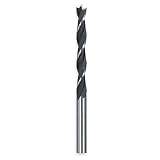
A brad-point bit has a sharp center spur and two outer spurs. The center spur locates the bit; the outer spurs score the hole’s perimeter. Cutting edges between the spurs clear the waste. This arrangement works well in wood because it establishes the hole’s outline before removing material.
A twist bit has a pointed tip and spiral flutes that carry chips out of the hole. Many common twist bits are made for metal, though they can also cut wood. They do not have the same perimeter-scoring spurs, so their tips are more likely to skate across a hard, smooth surface before biting. In wood, a twist bit may also tear fibers at the entry or exit.
Brad-point vs. twist bits
| Factor | Brad-point bit | Twist bit |
|---|---|---|
| Starting on a mark | Center spur helps locate the hole | More likely to wander; a punch or pilot hole can help |
| Hole edge in hardwood | Usually cleaner, particularly at the entry | Can be rougher or tear fibers |
| Blind holes | Good control of diameter and position | Usable, but less tidy at the opening |
| Availability and price | Woodworking-specific; usually costs more | Common and often inexpensive |
| Other materials | Best suited to wood and some wood composites | Metal-rated versions can handle metal as well as wood |
When a brad-point bit is worth buying
Choose a brad-point bit when the hole must land accurately in a finished board, cabinet part, shelf, or furniture component. It is especially useful for holes that will be seen, holes near an edge, and blind holes where a clean rim matters. For example, when drilling a 6 mm hole for a dowel, the center spur gives a clear starting point instead of asking the bit to find its own position.
Brad points are sold in metric and fractional sizes, and many sets cover common woodworking diameters. If you need just one size, buying a single bit can be more sensible than paying for a large set. A brad-point bit for wood is a practical purchase for repeated clean holes, not a requirement for every household drilling job.
Keep the bit sharp and clear chips from deeper holes. Hardwood can heat a small bit quickly if you force it or keep drilling with packed flutes. Back the bit out periodically, especially in holes deeper than roughly one to two bit diameters. A dull brad point may burn the wood and leave a fuzzy edge rather than a clean cut.
When a twist bit is enough
Use a twist bit when the hole is hidden, the fit is not critical, or you already own a suitable bit and only need a few holes. It is also handy if the same job involves metal, provided the bit is rated for that material. There is little benefit in buying a specialty bit for a rough pilot hole that will be covered by a screw head.
For a cleaner start with a twist bit, make a small starter hole, use an awl to mark the center, or clamp a guide block with a hole drilled through it. A simple guide helps keep the bit square, but it does not give the same edge-cutting action as a brad point. For general-purpose work, a twist-bit set is often the cheaper, more versatile choice.
Preventing tear-out and wandering
Bit choice helps, but setup matters. Clamp the work securely; hardwood should not be held by hand while drilling. Mark the center carefully, and use a square or drill guide if the hole must be perpendicular. A cordless drill on a low-to-medium speed setting gives you time to control the feed. Press steadily rather than leaning hard on the drill: excessive pressure can bend a small bit, overheat it, or pull the bit through as it exits.
For a through-hole, clamp a scrap piece tightly against the back of the board. The backing supports the fibers as the bit breaks through and can reduce splintering with either bit type. If you cannot use a backing board, stop when the tip just emerges, turn the work over, and finish from the other side using the small exit hole as your guide.
For a blind hole, set a depth stop or wrap a visible piece of tape around the bit as a rough depth marker. Tape is only a visual aid, not a mechanical stop; watch it closely and drill slowly near the target depth. Clear the flutes before they clog, and keep the drill aligned. If the hole is for a screw, check the screw’s shank and thread diameter rather than assuming the screw size matches the drill-bit size.
What to buy for the job
If you make furniture, install hardware, or drill repeatable holes in hardwood, buy the sizes you use most often in brad-point form. A small set covering roughly 3–10 mm or 1/8–3/8 inch handles many dowel, pilot, and hardware tasks; check the exact sizes before buying. For occasional repairs and mixed materials, a basic twist-bit set plus a way to mark or guide the hole is often enough.
Neither bit type is meant to replace a spade bit or hole saw for large-diameter holes. For clean holes wider than about 1/2 inch, use a bit designed for that size and job rather than forcing a small twist or brad-point bit to do it. In hardwood, take your time, support the exit side, and match the bit to the finish you expect: brad point for placement and cleaner wood holes, twist bit for economical general use.