What's inside
As an Amazon Associate I earn from qualifying purchases. This post may contain affiliate links at no extra cost to you.
For a clean hole in wood, a brad-point bit is usually easier to place accurately. Its sharp center point helps keep the bit from skating, while the outer spurs score the edge before the cutting lips remove material. A twist bit can still be the right choice: it costs less, is easy to find, and works well for many general-purpose holes. The better pick depends on the hole’s size, location, depth, and visibility.
As an Amazon Associate we earn from qualifying purchases at no extra cost to you.

What we cover
How the two bit types cut
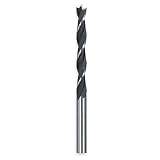
A brad-point bit has a pointed tip in the center and small spurs at the edges. The center point locates the hole; the spurs slice the wood fibers around its perimeter. That layout tends to make a neat, round entry hole, especially in softwood and plywood. Common sizes for woodworking range from about 1/8 inch to 1/2 inch, though larger sizes are available.
A standard twist bit has a conical point and spiral flutes that carry chips up and out. Twist bits are sold in a wide range of diameters and lengths, and many people already own a set for metal, plastic, or general repairs. In wood, though, the point can wander before it bites, and the cutting edges may tear fibers at the surface. A sharp twist bit can still make a perfectly serviceable hole, particularly when placement and appearance are not critical.
Brad-point vs. twist bits at a glance
| Factor | Brad-point bit | Twist bit |
|---|---|---|
| Starting accuracy | Center point helps hold the marked location | More likely to skate, especially on smooth or angled surfaces |
| Hole edges | Usually cleaner in wood because the spurs score the rim | Can leave more splintering at the entry or exit |
| Best use | Visible, accurately placed holes in wood | General-purpose drilling and rough holes |
| Material range | Primarily wood and wood-based panels | Many types are suitable for wood, metal, or plastic |
| Cost and convenience | Often an extra purchase for woodworking | Commonly included in inexpensive mixed sets |
Choose by the job, not the bit label
For a row of shelf-pin holes, cabinet hardware, dowels, or a visible hole in a furniture part, use a brad-point bit if the size is available. Accurate starting matters when holes must line up, and a clean rim saves sanding. For a single hole in a hidden stud-side surface, a sharp twist bit may be all you need. If you are buying specifically for woodworking, a brad-point bit set for wood is a practical choice in the sizes you use most.
Check the bit’s shank before buying. Many small bits have round shanks that fit standard drill chucks; some larger woodworking bits have reduced shanks so they can fit a 3/8-inch or 1/2-inch chuck. Do not assume a bit will fit an impact driver just because it has a hex shank. Impact drivers are designed for driving fasteners, and their hammering action can be rough on small drill bits. A regular cordless drill gives better control for accurate wood holes.
For holes larger than about 1/2 inch, a spade bit or Forstner bit may be more suitable than either option. Spade bits drill quickly but can tear out more. Forstner bits leave a flatter-bottomed hole and can be easier to control for clean, larger-diameter work, but they need a steady drill and can generate more heat. Don’t force a small cordless drill through a large bit; slow down and clear chips often.
How to drill a cleaner, more accurate hole
Mark the center with a sharp pencil or awl, then hold the drill square to the surface. With a brad-point bit, set the center point directly on the mark. With a twist bit, start slowly; a small pilot hole can help keep it on course. For repeated holes, a drill guide or drill press is more reliable than trying to correct a tilted hole by hand.
Use moderate speed and steady pressure. Small bits generally tolerate higher speed than large ones, but wood species, bit diameter, and drill power all matter. If the bit smokes, darkens the wood, or stops making chips, stop and clear the flutes. Dull edges and packed chips create heat and can burn the hole. A quality wood drill bit set is useful only if the bits stay sharp; replace or sharpen bits that require excessive pressure.
To prevent tear-out on the far side, clamp a scrap piece tightly behind the work and drill into it. If you cannot use a backing board, stop when the center point just emerges, then finish from the opposite side using that point as a guide. This takes more setup but usually leaves a cleaner exit than pushing straight through.
When a twist bit is enough
Do not buy a dedicated set just to make an occasional hole in framing lumber or a hidden part. A sharp, correctly sized twist bit is inexpensive and adequate for many everyday jobs. It is also more versatile if you need one set for wood, thin metal, and plastic—provided the bit is rated for those materials. For mixed household work, a general-purpose twist bit set may offer better value than several specialized sets.
The trade-off is control and finish. If a twist bit wanders, stop rather than leaning hard on the drill; pressure will not reliably steer it and can bend a small bit. Re-mark the center, use an awl or pilot hole, or switch to a brad-point bit. For furniture, cabinetry, or holes that need to match across several parts, that modest upgrade can prevent misaligned work and chipped edges.