What's inside
As an Amazon Associate I earn from qualifying purchases. This post may contain affiliate links at no extra cost to you.
What we cover
What each tool is designed to do
A cordless drill-driver turns a chuck to spin a bit. Its clutch can slip when resistance reaches a setting you choose, which helps drive screws without burying them or stripping their heads. It also accepts round- and hex-shank bits for drilling holes. For everyday assembly, pilot holes, and general household work, a drill-driver is usually the more versatile first tool.
An impact wrench uses rapid rotational blows to turn a fastener. Those blows help it loosen or tighten high-resistance nuts and bolts without requiring the same steady force from your hands. It normally takes square-drive sockets, commonly 1/2 inch or 3/8 inch. It is built for jobs such as lug nuts, suspension hardware, and large structural bolts—not delicate screw placement.
As an Amazon Associate we earn from qualifying purchases at no extra cost to you.


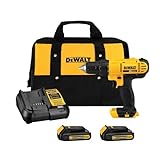

People sometimes mean an impact driver when they say “impact wrench.” They are related but not interchangeable: an impact driver usually has a 1/4-inch hex collet for driver bits and is intended mainly for screws and smaller bolts. An impact wrench accepts sockets and is designed for larger fasteners.
Quick comparison
| Feature | Cordless drill-driver | Impact wrench |
|---|---|---|
| Typical connection | Three-jaw chuck; accepts many drill and driver bits | Square drive; accepts impact-rated sockets |
| Best at | Drilling holes and controlled screw driving | Turning stubborn or large nuts and bolts |
| Control | Variable trigger and adjustable clutch; generally easier to stop precisely | Strong pulsed torque; settings and trigger may help, but fine control takes practice |
| Common failure | Chuck slips, clutch clicks, or the bit stalls under heavy load | Over-tightening, damaged threads, or using a non-impact-rated socket |
| Useful for furniture and cabinets | Yes, usually the better choice | Often excessive unless driving substantial fasteners |
Choose by the fastener and material
For cabinet screws, hinges, small repairs, and most furniture assembly, choose a drill-driver. Set its clutch low, drive a test screw into scrap of the same material, then increase the setting only as needed. Softwood and particleboard can strip easily; a clutch does not guarantee protection, but it gives you a useful stopping point. For small screws, finishing by hand is often safer than using either tool at full speed.
For long construction screws in framing or a dense hardwood, an impact driver may be a better match than either a basic drill-driver or a socket-style impact wrench. Its hex collet takes common driver bits, and its hammering action can reduce the twisting force felt at your wrist. Start straight, use the correct bit, and ease off as the head seats: impacts can still snap a screw or bury it below the surface.
For lug nuts, large lag screws fitted with sockets, or stubborn machinery bolts, an impact wrench can save time and effort. A 1/2-inch drive is common for automotive work; a 3/8-inch drive is more compact for lighter socket jobs. Check the tool’s stated fastening and breakaway torque, not just a headline maximum. Results vary with battery charge, fastener condition, socket, and how long the tool is run.
Drilling holes and installing wall anchors
A drill-driver is the right choice for most holes in wood, metal, and plastic because it can hold ordinary drill bits and provides steady rotation. Use a pilot hole for many screws, especially near the edge of wood or when driving a large screw. Match the pilot-hole diameter to the screw and material; too small a hole raises the chance of splitting, while too large a hole weakens the grip.
For drywall anchors, drill the hole to the size specified on the anchor package. A hole that is too wide can leave the anchor spinning; one that is too narrow can crush the anchor or damage the wall. Set the drill to a low speed, keep it square to the surface, and stop once the hole is deep enough. Do not use an impact wrench for this work. An impact driver can install some anchor screws, but its pulses make it easier to overdrive plastic anchors, so a drill-driver’s clutch is often the safer choice.
If you regularly switch between hole drilling and screw driving, a general-purpose cordless drill-driver kit covers more tasks than an impact wrench. Check whether the kit includes batteries and a charger, and whether its chuck accepts the bit sizes you plan to use.
When an impact wrench is worth buying
Buy an impact wrench when socket fasteners are a regular part of your work, or when a drill stalls before it can turn them. It can be particularly useful for repeated automotive or equipment repairs. If you only change a car’s wheels once or twice a year, a breaker bar and a correctly set torque wrench may be a cheaper, more controlled solution. Many vehicle makers specify roughly 80–150 lb-ft for wheel nuts, but the correct value depends on the vehicle; check its manual.
Do not use an impact wrench to set critical fasteners to final torque. Impact tools can run a nut down quickly, but their output is difficult to judge from sound or run time. Tighten to the manufacturer’s specification with a calibrated torque wrench where required. Use impact-rated sockets, which are designed for the repeated blows; ordinary chrome sockets can crack or shatter under impact.
Before buying, compare the wrench’s drive size, battery platform, weight, and speed or torque modes. More torque is not automatically better: a powerful wrench can damage small bolts, wheel studs, or aluminum threads before you react. For occasional light socket work, a compact cordless 3/8-inch impact wrench may be easier to handle than a heavier 1/2-inch tool, but it may not loosen heavily seized fasteners.
A practical buying decision
If you own no cordless tools, start with a drill-driver unless your main jobs involve automotive or other socket fasteners. It drills, drives, and works with a broad range of bits. A drill with a hammer-drill mode can handle occasional small holes in masonry when paired with suitable masonry bits, though a rotary hammer is better for frequent or larger concrete holes.
If your drill already meets your needs, add an impact tool only to solve a specific limitation. Choose an impact driver for frequent long screws and a socket-style impact wrench for nuts and bolts. Keep the right tool for the job, use the correct bit or impact-rated socket, and stop before force becomes a substitute for proper fit or torque control.