What's inside
As an Amazon Associate I earn from qualifying purchases. This post may contain affiliate links at no extra cost to you.
A useful home-repair bit set should cover the materials you actually drill, fit the tools you own, and include replacements for common wear items. Bigger sets are not automatically better: many fill their cases with sizes you may rarely use while omitting a masonry bit or a sturdy bit holder. Check shank compatibility before buying, especially if you use an impact driver as well as a drill.
As an Amazon Associate we earn from qualifying purchases at no extra cost to you.
What we cover
Know which shank fits which tool
Most ordinary round-shank drill bits fit a standard drill chuck, including the three-jaw chucks on many cordless drills and hammer drills. Common round shank diameters are 1/4 inch and larger; the bit’s cutting diameter is not necessarily the same as its shank diameter. Check both before buying unusually large or small bits.
Impact drivers usually take 1/4-inch hex-shank bits in a quick-change collet. A round-shank bit will not lock into that collet. Hex-shank bits may fit a regular drill chuck, but they are not a substitute for SDS-plus bits in an SDS-plus rotary hammer. SDS-plus bits have grooved shanks made for that hammer’s chuck; they generally cannot be clamped directly in a standard drill chuck.
For routine wood, metal, and plastic work, a standard drill-bit set with round shanks is a sensible starting point. If your main tool is an impact driver, choose a set specifically marked 1/4-inch hex shank, or use a compatible chuck adapter for occasional drilling. An adapter adds length and can wobble, so it is less suitable for precise holes or heavy drilling.
Match the bit set to the job
Twist bits are the general-purpose choice for wood and metal. Smaller bits can snap if you lean on the drill or let the bit wander; a center punch helps keep metal holes on target. For clean holes in wood, brad-point bits are easier to position than ordinary twist bits. They are not the best choice for metal.
Masonry bits have a carbide tip for brick, block, or concrete. They work with a hammer drill in hammer mode where appropriate, but a regular drill in rotary mode is usually slower in masonry. For repeated or larger holes in concrete, an SDS-plus rotary hammer and matching SDS-plus bits are a better fit. Do not use hammer mode on tile: it can crack the surface. Drill tile slowly in rotary mode with a tile-rated bit.
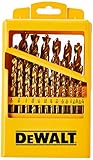
A mixed drill bit set for wood, metal, and masonry with round shanks suits households with a standard drill and occasional wall holes. If you mainly drill wood and sheet metal, a smaller twist-bit set plus a few separately bought masonry bits can cost less and avoid unused pieces.
Compare the common set types
| Set type | Shank | Best for | Trade-off |
|---|---|---|---|
| General twist-bit set | Usually round | Wood, metal, plastic | May not include masonry bits; ordinary points can wander in wood |
| Mixed-material set | Often round; check listing | Occasional holes in several materials | Fewer sizes per material; masonry bits may be basic |
| Impact-driver drill-bit set | 1/4-inch hex | Drilling with a quick-change impact driver | May cost more; not the same as an impact-rated screwdriver-bit set |
| SDS-plus masonry set | SDS-plus | Rotary-hammer drilling in masonry | Won’t fit a standard chuck without a different tool or adapter |
Choose useful sizes, not just a high piece count
For common household fastening and pilot holes, look for small bits around 1/16 to 1/4 inch, with intermediate sizes rather than large gaps. Those sizes cover many screw pilot holes and light hardware work, though the right pilot size depends on the screw and material. For wall anchors, follow the anchor maker’s stated hole diameter; a hole that is too large can let the anchor spin or pull out.
Metric sets are also practical. A set covering roughly 1.5 to 6 millimeters handles many small repair tasks. Buying both inch and metric ranges is useful if you regularly work with hardware specified in each system, but it is unnecessary for many occasional repairs. Check that the case labels each size clearly: replacing a broken 3/32-inch bit with a nearby size can leave a screw pilot hole too large.
What to check before buying
Look for clearly listed shank type, cutting sizes, and intended materials. A 100-piece count may include driver bits, countersinks, and duplicates, so compare the actual drill-bit sizes instead of the headline number. A rigid case that holds small bits securely is useful; loose bits are easy to lose, and mixed sizes are slow to sort out on a ladder.
For an impact driver, buy drill bits made for impact-driver use rather than assuming any hex-shank bit is suitable for repeated impact loading. A 1/4-inch hex-shank drill-bit set for impact drivers is convenient for quick changes, but a corded or cordless drill with a chuck may hold ordinary round-shank bits more accurately.
If you need to attach a round-shank bit to an impact driver occasionally, a 1/4-inch hex-to-chuck adapter can handle light work. Expect added runout and extra length, and stop if the adapter loosens or the bit slips. For frequent drilling, the correct bit shank or a drill is the better buy.
Use bits so they last
Use low speed for larger holes and metal, keep the bit straight, and apply steady pressure rather than forcing it. If a metal bit gets hot, pause and let it cool; heat dulls the cutting edge. A cutting lubricant can help when drilling thicker steel, but is unnecessary for most light household holes. Clear chips from deep holes periodically so the bit does not bind.
In wood, clamp the work where possible and back up the exit side with scrap to reduce splintering. In a wall, first check for likely wires and pipes, then choose an anchor rated for the wall material and load. Stop if a masonry bit wanders, overheats, or meets an unexpected obstruction. A modest set with the right shanks, a few useful sizes, and bits you can replace is a better home-repair purchase than a large assortment that does not fit your tools.