What's inside
As an Amazon Associate I earn from qualifying purchases. This post may contain affiliate links at no extra cost to you.
For most cabinet and furniture assembly, a cordless drill is the better first tool. It gives you more control over screw speed and depth, and its clutch helps prevent stripped holes and crushed panels. An impact driver is useful when you have many long screws or need to fasten into dense material, but its pulsing force makes delicate assembly less forgiving.
As an Amazon Associate we earn from qualifying purchases at no extra cost to you.



What we cover
Quick answer
Choose a drill for flat-pack furniture, cabinet hardware, pilot holes and most screws up to about 2 inches. Choose an impact driver for repeated driving of longer screws into framing or hardwood, or for occasional heavier fastening. If you already own an impact driver, you can use it for assembly with the right bit and a light touch; buying a drill is not essential for one small job.
How the tools behave
A drill turns the bit steadily. Most cordless drills have a clutch: when resistance reaches the selected setting, the clutch slips instead of continuing to drive. That makes it easier to stop before a screw head strips or a particleboard panel splits.
An impact driver also rotates, but when resistance rises, its internal mechanism delivers short rotational blows. Those blows help keep a bit turning under heavy load, so long screws are less likely to stall the tool. The trade-off is more noise, vibration and sudden torque. Many impact drivers have speed modes, but they generally do not offer the same useful clutch control as a drill.
Drill vs. impact driver for assembly
| Task | Cordless drill | Impact driver |
|---|---|---|
| Flat-pack furniture screws | Best control; use a low clutch setting | Works, but easy to overdrive small screws |
| Cabinet hinges and drawer slides | Preferred for precise, repeatable fastening | Use cautiously; hand-finish if needed |
| Pilot holes | Best choice; accepts ordinary drill bits | Needs a suitable hex-shank bit and can feel less controlled |
| Long screws into hardwood or framing | Can work, but may stall on larger fasteners | Usually faster and less prone to stalling |
| Noise and user control | Quieter and easier to modulate | Louder, with pulsing torque |
Cabinet work calls for control
Cabinets are often made from particleboard, MDF or plywood. These materials can hold screws well when the hole and screw are appropriate, but they do not tolerate repeated overdriving. A screw driven too far can strip the hole, pull through a thin panel or leave a hinge sitting crooked. Near an edge, a screw can also split the material.
Use a drill for hinge plates, drawer slides and cabinet connectors. Start with a low speed, select a modest clutch setting, and test it on an inconspicuous spot or scrap of similar material. Increase the setting only if the screw stops before it is seated. For final alignment, a hand screwdriver is often worth the few extra seconds.
When the manufacturer specifies pilot holes, drill them. A pilot hole reduces splitting and makes it easier to place a screw accurately. Its diameter should match the screw’s core rather than the outside diameter of its threads; check the hardware instructions or a pilot-hole chart. Keep the drill square to the panel, and use a depth stop or tape on the bit if drilling through the panel would damage its face.
Furniture assembly and small fasteners
For flat-pack furniture, a drill is generally easier to manage, especially with short screws and small fittings. Use the correct Phillips, Pozidriv or Torx bit: a poor fit can cam out and damage the screw head. Hold the tool in line with the screw, press firmly enough to keep the bit seated, and avoid leaning hard on thin panels.
An impact driver can assemble furniture, but do not treat its speed trigger as a substitute for a clutch. Begin in the lowest speed mode, use brief trigger pulls, and stop as soon as the joint is snug. If the screw is small, the material is thin, or the fastener is near an edge, finish by hand. A screw that spins without tightening has probably stripped the material; driving it harder will not restore its grip.
What to buy
If you need one tool for assembling furniture, installing cabinet hardware and drilling pilot holes, buy a cordless drill/driver. A basic model is enough for these jobs; a hammer-drill function is unnecessary unless you also need to drill masonry. Spending more for high torque alone does not make assembly safer.
If you already have a drill and regularly drive long screws into wood, a cordless impact driver can save time. It is less useful as a second tool if your work is mostly cabinets and flat-pack furniture. You may also need impact-rated driver bits; ordinary bits can break under an impact driver’s repeated blows.
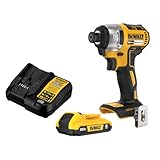
Some kits pair a drill and impact driver. That combination is convenient if you often switch between drilling pilot holes and driving substantial fasteners, but it costs more and is unnecessary for occasional furniture assembly. A separate hex-shank drill-bit set can be fitted to an impact driver, but for careful drilling a drill remains easier to control.
A few habits prevent damage
Match the screw length to the panel thickness and the hardware instructions. Before driving near an edge, check that the screw will not break through the visible face. Keep the bit straight, use a sharp driver bit, and reduce speed as the screw approaches the surface. Stop when the head is seated; countersinking a screw into a soft panel can weaken the joint.
If the screw hole is already stripped, do not keep trying with a more powerful tool. Remove the screw and use the repair method recommended for the furniture or cabinet material, such as a correctly sized insert or a suitable wood repair. For a loose hinge in particleboard, moving to a longer screw without checking what lies behind the panel can cause new damage.