What's inside
As an Amazon Associate I earn from qualifying purchases. This post may contain affiliate links at no extra cost to you.
What we cover
Choosing a hammer drill for stone anchor holes
For occasional holes in softer stone, a good cordless hammer drill with a sharp masonry bit can do the job. For repeated holes, hard stone, or larger anchors, a compact SDS-plus rotary hammer is usually faster and easier on your hands. The key distinction: a hammer drill uses a ratcheting action that pulses the bit, while a rotary hammer drives it with a piston. Both rotate and hammer, but the rotary hammer generally removes masonry more efficiently.
Before buying, check the anchor maker’s specified hole diameter and depth. Common light-duty anchors use holes around 1/4 inch to 3/8 inch; larger sleeve or wedge anchors may call for 1/2 inch or more. Stone varies widely: soft limestone is not the same as dense granite. If you are drilling only a few small holes in softer stone, a cordless hammer drill kit is often the sensible lower-cost choice.
As an Amazon Associate we earn from qualifying purchases at no extra cost to you.
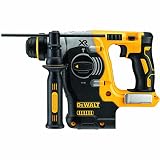


Hammer drill or rotary hammer?
| Tool | Best fit | Trade-off |
|---|---|---|
| Regular drill | Soft material, or drilling with a diamond bit where hammering is unsuitable | Slow in ordinary masonry; not a good default for stone anchor holes |
| Cordless hammer drill | A few small holes, softer stone, and users who also need a general-purpose drill | Needs firm pressure and sharp bits; progress can stall in dense stone |
| SDS-plus rotary hammer | Repeated holes, harder stone, and larger masonry bits | Costs more, is bulkier, and is less convenient as an everyday screwdriving tool |
For a mixed job—say, several 1/4-inch holes in a stone veneer—a hammer drill can be adequate. For a dozen 3/8-inch holes in dense stone, a rotary hammer will usually save time and reduce the effort needed to keep the bit cutting. Look at the manufacturer’s stated maximum drilling capacity and energy rating, but do not treat the maximum capacity as a promise of comfortable all-day performance.
What to look for when buying
On a hammer drill, useful features include two mechanical speed ranges, a side handle, a variable-speed trigger, and a hammer-mode selector. A side handle matters because a bit can bind abruptly; holding only the main grip can twist your wrist. A clutch is useful for screws, but set it aside when drilling. Brushless motors can improve runtime, though they do not make a weak hammer mechanism suitable for hard stone.
If the work is mainly masonry, compare cordless SDS-plus rotary hammers. SDS-plus bits lock into the tool and can move axially, which is why they are not interchangeable with standard round-shank masonry bits. Check whether a battery and charger are included: tool-only prices can be misleading if you do not already own compatible batteries.
Choose a masonry bit with a carbide tip and the exact diameter required by the anchor instructions. Worn or overheated bits cut slowly, wander, and can leave an oversized or ragged hole that will not hold an anchor reliably. For a cordless job, bring a spare battery; dense stone can drain one faster than wood or metal work.
How to drill a clean anchor hole
Mark the hole and check for wiring, plumbing, and concealed services before drilling. On polished, sloped, or crumbly stone, start with a small guide hole or use a punch only if the stone surface can take it without chipping. Keep the drill square to the surface. A bit that starts at an angle can skate and leave an opening too wide for the anchor.
Start at low speed with light pressure until the carbide tip has a secure bite, then increase speed while keeping steady pressure. Let the tool do the hammering; forcing it can overheat the bit, fatigue the operator, or cause the bit to bind. Pause periodically to withdraw the bit and clear dust. Dust packed in the hole slows cutting and can prevent an anchor from seating. Wear eye protection and a suitable dust mask, and use dust extraction where practical.
Drill to the depth specified for the anchor, allowing for the dust that may collect at the bottom. A depth stop or a piece of tape on the bit is a simple visual check, but do not rely on tape if the hole must be precise. If progress stops, ease off and check for a worn bit, packed dust, or a stone layer harder than expected. Do not lean harder on a stalled tool. If the bit repeatedly binds or the job requires many holes, switching to an SDS-plus rotary hammer is safer and more effective.
Avoiding anchor failures
Match the anchor to the stone and the load. Not every plastic wall plug is suitable for every kind of stone, and brittle or irregular stone may not provide reliable holding for an expansion anchor. Follow the anchor manufacturer’s minimum edge distance and embedment depth; drilling close to an edge can split or spall stone. If the surface is thin veneer over another material, identify what the anchor will actually engage before choosing it.
A hole that is too large is a common failure. The anchor may spin, pull out, or fail to expand correctly. If the hole is loose, do not assume a larger screw will fix it; choose an appropriate repair or a different anchor system. Clean the hole as directed by the anchor instructions, seat the fastener without striking the stone, and stop if the stone cracks or flakes around the opening. For a few small holes in soft stone, a hammer drill and careful technique are enough. For hard stone, repeated drilling, or larger anchors, the extra cost of a rotary hammer is often justified by cleaner, more consistent holes.