What's inside
As an Amazon Associate I earn from qualifying purchases. This post may contain affiliate links at no extra cost to you.
What we cover
Choose the bit for the hole
For ordinary holes in concrete masonry units (CMUs)—concrete blocks, including hollow blocks—a carbide-tipped masonry bit is usually the right starting point. Match its diameter to the anchor or fastener instructions, and make sure the shank fits your drill. A standard round-shank bit works in most three-jaw chucks; an SDS-Plus bit needs an SDS-Plus hammer drill.
The main decision is not simply “which bit is toughest?” It is whether you need a few accurate holes or many holes in hard, dense masonry. For light work, a basic bit can be perfectly adequate. For repeated drilling, a better carbide tip and a hammer drill designed for masonry can save time and reduce wear.
As an Amazon Associate we earn from qualifying purchases at no extra cost to you.



Bit types and trade-offs
| Bit type | Best for | Trade-off |
|---|---|---|
| Basic carbide-tipped masonry bit | A few small holes for plastic plugs or light-duty anchors | Affordable, but may drill slowly and wear faster in dense block |
| Quality carbide-tipped bit | Regular drilling in block, brick, or concrete | Costs more; a sensible upgrade if you have several holes to make |
| SDS-Plus masonry bit | Repeated or larger holes with an SDS-Plus rotary hammer | Requires a compatible chuck; unnecessary for occasional small holes |
| Multi-material bit | Jobs that may include masonry and other materials | Check the maker’s rating: not every multi-material bit is intended for hammer mode |
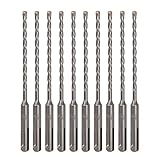
For a short punch list, a carbide-tipped masonry bit set is a practical buy. Check the sizes against your planned anchors rather than assuming a set includes the one you need.
Match the bit to the drill
A hammer drill uses rotation plus a rapid hammering action. It can handle small and medium masonry holes, especially in hollow CMU. A rotary hammer with an SDS-Plus chuck delivers stronger impact and is better suited to repeated drilling or larger holes. Do not confuse either tool with an impact driver: impact drivers are made for turning fasteners, and their hex-bit holders are generally not the right setup for drilling masonry holes.
Check both the bit’s shank and the tool’s instructions before buying. A round-shank bit cannot be clamped directly in an SDS chuck, and an SDS bit will not fit a standard drill chuck unless you use an appropriate adapter. Adapters add length and can introduce wobble, so use the right shank when possible.
If you are buying a tool for frequent masonry work, compare SDS-Plus rotary hammer bits with round-shank masonry bits. SDS-Plus bits typically cost more, but their positive chuck engagement and compatibility with rotary hammers are useful when drilling many holes. For a couple of small anchor holes in soft block, paying for an SDS setup may not be worthwhile.
Size and hole placement
Use the diameter specified by the anchor maker; the fastener diameter alone does not tell you the correct hole size. A hole that is too large may leave a sleeve anchor loose, while an undersized hole can make installation difficult or damage the anchor. Confirm the required depth too. As a starting check, mark the depth on the bit with tape, but do not use tape as a substitute for a depth stop when accurate depth matters.
CMU has a hollow interior and thicker webs, the solid sections between cavities. A hole through a web has more material to drill than a hole through a thin face shell. If the anchor instructions permit it, place the hole where the anchor will be supported by solid masonry, not over a cavity. Keep away from block edges and mortar joints unless the fastening instructions specifically allow them: weak or crumbling material can reduce holding strength.
Drill without burning the bit
Mark the spot, hold the drill square, and start slowly enough to keep the tip from wandering. Use hammer mode only with a bit rated for hammer drilling. Apply steady pressure, but do not lean your full weight on the tool; excessive force can overheat the tip, stall the bit, or make it harder to keep the hole straight. Ease pressure as the bit breaks through a thin face shell.
For a small hole in hollow block, begin with the drill maker’s recommended setting and let the bit cut. If the bit skates, make a shallow starter mark or use a center punch gently. Pause periodically to clear dust from the hole and let the bit cool. Masonry dust can bind the bit and make drilling slower; wear eye protection and a suitable dust mask, and keep dust out of the tool’s vents.
Common warning signs are straightforward: a bit that spins without advancing may be blunt or packed with dust; a hole that wanders often means the drill was tilted at the start; a hot, discolored tip suggests excessive pressure or prolonged drilling. Stop if the bit catches or the block starts breaking apart. Continuing can enlarge the hole beyond the anchor’s usable size.
When to upgrade
If you drill only a few small holes a year, buy a correctly sized basic carbide bit and replace it when it stops cutting cleanly. There is little benefit in paying for a premium bit that will sit unused. If you are fitting many anchors, drilling larger diameters, or working in dense concrete block, a better carbide bit—or an SDS-Plus bit paired with a rotary hammer—can be worth the added cost.
For a single anchor, the bit is only one part of a reliable fixing. Follow the anchor instructions for hole diameter, depth, cleaning, and installation, and choose an anchor rated for the load and for the specific CMU location. If the hole is oversized, damaged, or positioned in a cavity where the anchor is not designed to work, changing to a more expensive bit will not solve the fastening problem.