Key takeaways
- Most table saw problems are maintenance problems: here is the tune-up order I use, from waxing cast iron to squaring the blade, fence, and stops.
What's inside
As an Amazon Associate I earn from qualifying purchases. This post may contain affiliate links at no extra cost to you.
Nine times out of ten, when somebody tells me their table saw went bad, the saw is fine. The top is sticky, the blade is wearing a jacket of pitch, the fence has crept out of parallel, and the poor thing is still expected to rip hard maple. This table saw maintenance guide is the routine I run on my own saw, in the order I run it, because order matters here. Fix the top before you fight the fence, and fix the fence before you blame the blade.
I spend most of my day behind a drill, a tool that complains the second something is wrong. A table saw is sneakier. It degrades slowly, you compensate slowly, and one afternoon you are leaning on the stock hard enough to make the cut wander. Burn marks, drift, a rip that measures 2 inches at the front and a hair over at the back, a motor that bogs in stock it used to walk through: those are maintenance symptoms, not old-age symptoms. Before any of what follows, unplug the saw. Not switched off. Unplugged.
As an Amazon Associate we earn from qualifying purchases at no extra cost to you. Product prices and availability are accurate as of the date shown and are subject to change.




| Task | How often | What it takes |
|---|---|---|
| Wipe and re-wax the top | Every few weeks of use | Paste wax, clean rag, ten minutes |
| Clean pitch off the blade | Every 8 to 10 hours of cutting | Blade cleaner, nylon brush |
| Vacuum trunnions and cabinet | Two or three times a year | Shop vac, brush, dry lube |
| Check blade to slot alignment | Twice a year, or after moving the saw | Square or dial indicator |
| Inspect belt, arbor, and cord | Once a year | Eyes, ears, fifteen minutes |
A Table Saw Maintenance Guide That Starts With the Top
Cast iron collects a film of resin, hand oil, and fine dust that behaves like weak glue. Scrub it with mineral spirits and a maroon non-woven pad, working along the machining marks instead of across them. Light surface rust lifts the same way, and pitting that is already there is cosmetic. Wipe dry, lay on a thin coat of silicone-free paste wax, let it haze a few minutes, then buff it off with a clean rag. Two thin coats beat one thick one. You feel it on the first push: stock glides, so you can slow the feed down and let the blade cut instead of shoving.
Do the fence face, the miter gauge bar, and the wings while the can is open. Go easy inside the miter slots, though, because wax buildup makes a well-fitted bar feel sloppy.
Silicone-free paste wax
Buy plain paste wax in a can, not a silicone spray. One can lasts years across a saw top, jointer bed, and plane soles, and it will not haunt you later when a finish refuses to flow out.
- ✔ Lower sliding friction, so you can feed slower and straighter
- ✔ Blocks the moisture that starts surface rust
- ✔ One can covers years of shop use
- ✔ No silicone to wreck glue joints or finish
- ✘ Needs redoing every few weeks in a humid shop
- ✘ Buildup in miter slots makes a good bar feel sloppy
- ✘ Does nothing for rust that already pitted the iron
Get the Blade, Fence, and Miter Slot Talking
Alignment needs an order and a reference, and the reference is the miter slot, because every sled and gauge you own registers off it. Raise the blade fully, mark one tooth, measure from that tooth to the slot at the front of the throat, then rotate the blade and measure the same tooth at the back. A combination square gets you close; a dial indicator riding a bar in the slot ends the argument. I want a couple thousandths of an inch or less of difference, which on a cabinet saw means loosening trunnion bolts and tapping, and on many contractor saws means shifting the table itself.
Only then set the fence. Lock it, measure front and back off the same slot, and if you toe it at all, toe the rear a whisker away from the blade, in the two to five thousandths neighborhood. Toed the other way you are pinching the offcut against a spinning blade, which is how boards get thrown. Finish by resetting the 90 and 45 degree stops with a square against the blade plate, never the teeth, and check that the riving knife sits in the blade’s plane rather than off to one side.
Dial indicator and miter slot bar
A square works, but a dial indicator on a slot bar turns alignment from an argument into a number. Worth it on a saw you plan to keep; skip it if you set the saw once and never move it.
Under the Table: Trunnions, Belt, and Arbor
Open the cabinet and you will find why the elevation crank got stiff: sawdust packed into gear teeth and trunnion ways. Vacuum, brush, vacuum again, then lubricate with something dry. Oil and grease down there catch dust and turn into a paste that binds worse than the dust did, so reach for dry PTFE spray, paraffin, or a rub of that same paste wax on the gear teeth and tilt threads.
Check the belt while you are in there. Cracks, glazing, or a set from sitting all winter in one position shows up as vibration at the table, and on a belt-drive contractor saw a segmented link belt is a cheap change you can actually feel. Spin the arbor by hand and listen; a dry growl means bearings, and bearings are a repair rather than a tune-up. Clean pitch off the arbor flange and washer too, since a speck of crud there tilts the blade a hair and reads as wobble that no alignment will cure.
Blade Care, and When to Retire One
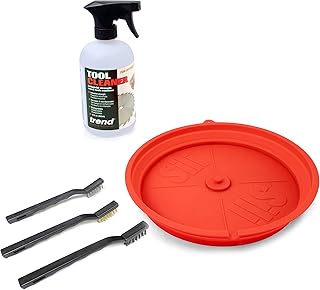
A blade caked with pitch runs hot, cuts slow, and burns wood while looking perfectly sharp. Every eight to ten hours of cutting, pull it and soak it in a dedicated blade cleaner or a citrus degreaser, then work the gullets and tooth faces with a nylon brush. Skip caustic oven-type cleaners, which can attack the brazing holding the carbide on. Dry it immediately, wipe the plate with a rust preventative, and reinstall with the teeth pointing toward the front of the table.
Sharpening beats replacing on anything above builder grade; a decent 40 to 50 tooth combination blade is worth two or three trips to a sharpening service. Retire a blade when teeth are chipped or missing, when the plate is warped or shows heat bluing, or when it has been ground back far enough to change the tooth geometry. Keep a separate crosscut blade for plywood, because running one blade for everything is how a saw starts tearing veneer.
Blade cleaner and resin remover
A pint of dedicated cleaner and a nylon brush give back more cutting performance per dollar than any accessory here. Get the non-caustic kind so it is safe on brazed carbide teeth.
Dust, Inserts, and the Guard You Keep Taking Off
Dust collection is maintenance, not accessory shopping. A cabinet packed with chips presses against the motor and trunnions and undoes your cleanup in a week. Check the port for a clog and the extractor filter and bag, and remember that a shop vac hose has suction but very little volume, while under the table you need volume.
The insert plate matters as well. A worn factory insert with a sloppy slot lets thin offcuts drop and jam, so make or buy a zero-clearance insert, keep a spare, and level it to the top with its set screws before you trust a fine cut. As for the guard and riving knife, I know they come off for non-through cuts. Put them back; every alignment step above exists so they fit without fighting you.
Table Saw Maintenance FAQ
How often should I wax a cast iron table saw top? A couple of times a season in a dry shop, every few weeks of active use in a humid garage, and always after you scrub the top with solvent. If stock hesitates when you push it, you waited too long.
Can I use WD-40 or silicone spray instead of paste wax? Use a light penetrating oil to clean rust, then wipe it off. Neither makes a good top coat: oil migrates into the workpiece and shows up under stain, and silicone is the enemy of glue and finish.
What should I check after moving the saw? Blade to miter slot first, then the fence, then the 90 and 45 degree stops. Rolling a saw across a garage floor or hauling it in a truck bed is enough to shift a trunnion, and ten minutes with a square settles it.
None of this is a weekend project. The wipe and wax is coffee-break work, a full alignment is an hour with a square and a wrench, and the cabinet cleanout comes around twice a year. Keep wax and blade cleaner on a shelf you actually reach for, work in that order, and the saw stops being the thing you blame.
Check prices on Amazon →