What's inside
As an Amazon Associate I earn from qualifying purchases. This post may contain affiliate links at no extra cost to you.
What we cover
Why use an impact driver on MDF?
MDF is dense, uniform, and easy to split or crush if a screw is driven too hard. An impact driver can make repetitive fastening faster than a drill because its hammering action delivers bursts of rotational force. That is useful when assembling cabinets, attaching cleats, or driving many screws into panels. It is not automatically the best tool for every MDF job: a drill with a clutch offers finer control, especially near edges and on visible surfaces.
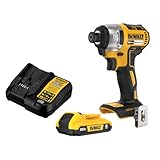
For occasional assembly, a basic cordless drill is often enough. If you routinely drive long screws or fasten panels in batches, consider a cordless impact driver kit with variable-speed control and a comfortable low-speed trigger. The tool matters, but screw choice, pilot holes, and driving technique matter just as much.
As an Amazon Associate we earn from qualifying purchases at no extra cost to you.



What to look for when buying
Choose a compact 18V or 20V-class impact driver if you want one tool for shop and household fastening. These platforms generally offer enough power for common MDF screws without the size and weight of a heavy-duty model. A 12V driver can be a good lighter, less expensive choice for cabinet assembly and shorter screws; it may slow down with long fasteners or repeated work in thick panels.
Prioritize a controllable trigger, a low-speed setting or selectable modes, and a good belt hook or work light if those suit your work. Brushless motors can improve runtime and reduce maintenance, but they are not essential for occasional use. A bare tool is only a bargain if you already own compatible batteries and a charger.
Use a 1/4-inch hex-shank bit that fits the screw head closely. A bit that wobbles or cams out can strip the recess before the screw is seated. For frequent MDF work, a set of quality impact-rated driver bits is more useful than buying the highest-torque tool available.
Impact driver options at a glance
| Option | Best fit | Trade-off |
|---|---|---|
| 12V impact driver | Light assembly and shorter screws | Lighter and often cheaper, but less suited to long fasteners and high-volume work |
| Compact 18V/20V impact driver | Regular DIY and cabinet work | Good balance of control and capability; platform batteries add cost |
| Drill with clutch | Precise, occasional fastening | Slower for lots of screws, but easier to limit torque |
| High-output impact driver | Frequent heavy fastening across materials | More power than most MDF jobs need; easier to overdrive a screw |
For most buyers, a compact 18V/20V tool is the flexible choice. A 12V impact driver kit makes sense if low weight and price matter more than driving speed. If you mainly fasten MDF furniture panels, a cordless drill with a clutch may be the better buy.
Screws, pilot holes, and edge distance
Use screws intended for wood or particleboard, with a coarse thread that can grip MDF. A screw around 1 1/4 inches long is common for joining 3/4-inch panels, but the right length depends on the joint: the screw must penetrate the receiving piece without breaking through its far face. Check the screw’s actual thread and shank dimensions rather than relying on length alone.
Pre-drill near edges, for small screws, and whenever the panel is valuable or the joint must be neat. A pilot hole roughly the screw’s core diameter helps reduce splitting and bulging; in a scrap piece, test a bit slightly smaller than the screw’s solid shank and adjust if the screw feels loose. Keep the hole centered and leave about 1 inch or more from an edge when the design allows. MDF edges are weaker than faces, so a screw driven too close can blow out the edge even if the panel does not visibly split.
For a clean face, use a countersink only deep enough for the screw head to sit flush. Over-countersinking removes the surface material that supports the head. For joints that will be loaded repeatedly, glue can add strength, but do not treat a screw in an MDF edge as a substitute for a proper connector or reinforced joint.
How to drive screws without damaging the panel
Clamp the pieces so they cannot shift, seat the bit fully, and start at low speed. Let the tool’s weight and steady pressure keep the bit engaged; leaning hard on the driver can cause cam-out. Stop when the head is flush. Impacts can continue tightening after the screw appears seated, leaving a crater, crushed fibers, or a stripped hole in a fraction of a second.
Test the setting on an offcut of the same thickness. If your driver has modes, start with the gentlest setting; otherwise feather the trigger and release as the head approaches the surface. A clutch-equipped drill gives a more repeatable stopping point, although clutch numbers are not calibrated across brands. When fastening a panel face, a drill’s lower-speed range may produce a cleaner result than an impact driver.
Common failures and fixes
Screw spins without tightening: The hole may be too large, the threads may be damaged, or the fastener may be poorly suited to MDF. Move to an undamaged location where possible, pre-drill correctly, and use a suitable coarse-thread screw. Filling the old hole alone may not restore a strong structural joint.
Head sinks below the surface: Reduce speed, stop sooner, and check whether the countersink is too deep. If the surface is already crushed, the damage is difficult to hide under paint or a thin finish.
Edge bulges or breaks: Move farther from the edge, drill a pilot hole, and avoid overtightening. If the panel is too narrow to provide safe edge distance, change the joint design rather than relying on more impact force.
Wear eye protection, keep hands clear of the bit, and avoid driving screws near hidden wiring or plumbing when working in installed panels. For a small number of screws, patience and a drill clutch are often worth more than extra torque; for repeated fastening, a controllable impact driver saves time when paired with the right screw and a light touch.