Key takeaways
- A great drill with junk bits is a loud paperweight. My picks for bits that stay sharp and do not snap.
What's inside
As an Amazon Associate I earn from qualifying purchases. This post may contain affiliate links at no extra cost to you.
Here’s a truth nobody tells beginners: your drill is only as good as the bit in it. I’ve watched people blame a perfectly good drill when the real problem was a dull, wandering bargain-bin bit. Good bits changed my work more than any new drill.
What follows is the reasoning behind the drill bit sets that stay on my shelf instead of rotating through the trash. Bits are one of the few purchases in a shop where the expensive option is genuinely cheaper over five years, and also one of the few where the expensive option is a waste of money. Knowing which of those two situations you are in is the whole decision.
As an Amazon Associate we earn from qualifying purchases at no extra cost to you. Product prices and availability are accurate as of the date shown and are subject to change.


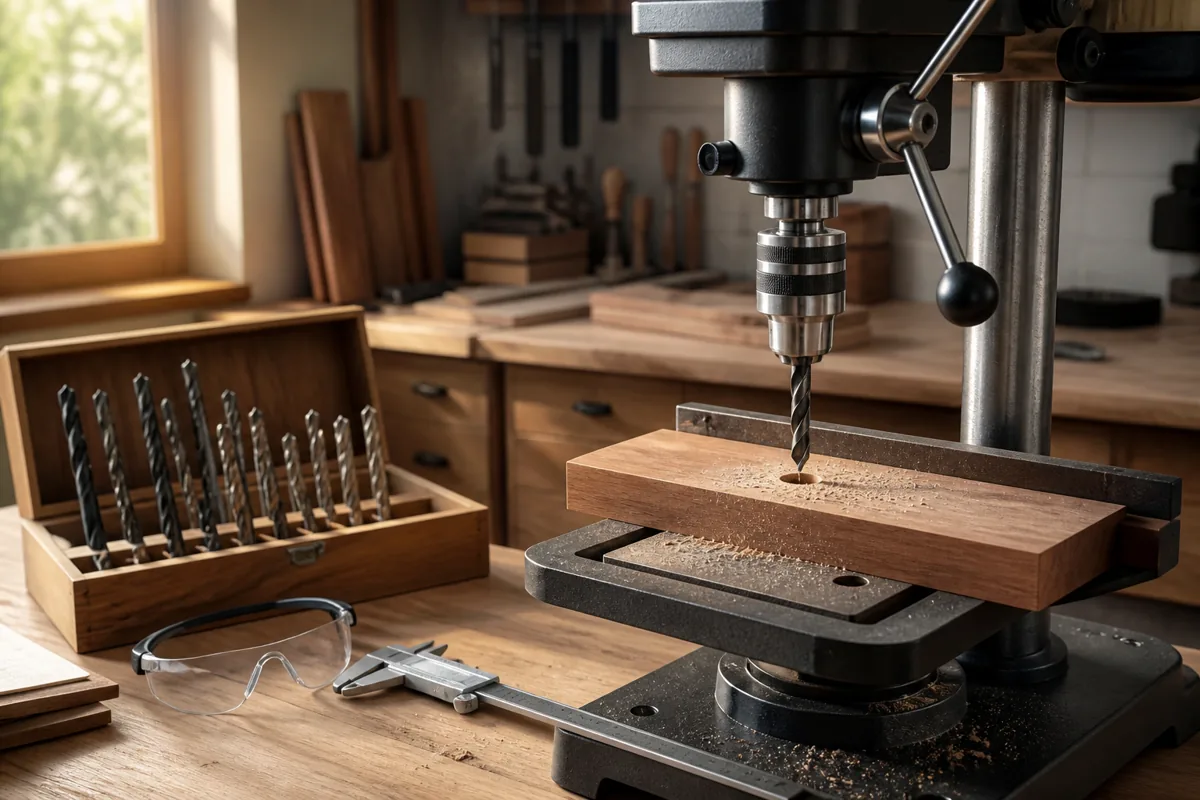
What Separates a Good Bit From a Bad One
Packaging sells piece count. Piece count decides almost nothing. Four things decide it, and this is the order I weigh them in.
The grind at the tip. On twist bits, look for a split point rather than a plain cone. A split point starts cutting where you put it instead of skating, and cheap sets are ground fast enough that the two cutting lips end up different lengths. Uneven lips drill an oversized hole and chatter no matter how carefully you punched the mark.
The steel underneath. Plain high speed steel covers wood, plastic, and mild steel, which is most of what a woodworker does. Cobalt alloy holds its edge hotter and is what you want for stainless and hardened fasteners, but it is more brittle and chips if you lever it sideways. Carbide belongs in masonry and tile and nowhere near a furniture project.
The coating, which matters least. Black oxide resists rust and holds a film of oil. Titanium coatings are harder than the steel beneath them, but the layer is microns thick and wears off the cutting edge first, which is exactly where you wanted it. A gold-colored budget bit is still a budget bit. Coating is a tiebreaker, never a reason to buy.
The shank and the case. Round shanks in a clean keyless chuck run truer than hex, and I use round for anything above a quarter inch. Hex and quick-change shanks buy speed, not accuracy. For the case, you want an index with labeled, sized holes and a latch that holds. Blow-molded clamshells dump bits into the bottom of a toolbag.
When those pull against each other, buy geometry first, steel second, case third, coating last. A well-ground uncoated bit beats a badly ground titanium one every single time, and a good case is what keeps the set from quietly becoming a handful of loose bits in a drawer.
Brad-point for wood
Brad-point bits have a sharp center spur that stops the bit from wandering, so holes land exactly where you marked. For woodworking, they’re night and day versus twist bits.
The outer spurs are the other half of the story. They slice the wood fibers around the rim ahead of the cutting edges, so the hole is severed instead of torn, which is why the entry looks crisp even across figured grain. Exit is still your job: clamp a sacrificial backer board under the workpiece, or the last fibers blow out and take your clean hole with them.
They have limits worth knowing. Deep holes pack the flutes, so back the bit out to clear chips instead of leaning harder. Large diameters and flat-bottomed holes are forstner territory. And a brad point in steel is a ruined brad point: the center spur rolls over on the first hole and never centers again.
Between price bands, the tell is the spur. On cheap sets the center spur is often ground off-center or barely ground at all, so the bit locates in roughly the right place and then walks. On a good set the spur is dead center, the outer spurs are proud and sharp enough to catch a fingernail, and the bit bites at finger pressure.
Brad-Point & Twist Bit Set
A brad-point set for clean wood holes plus quality twist bits for metal and everything else. Sharp out of the box, and they stay that way. This is the set that lives on my shelf.
- ✔ Brad-points don’t wander
- ✔ Stay sharp
- ✔ Cover wood & metal
- ✔ Organized case
- ✘ Not for masonry (get separate)
- ✘ Premium price
What You Get At Each Price Band
Bargain multi-packs
You get quantity, a thin coating, and a grind nobody inspected. They cut a few holes in softwood or drywall and then need pressure. That is acceptable if you drill twice a year, or if you are drilling into salvage where a hidden nail will eat the bit anyway. Skip them if you build anything that gets measured afterward.
The middle of the market
This is where most home shops should live. Consistent grinds, honest steel, a usable index case, and sizes in even increments you will actually reach for. A mid-tier set from a brand that also sells replacements individually is the highest-value purchase on this page for a weekend woodworker.
The premium end
Tighter tolerances, better concentricity, edges that survive hardwood and repeated metal work, and cases built to be opened daily. Worth it if you drill for a living, work a lot of hard maple or stainless, or hate re-drilling. Not worth it if the set will sit in a cupboard for months at a stretch.
Mistakes That Kill Good Bits
- Too much speed on big holes. The larger the diameter, the slower the drill should turn. Speed plus pressure equals a burned edge.
- Drilling metal dry. A drop of cutting oil, slow speed, and steady pressure keeps the edge alive. High revs and no lube blues the tip in seconds.
- Pushing a dull bit. If it stops throwing chips and starts making dust, smoke, or squeal, it is finished. Leaning on it wrecks the bit and can grab the workpiece.
- Loose storage. Bits knocking together in a bag get nicked edges and rust. Back into the index every time.
- Wrong bit, wrong material. Brad points in metal, twist bits in brick, masonry bits in plywood: each one is a fast way to buy a replacement.
Don’t forget driver bits
Impact-rated driver bits are worth every penny — cheap ones cam out and strip screws. Buy quality bits once and stop cursing your impact driver when the real culprit was a $2 bit.
What makes an impact-rated bit different is that it is engineered to flex. A torsion zone in the shank absorbs the hammer blows that would otherwise snap a rigid bit, and the tip is hardened harder than the shank so the drive geometry survives longer than the body. Standard insert bits in an impact driver shear at the neck, usually mid-screw, usually somewhere awkward.
The other half of cam-out is fit. A number two Phillips in a Pozidriv screw will slip no matter what it cost, and so will the right bit held at an angle or without enough axial pressure. Square and Torx drives resist cam-out far better than Phillips if you get to choose your fasteners. Buy number two Phillips in bulk, because it is the one that wears, and retire tips as soon as the corners look rounded.
FAQ
How many pieces do I actually need?
Far fewer than a big set implies. A brad-point range for wood, a twist range up to about a half inch for everything else, and a small selection of the sizes your project actually calls for. I reach for the same handful of sizes constantly and the odd ones almost never.
Can I sharpen bits, or just replace them?
Larger twist bits are worth sharpening, either freehand on a grinder if you can keep both lips even or with a jig if you cannot. Brad points can be touched up with a small file if you are patient with the spurs. Small diameters and worn carbide are not worth the effort: replace them.
Do I really need a separate masonry set?
Yes. Masonry bits use a carbide tip that grinds rather than cuts, and no wood or metal bit will survive brick or concrete. If you own a hammer drill, a small dedicated masonry set is a separate purchase and always will be.
Why does my bit smoke and squeal in hardwood?
Almost always too much speed, too little chip clearance, or a dull edge. Slow the drill down, back out to clear the flutes on deep holes, and check whether the bit still throws curls. If it only makes powder, the problem is the bit and not your technique.